La Paz, Bolivia
Quick facts
- Country
- Bolivia
- Population
- 755,732
- Languages
- Spanish, Aymara
- Currency
- BOB
- Time zone
- BOT (UTC-4)
- Guide score
- 5.4/10
- Safety
- 4/10
Overview
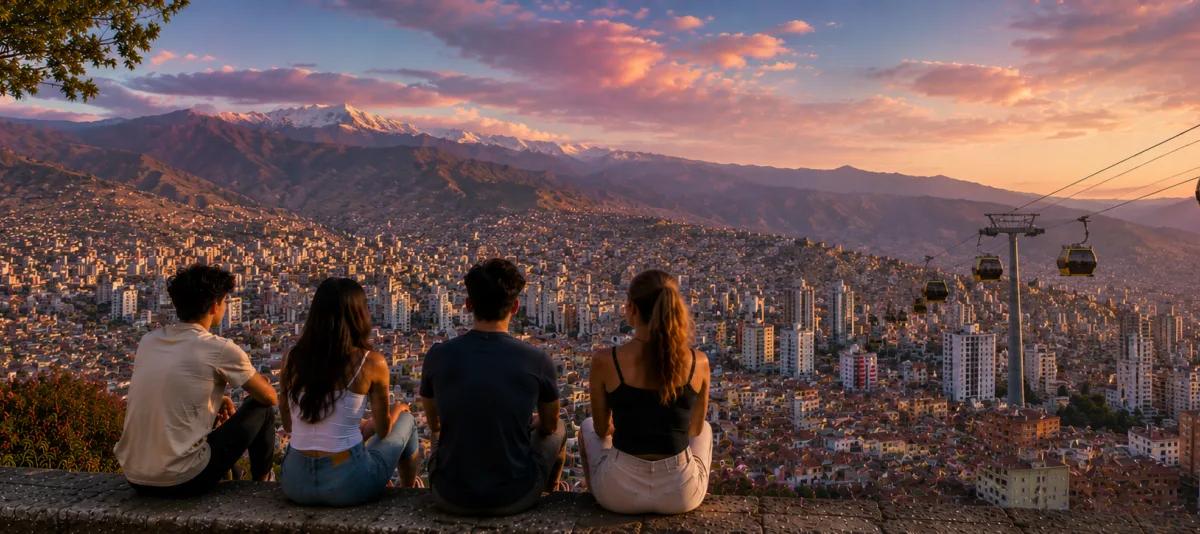
La Paz is the administrative capital of Bolivia and the highest seat of government in the world, sitting in a dramatic canyon at approximately 3,640 meters (11,975 feet) above sea level. With around 756,000 inhabitants in the city proper (2024 census) and well over 1.6 million together with the sprawling sister city of El Alto on the rim above, it is Bolivia's political, cultural, and economic center. The cityscape is unforgettable — a bowl of terracotta rooftops carved into steep hillsides, framed by the snow-capped peak of Illimani (6,438 m) and connected by the world's largest urban cable car network. La Paz is chaotic, colorful, and deeply Andean in character, offering an experience unlike any other capital in the Americas.
The city's main university is the Universidad Mayor de San Andrés (UMSA), Bolivia's oldest and most prestigious public university, founded in 1830. UMSA has 13 faculties offering 56 undergraduate and 150 postgraduate programs, with its iconic Monoblock building serving as the architectural centerpiece of the Zona Central campus. Other institutions include the Universidad Católica Boliviana (UCB – La Paz campus), the private Universidad Privada de Bolivia (UPB), and the Escuela Militar de Ingeniería (EMI). Nearly all instruction is in Spanish. International exchange programs exist but are limited compared to European or North American universities — students typically arrange placements through bilateral agreements or their home institution's international office.
Student life
Student life in La Paz revolves around the university campus, the bustling street culture, and the city's mercados. UMSA's Monoblock and surrounding blocks in the Zona Central form a natural student hub where you'll find cheap comedores, photocopy shops, and impromptu political debates. Bolivian students are politically engaged — marches, assemblies, and faculty strikes are part of the rhythm. International students are a rarity, which means you'll attract genuine curiosity and warm hospitality, but also means there's no established Erasmus-style social infrastructure. Building friendships happens through faculty centros de estudiantes, sports leagues (fútbol is king), and weekend excursions to places like Tiwanaku, Valle de la Luna, or the Yungas roads. The intercultural aspect is profound — many local students are Aymara or Quechua-speaking and can introduce you to indigenous perspectives you won't find in textbooks. Altitude is the ever-present companion: expect to move more slowly, get winded on stairs, and need extra sleep for the first week or two.
Neighborhoods
Sopocachi is La Paz's bohemian quarter and the most popular neighborhood for students and young expats. Tree-lined streets, independent cafés, bookshops, and a good selection of restaurants make it walkable and pleasant. It's centrally located with easy access to the Prado and UMSA. Rooms in shared apartments cost 1,500–2,500 BOB/month (€115–€190). Safe and lively, especially around Plaza Avaroa and Calle 20 de Octubre.
Zona Sur (Calacoto / San Miguel / Achumani) is the affluent southern district, sitting lower in the canyon with slightly warmer temperatures and a more modern feel. Shopping malls (MegaCenter), international restaurants, and expat-friendly services are concentrated here. Rooms run 2,000–3,500 BOB/month (€150–€265). Very safe but far from the university center — commuting requires the teleférico or minibus (30–45 minutes).
Miraflores is a large, middle-class residential area east of the center, home to the Estadio Hernando Siles and the main UMSA campus annex. It has good markets, pharmacies, and everyday services. Rooms cost 1,200–2,000 BOB/month (€90–€150). Reasonably safe during the day, though exercise caution at night on quieter streets.
Obrajes sits between the center and Zona Sur, popular with expats and digital nomads for its balance of affordability and comfort. It has a growing café scene and is connected by the Green Line teleférico. Rooms cost 1,000–2,000 BOB/month (€75–€150). A good middle-ground option.
Centro / Casco Viejo is the historic downtown around Plaza Murillo and Calle Jaén, packed with colonial architecture, museums, and bustling commerce. Very close to UMSA's Monoblock. The cheapest rooms (800–1,500 BOB/month, €60–€115) but also the noisiest and least safe area after dark. Best for students who want to be in the thick of it and don't mind urban grit.
Food & restaurants
La Paz is extraordinarily cheap for eating out. The almuerzo (set lunch) is the backbone of daily eating — available at market stalls, comedores, and small restaurants for 14–20 BOB (€1.05–€1.50), typically including soup, a main course, and a drink. Mercado Lanza (near Plaza San Francisco) and Mercado Rodriguez (Sopocachi) are the best markets for cheap, authentic lunches.
Tomatecafé (Sopocachi) is a vegetarian comedor offering full set lunches for 20 BOB (€1.50), including salad, soup, main, and tea. Natur Center (Centro) serves Andean-inspired vegetarian lunches for just 16 BOB (€1.20). El Alfarero Café is a student-friendly spot that offers discounts to university students and even lets volunteers eat free in exchange for kitchen help. For a splurge, Gustu (Calacoto) — founded by Claus Meyer of Noma fame — showcases modern Bolivian haute cuisine using local ingredients (mains 80–150 BOB / €6–€11).
Street food is essential: salteñas (baked empanadas with juicy filling) cost 7–10 BOB, api con pastel (warm purple corn drink with a cheese fritter) costs 5 BOB, and tucumanas (fried empanadas) go for 3–5 BOB. For groceries, Ketal and Hipermaxi are the main supermarket chains, while the markets offer fresher produce at lower prices. A weekly grocery shop costs roughly 150–250 BOB (€11–€19).
Nightlife & entertainment
La Paz's nightlife is modest compared to Buenos Aires or Bogotá but has a loyal local scene, concentrated in Sopocachi and parts of the Centro. Nights typically start late (10–11 PM) at a bar and move to a club around midnight.
Mongo's (Calle Hermanos Manchego, Sopocachi) has been the go-to backpacker and expat bar since 1995 — DJs spin Latin dance, R&B, and house music, and the dance floor fills every night. Arrive early to get in. Diesel Nacional is a 25-year institution with industrial décor, charcoal-grilled food, and classic cocktails, open Monday–Saturday from 7 PM to 3 AM. El Gurú is a popular disco open Thursday–Sunday from 8 PM to 3 AM, hosting themed nights with a mix of Bolivian and international music. Ambar Casino & Club (MegaCenter, Zona Sur) opened in 2026 as a new upscale entertainment venue.
For cultural entertainment, Peña Huari and other peñas folkloricas host live Andean music performances with traditional instruments — a quintessential La Paz experience. Cover charges are typically 20–40 BOB (€1.50–€3). Beer at a bar costs 15–25 BOB (€1.10–€1.90), cocktails 30–50 BOB (€2.25–€3.75). The altitude means alcohol hits harder — pace yourself, especially in your first weeks.
Transport
La Paz's transport system is defined by its dramatic topography. The city's crown jewel is Mi Teleférico, the world's longest urban cable car network with 10 color-coded lines covering 30.6 km across La Paz and El Alto. A ride costs 3 BOB (about €0.23) for the first line plus 2 BOB per transfer; students aged up to 24 can get a Tarjeta Estudiantil (20 BOB) at any station and pay 1.50 BOB plus 1 BOB per transfer, making it one of the cheapest and most scenic urban transit systems anywhere. Lines connect key neighborhoods: the Green Line serves Obrajes and Irpavi, the Red Line links the Centro to El Alto, and the Yellow Line connects Sopocachi to the Zona Sur area. The system operates roughly 6:30 AM to 10:30 PM every day (7 AM to 9 PM on public holidays).
Minibuses and micros are the backbone of local transport. Minibuses follow fixed routes (displayed on signs in the windshield) and cost 3 BOB for short trips and 3.50 BOB for long ones (€0.23–€0.26), with a small night surcharge after 9 PM; larger micros charge a flat 2.50 BOB. They're frequent but crowded and chaotic — pickpocketing is a risk, so keep valuables secure. Trufis (shared taxis following set routes) cost 2.50–4.50 BOB depending on distance. Regular taxis are abundant and inexpensive: a cross-city ride typically costs 10–25 BOB (€0.75–€1.90). Always confirm the price before getting in, as meters are rare.
For intercity travel, the Terminal de Buses (near Plaza Antofagasta) connects La Paz to Cochabamba (6–8 hours, 55–150 BOB on the official tariff depending on bus class, though operators pushed fares higher after the September 2026 diesel price rise), Sucre, Oruro, and other cities. Budget airlines Boliviana de Aviación (BoA) and EcoJet operate from El Alto International Airport (LPB), the world's highest international airport.
Cost of living
La Paz is among the cheapest capital cities in the world. A student can live on 3,500–5,500 BOB (€265–€415) per month. Euro figures use the September 2026 rate of about 13 BOB per euro; the boliviano has floated freely since mid-2026 and local prices are rising.
Monthly breakdown:
- Room in shared apartment: 1,200–2,500 BOB (€90–€190)
- Groceries: 700–1,000 BOB (€55–€75)
- Transport (teleférico + minibuses): 100–200 BOB (€8–€15)
- Mobile phone (prepaid data plan): 50–80 BOB (€4–€6)
- Dining out (occasional): 200–500 BOB (€15–€38)
- Utilities (electricity, water, internet — shared): 200–400 BOB (€15–€30)
- Gym membership: 180–300 BOB (€14–€23)
- Entertainment: 150–300 BOB (€11–€23)
The key to living cheaply is embracing the almuerzo culture (14–20 BOB lunches), shopping at markets instead of supermarkets, and using the teleférico and minibuses instead of taxis. A 10 BOB salteña breakfast and a 15 BOB market lunch means you can eat two full meals for under €2.
Safety
La Paz requires sensible urban caution. The U.S. Department of State rates Bolivia as a whole at Level 2 (exercise increased caution) and, as of 2026, advises reconsidering travel to La Paz because of frequent demonstrations and roadblocks. Violent crime against foreigners is uncommon, but petty theft — pickpocketing, bag-snatching, and phone theft — is the primary concern, especially in crowded markets, on minibuses, and around bus terminals.
Safer areas: Sopocachi, Zona Sur (Calacoto, San Miguel, Achumani), Miraflores, and Obrajes are generally safe both day and night, with good police presence and lighting.
Areas to avoid at night: The Centro Histórico / Casco Viejo area is busy during the day but empties out and becomes risky after dark. Max Paredes, Villa Fatima, and the peripheral hillside neighborhoods are best avoided after sunset. El Alto — the sprawling city on the plateau above La Paz — has significantly higher crime rates and is not recommended for nighttime visits.
Protests and road blockades (bloqueos) occur periodically and can disrupt transport. The teleférico has temporarily suspended lines during unrest. Stay informed through local news and your university. Emergency numbers: 110 (police), 118 (ambulance), 119 (fire). Use radio taxis (called by phone) rather than hailing cabs on the street, especially at night.
Weather & climate
La Paz has a subtropical highland climate heavily influenced by its extreme altitude of 3,640 m. Forget what you know about South American heat — La Paz is cool to cold year-round with intense sun during the day and sharp temperature drops at night.
Dry season (April–October): Clear blue skies, strong sunshine, and cold nights. Daytime temperatures reach 14–18°C but drop to 0–5°C at night, especially June–July. This is the best time for outdoor activities and travel. Frost is possible in winter months.
Wet season (November–March): Afternoon thunderstorms are common, with January being the wettest month (~188 mm rainfall). Daytime temperatures are slightly warmer (15–19°C) but overcast skies are frequent. Streets in steep areas can flood briefly during heavy rains.
Altitude effects are significant. At 3,640 m, oxygen levels are about 65% of sea level. New arrivals commonly experience altitude sickness (soroche) — headaches, shortness of breath, nausea, insomnia, and fatigue — for the first 2–5 days. Drink coca tea (mate de coca), stay hydrated, avoid alcohol for the first 48 hours, eat lightly, and take it slow. Water boils at 88°C at this altitude, so cooking times are longer. UV radiation is intense due to the thin atmosphere — always wear sunscreen (SPF 50+) and sunglasses, even on cloudy days. Layered clothing is essential: mornings and evenings are cold, but midday sun can feel warm.
Universities in La Paz
Other cities in Bolivia
Next steps
Sources
- erbol.com.bo/nacional/datos-del-ine-ciudad-de-la-paz-redujo-poblaci%C3%B3n-y-el-
- oopp.gob.bo/nota_prensa/mi-teleferico-opera-con-normalidad-en-sus-10-lineas-de-l
- atb.com.bo/2026/01/28/mi-teleferico-proyecta-transportar-a-mas-de-60-mil-estudia
- vision360.bo/noticias/2026/09/15/67786-mi-teleferico-ampliara-su-horario-de-aten
- noticiasfides.com/nacional/sociedad/alcaldia-en-la-paz-define-nuevas-tarifas-del
- urgente.bo/noticia/la-alcaldia-de-la-paz-define-en-bs-3-00-la-tarifa-de-minibuse
- reduno.com.bo/noticias/att-fija-tarifas-de-pasajes-desde-la-paz-conoce-los-preci
- brujuladigital.net/economia/2026/09/24/se-mantienen-precios-de-los-almuerzos-en-
- numbeo.com/cost-of-living/in/La-Paz
- travel.state.gov/en/international-travel/travel-advisories/bolivia.html
- umsa.bo/facultades