Universidad Mayor de San Andrés
Quick facts
- City
- La Paz
- Country
- Bolivia
- Type
- Public
- Founded
- 1830
- Students
- 80,832
- National ranking
- #1
- Tuition (local students)
- BOB 27
- Tuition (international)
- BOB 2,238
- Guide score
- 6.3/10
Official website: www.umsa.bo
Overview
The Universidad Mayor de San Andrés (UMSA), founded in 1830, is La Paz's public autonomous university and part of the CEUB system (Comité Ejecutivo de la Universidad Boliviana). It is the highest-ranked Bolivian institution in the QS Latin America & the Caribbean 2026 ranking, in the 161–170 band (129th within South America). In the QS World University Rankings it has sat in the 1201–1400 band since 2023.
Institutional statistics reported in early 2024 counted 80,832 enrolled students in 13 faculties and 54 carreras. Law is the single largest programme (about 7,400 students); Ciencias Económicas y Financieras is the largest faculty and Geological Sciences the smallest. No official share of foreign students is published.
Academic programs
The 13 faculties are Agronomía; Arquitectura, Urbanismo, Diseño y Artes; Ciencias Geológicas; Ciencias Sociales; Ciencias Económicas y Financieras; Ciencias Farmacéuticas y Bioquímicas; Ciencias Puras y Naturales; Derecho y Ciencias Políticas; Humanidades y Ciencias de la Educación; Ingeniería; Medicina, Enfermería, Nutrición y Tecnología Médica; Odontología; and Tecnología. Teaching is in Spanish, and most carreras run semesters (March–July and August–December). Medicine and a few others are annual.
The public fee is tiny for nationals. For 2026 the university matrícula is Bs 27 for Bolivians and Bs 2,238 for foreigners (about €177 at the September 2026 official rate of roughly Bs 12.6 per euro), in both cases plus a faculty contribution (aporte facultativo) that varies by faculty. Graduating also costs foreigners more: the professional title fee is Bs 4,846, compared with Bs 2,242 for nationals.
Campus life
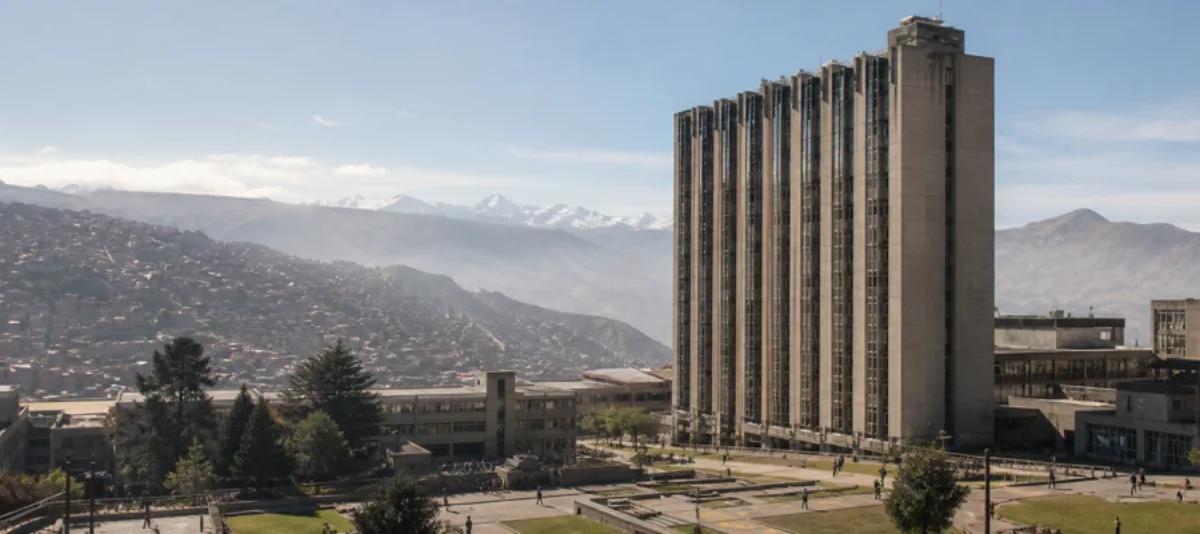
Most of the university is in the Monoblock Central on Av. Villazón 1995 (Plaza del Bicentenario), at the lower end of the Prado near Sopocachi and San Pedro. Much of Ciencias Puras y Naturales sits on the Cota Cota campus (Calle 27) in the Zona Sur, a long minibus ride away (budget 30–45 minutes or more at peak). The Monoblock houses the central library, a coliseum, a gym and a subsidised comedor for beca holders.
La Paz sits at about 3,600 m, so plan a few slow days to adjust and expect cold nights. Marches and blockades can interrupt the calendar.
Exchange programs
Outbound and inbound mobility runs through the DRICI (Departamento de Relaciones Internacionales y Cooperación Internacional). Active schemes include AUGM Escala (for example with Universidad Nacional del Litoral and Rosario), CRISCOS, UFRJ in Brazil, and Erasmus+ International Credit Mobility with the Universidad de Sevilla (undergraduate and postgraduate). Incoming students need a nomination from a partner university. Budget for the student visa and the DIGEMIG residence permit (see Admissions).
Admissions
Each faculty chooses its method: PSA (Prueba de Suficiencia Académica), CPF (curso prefacultativo), or PAF (PSA first, then CPF for those who fail). Calls are published at umsa.bo/pregrado. Seats and dates differ by carrera, and no overall acceptance rate is published.
Foreign degree-seekers must pass the same admission method. They then file with the División de Gestiones, Admisiones y Registros: the secondary diploma validated by SEDUCA or legalised/apostilled, a birth certificate, a police record, and a passport with a valid visa. The Bolivian student visa (60 days, about USD 50 at consulates) must be converted into a DIGEMIG permanencia temporal de estudiante for 1, 2 or 3 years (500, 800 or 1,100 UFV), renewable until graduation. Foreign degrees are revalidated through the university system.
Student housing
UMSA has no residences. Students rent rooms in Sopocachi, Miraflores, San Pedro and the centre. Recent listings show rooms for Bs 800–1,250 a month (about €63–99), with shared flats in Sopocachi around Bs 1,100–1,200. Most listings predate the 2026 devaluation, so expect asking prices to have risen. Zona Sur costs more but is closer to Cota Cota.
Career services
Internships (pasantías) and trabajo dirigido are arranged per carrera, often with ministries and public companies. The UMSA name carries most weight in the public sector, law and medicine. Information pending on a university-wide careers office — contributions welcome.
Academic programs
- Law
- Economics
- Business Administration
- Medicine
- Engineering
- Architecture
- Pure and Natural Sciences
- Social Sciences
- Humanities
- Pharmacy and Biochemistry
- Dentistry
- Agronomy
- Geological Sciences
- Technology
Application deadlines
- fall: Admission tests (PSA or curso prefacultativo) set per faculty from late in the previous year; enrolment for semester I closed 20 March 2026
- spring: Semester II enrolment for new students closed 21 August 2026 (late fee Bs 242 afterwards)
Exchange
Inbound and outbound mobility via DRICI-UMSA (AUGM Escala, CRISCOS, Erasmus+ ICM with Sevilla and others). Parlamento Andino network member. Teaching in Spanish.
Universities in La Paz
Next steps
Sources
- topuniversities.com/universities/universidad-mayor-de-san-andres-umsa
- topuniversities.com/latin-america-south-america-rankings?countries=bo&order_by=a
- ae.umsa.bo/wp-content/uploads/2026/08/ALUMNOS-NUEVOS-II-2026.pdf
- gestiones.umsa.bo/
- umsa.bo/web/guest/faq
- umsa.reyqui.com/2024/02/derecho-la-carrera-mas-poblada-de-la.html
- drici.umsa.bo/movilidad
- daf.fcpn.edu.bo/
- consulados.cancilleria.gob.bo/base/visas/
- tramitesenbolivia.com/tramites/69_permanencia-temporal-para-estudiantes-de-uno-o
- bcb.gob.bo/librerias/indicadores/otras/ultimo.php