Oruro, Bolivia
Quick facts
- Country
- Bolivia
- Population
- 298,350
- Languages
- Spanish
- Currency
- BOB
- Time zone
- BOT (UTC-4)
- Guide score
- 4.9/10
- Safety
- 5/10
Overview
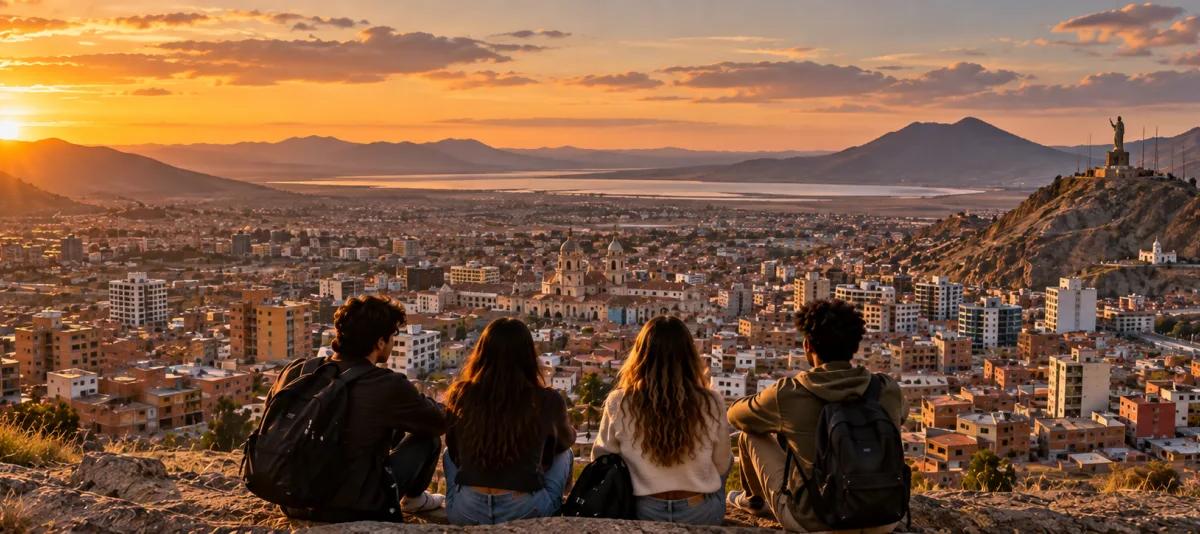
Oruro is a high-altiplano city of about 298,350 people (municipality, Censo 2024), capital of Oruro Department and one of Bolivia's classic mining and folklore centres. It sits at roughly 3,735 m on the cold, dry plateau north of Lakes Uru Uru and Poopó — thin air, strong sun, and sharp night cold define daily life. UNESCO recognises the Carnaval de Oruro as Intangible Cultural Heritage, and for a few days each year the quiet mining city becomes Bolivia's densest folkloric parade ground.
The public university is the Universidad Técnica de Oruro (UTO). Administrative offices sit on Av. 6 de Octubre (between Cochabamba and Ayacucho); the main Ciudad Universitaria campus is in the southern Chiripujio–Alamasi area (Av. Dehene), with faculties such as the Facultad Nacional de Ingeniería. Teaching is in Spanish. Oruro suits students who want an affordable altiplano base with strong engineering and technical programmes, plus weekend access to La Paz, Uyuni routes, and highland landscapes — not a warm valley lifestyle.
Student life
UTO structures most student social life: campus buses, faculty events, and political assemblies are part of the rhythm. International students are uncommon, so expect warm curiosity and Spanish-only classrooms. Living costs are low once you handle altitude and cold; weekends often mean markets, football, and short trips rather than a dense bar crawl.
Carnaval season transforms the city — lodging spikes, streets close, and the Socavón pilgrimage and diablada dances dominate. Outside carnival, Oruro feels like a working highland capital: practical, Quechua-influenced, and quieter than Cochabamba or Santa Cruz. Acclimatise seriously before climbing stairs or playing sports; mate de coca and rest help the first days.
Neighborhoods
Monthly room listings for ordinary student stays (not carnival packages) are uneven online, so use a city-wide estimate of about 700–1,500 BOB/month (€53–€113 at ~13.3 BOB/€) for a room in shared housing.
Centro (Plaza 10 de Febrero / Av. 6 de Octubre): Convenient for services, terminal links, and some UTO offices; mid-to-upper end of the city range; noisy during carnival.
Near Ciudad Universitaria (zona Sud / Av. Dehene): Best for engineering and campus-heavy schedules; often the practical student choice even if nightlife is thinner.
Residential belts toward Villa / peripheral districts: Generally cheaper than the historic centre; factor in micro time to campus.
Avoid relying on carnival-week prices (temporary rooms can be hundreds of BOB per person for a few days) when budgeting a semester.
Food & restaurants
Altiplano comfort food rules: soups, api with pastel, salteñas, roasted meats, and market almuerzos. Oruro is not a gourmet capital, but comedores keep students fed cheaply. Expect almuerzos around 15–25 BOB (€1.10–€1.90) and simple dinners 25–50 BOB (€1.90–€3.75).
Shop at mercados for staples; supermarket chains exist but cost more. At altitude, appetite and digestion can change in the first week — start light, stay hydrated, and go easy on alcohol.
Nightlife & entertainment
Outside Carnaval, nightlife is modest: a handful of centre bars and student gatherings, not a club circuit with famous verified venues. Social life leans toward university events, sports, and plazas. During carnival, the city is the entertainment — but book housing early and expect crowds, noise, and higher prices.
Day trips and nature matter more year-round: nearby salt lakes, highland roads toward La Paz or Potosí, and mining-heritage sites around the Socavón. For a bigger night out, La Paz is the usual longer trip.
Transport
Urban travel uses micros and minibuses. Municipal controls in 2026 cite Decreto 408 tariffs around 2.50 BOB for standard micro/minibus rides (€0.19), with lower differentiated fares for schoolchildren and older adults; short taxis often start near 5 BOB. Confirm current stickers — fuel reforms have made tariffs transitional nationwide.
UTO runs a Servicio de Transporte Urbano Universitario linking health-faculty and Ciudad Universitaria routes at 1 BOB for the university community (weekday service; check current maps on uto.edu.bo). Juan Mendoza Airport has limited BoA flights; long-distance buses connect Oruro tightly to La Paz, Cochabamba, and Potosí.
Cost of living
Monthly budget for a student in Oruro (city-wide estimate):
- Room in shared housing: 700–1,500 BOB (€53–€113)
- Food & groceries: 700–1,100 BOB (€53–€83)
- Transport: 100–250 BOB (€8–€19)
- Phone & internet: 80–150 BOB (€6–€11)
- Leisure & personal: 200–400 BOB (€15–€30)
- Total: roughly 2,000–3,500 BOB/month (€150–€265)
Euro figures use about 13.3 BOB per euro (September 2026). The boliviano has floated since June 2026, so recalculate often. Heating, warm bedding, and carnival-month spikes are the main budget surprises.
Safety
Oruro is generally calmer than the largest Bolivian metros, but petty theft occurs in markets, terminals, and crowded carnival streets. Use radio taxis at night when possible, keep phones secure on micros, and treat empty hillside streets carefully after dark. Protests and transport stoppages can interrupt service — common across Bolivia.
Altitude itself is a safety issue: do not ignore severe headache, confusion, or breathing trouble. Emergency numbers: 110 (police), 118 (ambulance), 119 (fire).
Weather & climate
Oruro's climate is cold semi-arid (BSk) at 3,735 m. Days can be bright and mild in the dry season; nights regularly plunge toward freezing, and winter outbreaks can reach roughly –15 °C with wind. Warmest months tend to be October–December; most rain falls in the November–March wet season, still modest by Amazon standards.
UV is intense on the altiplano — sunscreen and a hat matter even when air feels cold. Pack layers, a proper jacket, and expect dust and wind. This is not tropical Bolivia; plan for highland cold every night of the year.
Universities in Oruro
Other cities in Bolivia
Next steps
Sources
- es.wikipedia.org/wiki/Oruro
- cpv2024.ine.gob.bo/index.php/censo-2024-oruro-da-un-salto-gigantesco-en-los-hoga
- uto.edu.bo/contactos/
- uto.edu.bo/transporte-uto/
- lapatria.bo/enfoque-nacional/transporte-uto-retoma-actividades-con-pasaje-de-bs-
- lapatria.bo/enfoque-nacional/gestion/gamo-inicia-controles-tarifas-minibuses-tax
- travel.state.gov/en/international-travel/travel-advisories/bolivia.html