Cobija, Bolivia
Quick facts
- Country
- Bolivia
- Population
- 55,114
- Languages
- Spanish
- Currency
- BOB
- Time zone
- BOT (UTC-4)
- Guide score
- 4.5/10
- Safety
- 4/10
Overview
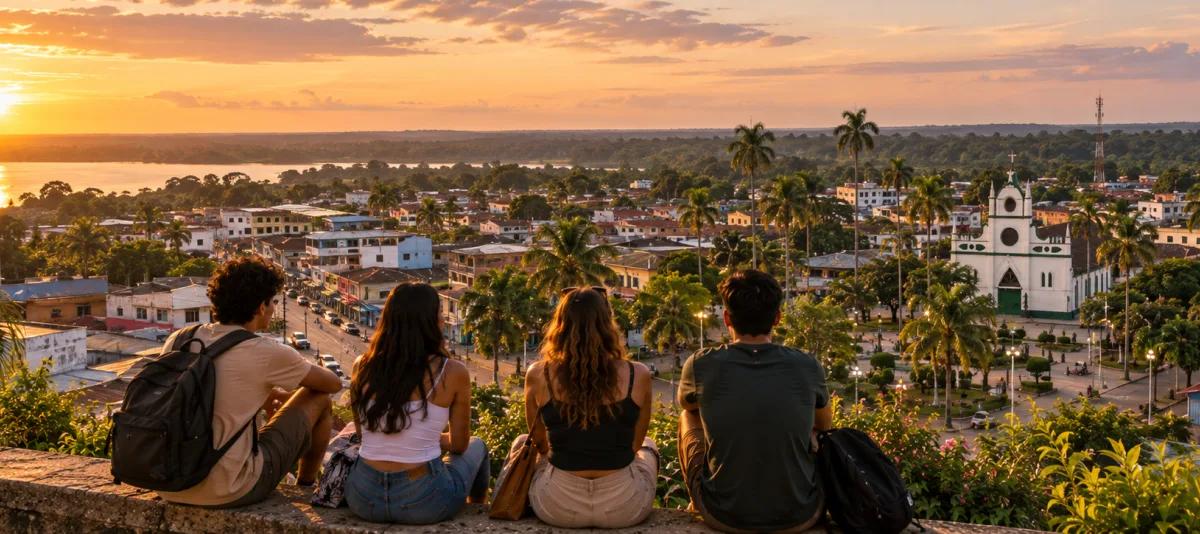
Cobija is the capital of Bolivia's Amazonian department of Pando and the country's least-populated departmental capital, with about 55,100 people in the municipality (Censo 2024). It sits at roughly 228 m on the Río Acre, directly on the Brazilian border opposite Brasiléia and Epitaciolândia — twin Brazilian towns linked by the Puente de la Amistad. The setting is tropical rainforest and river commerce, not Andes: hot, humid, and far from the highland cities most international students associate with Bolivia.
The public university here is the Universidad Amazónica de Pando (UAP), founded for Amazon-region formation and based in Cobija (central presence around Calle Bruno Racua / Plaza Potosí, with the larger Campus Las Palmas also in the city). Programmes lean toward biology, nursing, agroforestry, veterinary science, systems, law, and related regional fields, taught almost entirely in Spanish. For students, Cobija means a small Amazon border campus, cheap living, and easy day-to-day contact with Brazil — not a big-city university scene.
Student life
Student life is local, compact, and Amazon-focused. UAP is the main social hub; international exchange cohorts are rare, so friendships form through classes, faculty centres, and weekend river or forest trips rather than an Erasmus-style calendar. The border economy shapes daily life: Brazilian reais circulate alongside bolivianos in shops, Brazilian Portuguese is commonly heard, and many students cross for shopping or services. Expect a quieter rhythm than La Paz or Santa Cruz — football, river outings, and campus events matter more than clubs.
Political assemblies and occasional transport or fuel disruptions can still interrupt the academic calendar, as elsewhere in Bolivia. The payoff is proximity to Amazon ecosystems, Brazil's Acre towns, and a genuinely regional university mission around Amazon conservation and development.
Neighborhoods
Verified monthly room ads for Cobija are scarce, so treat rents as a city-wide estimate. Rooms in shared housing commonly fall around 600–1,400 BOB/month (€45–€105 at about 13.3 BOB per euro), with full apartments higher.
Centro / around Plaza Principal and Av. 9 de Febrero: Most convenient for services, markets, and trufi routes; usually mid-range within the city estimate.
Near UAP (Bruno Racua / Plaza Potosí and Campus Las Palmas area): Best for walking or short rides to class; demand from students can push prices toward the upper half of the city range.
Barrio Petrolero / 27 de Mayo corridor: Residential sectors often used for longer stays; generally cheaper than prime centre blocks if you accept a short mototaxi hop.
Peripheral riverside and southern barrios: Typically the cheapest options, but check flood risk in wet season and lighting at night.
Food & restaurants
Cobija's food mixes Amazonian Bolivian cooking with Brazilian influence across the Acre. Expect majadito, locro, cuñapé, farofa, river fish (surubí and others), plantain and yuca sides, and market almuerzos that keep lunch cheap. Empanadas and rice-based snacks are everywhere at the central market.
Cooking at home is inexpensive if you shop at mercados rather than imported supermarket lines. A simple almuerzo often costs roughly 15–25 BOB (€1.10–€1.90); a modest restaurant dinner might run 30–60 BOB (€2.25–€4.50). Brazilian products and snacks are easy to find on shopping runs across the bridge.
Nightlife & entertainment
Nightlife is quiet and small-town. There is no large club district; evenings revolve around a few bars and plazas, family gatherings, and campus events. Do not expect a verified list of named venues — if you want louder nights, Brasiléia across the border sometimes has more options, but cross only with ID, a clear plan, and daytime awareness of the frontier.
The real entertainment is outdoors and regional: river trips, nearby forest, and the binational border towns. Festivals and local music appear on the calendar, but this is a calm Amazon capital, not a party city.
Transport
Urban mobility relies heavily on mototaxis and trufis (shared route taxis). After the late-2025 fuel-subsidy shift, Cobija mototaxi fares were widely reported around 8 BOB per typical urban ride (€0.60). Trufi routes commonly pass the Av. 9 de Febrero / Av. 27 de Mayo rotunda. Agree the price before boarding and prefer identified drivers.
Capitán Aníbal Arab Fadul Airport connects Cobija to La Paz and other Bolivian cities (BoA and others). Overland links use Ruta 13 toward Porvenir and Beni; there is no direct paved highway to La Paz. Crossing to Brazil is on foot or by short vehicle hop via the Friendship Bridge — carry passport or identity documents.
Cost of living
Monthly budget for a student in Cobija (city-wide estimate):
- Room in shared housing: 600–1,400 BOB (€45–€105)
- Food & groceries: 700–1,100 BOB (€53–€83)
- Transport (mototaxi/trufi): 150–300 BOB (€11–€23)
- Phone & internet: 80–150 BOB (€6–€11)
- Leisure & personal: 200–400 BOB (€15–€30)
- Total: roughly 1,800–3,400 BOB/month (€135–€255)
Euro figures use about 13.3 BOB per euro (September 2026). The boliviano has floated freely since June 2026, so local prices and the euro conversion can move quickly — budget a cushion. Cobija remains cheaper than La Paz for housing, but imported goods and fuel-linked transport can feel expensive for a small Amazon city.
Safety
Cobija is a permeable Amazon border town. Petty theft and opportunistic crime exist as in any Bolivian city; the frontier context adds smuggling and organised-crime concerns reported along the Cobija–Brasiléia–Epitaciolândia corridor. Use normal urban caution: avoid flashing phones or cash, prefer known mototaxis at night, and stay in well-lit central areas after dark.
Flooding on the Río Acre has forced evacuations in low riverside barrios (notably in 2024). Check local alerts in the wet season. Emergency numbers in Bolivia: 110 (police), 118 (ambulance), 119 (fire). Keep passport copies if you cross into Brazil frequently.
Weather & climate
At about 228 m, Cobija has a hot, humid tropical climate (tropical savanna / monsoon type). Daytime temperatures commonly sit in the high 20s to low 30s °C year-round. Rainfall is heavy, especially in the austral summer wet season, when the Acre can rise and flood low neighbourhoods.
Expect intense sun, mosquitoes, and sticky heat — light clothing, rain protection, and mosquito precautions matter more than altitude gear. There is no soroche here; the challenge is heat, humidity, and seasonal flooding rather than thin air.
Universities in Cobija
Other cities in Bolivia
Next steps
Sources
- es.wikipedia.org/wiki/Cobija_(Bolivia)
- uap.edu.bo/
- uap.edu.bo/la-universidad/
- eldeber.com.bo/pais/suben-pasajes-todo-pais-tarifas-dispares-acuerdos-transitori
- ine.gob.bo/index.php/cronograma-del-censo-para-2024-es-apoyada-por-mesa-tecnica-
- travel.state.gov/en/international-travel/travel-advisories/bolivia.html