Bolivia
Datos rápidos
- Continente
- South America
- Idiomas
- Spanish, Quechua, Aymara
- Moneda
- BOB
- Visado
- Student visa costs US$50 and is valid 60 days, after which you apply to DIGEMIG for a temporary student residence of 1 to 3 years, renewable until you finish your studies. Requires legalized academic records, a criminal record certificate and an acceptance letter from a Bolivian institution; proof of financial solvency is required for the residence. Free for exchanges under a state agreement.
- Nota media de la guía
- 5,0/10
Resumen
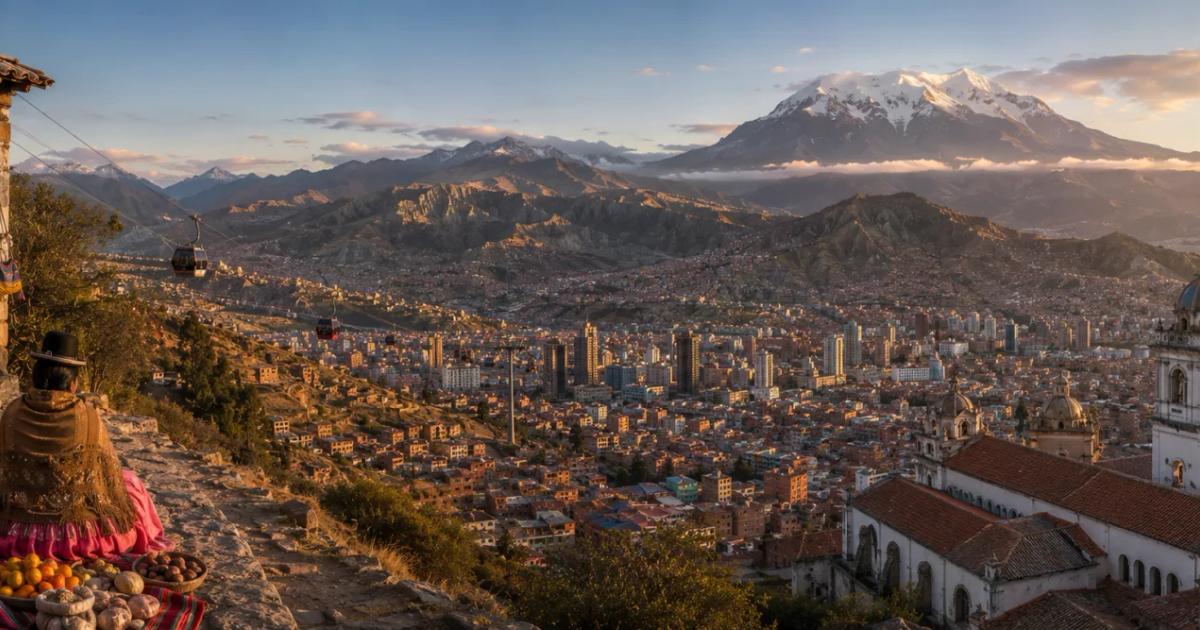
Bolivia is a landlocked country in the heart of South America, home to roughly 11.4 million people (2024 census) and an extraordinary range of geography — from the snow-capped Andes and the high-altitude Altiplano to the lush Amazon lowlands and the otherworldly Salar de Uyuni salt flats. It is one of the most ethnically diverse nations on the continent, with over 30 recognized indigenous groups. Spanish, Quechua, and Aymara are the three most widely spoken languages. The administrative capital is La Paz (the highest seat of government in the world at 3,640 m), while the constitutional capital is Sucre. Bolivia is also one of the most affordable countries in South America, making it attractive for budget-conscious international students willing to embrace a less polished infrastructure in exchange for a deeply authentic cultural immersion and breathtaking natural surroundings.
Sistema educativo
Bolivia's education system is structured into primary (6–13 years), secondary (14–17 years), and higher education. Public education is free at all levels up to and including university, as enshrined in the 2009 Plurinational Constitution and reinforced by Law 070 of 2010. The country has eight major public autonomous universities coordinated through the Sistema de la Universidad Boliviana (CEUB), plus a growing number of private institutions supervised by the Ministry of Education through the National Association of Private Universities (ANUP).
The two most prominent universities are the Universidad Mayor de San Andrés (UMSA) in La Paz — founded in 1830 with 13 faculties, 56 undergraduate programs, and 150 postgraduate programs — and the Universidad Mayor de San Simón (UMSS) in Cochabamba, the country's second-ranked university with 14 faculties and roughly 80,000 enrolled students. Most instruction is in Spanish, and English-taught programs are extremely rare. International students should expect to have at least B2-level Spanish proficiency before enrolling. Academic calendars typically run February–June and August–December, though schedules can shift due to strikes or political disruptions.
Visado e inmigración
International students need a student visa (Visa de Estudiante) to study in Bolivia. The visa is issued for 60 calendar days; within that window you apply to the immigration office (DIGEMIG) for a temporary student residence (permanencia temporal) of 1, 2 or 3 years, renewable until completion of studies. Students coming under academic agreements may receive a visa of up to 180 days, and it is free of charge when the exchange falls under a state agreement; otherwise the fee is US$50.
Required documents:
- Valid passport (6+ months validity)
- Completed sworn visa application form via the online portal (portalmre.rree.gob.bo)
- Letter of acceptance from a Bolivian educational institution
- Legalized academic transcripts or diploma (legalized by the Bolivian consulate)
- Criminal record certificate from your country of origin or last residence
- Recent 4x4 photo with red background
- Yellow fever vaccination certificate (required if visiting high-risk lowland regions)
- Proof of financial solvency (bank statements), required for the residence application in Bolivia
Applications should be submitted 30–40 days before the intended departure date. Processing times vary by consulate. Once in Bolivia, you must apply for your student residence at the Dirección General de Migración before the visa expires, which also requires a local medical certificate and a fee paid in UFV. Overstaying carries fines and can complicate future renewals.
Coste de vida
Bolivia is one of the cheapest countries in South America. A student can live comfortably on 4,000–6,500 BOB (€300–€490) per month depending on the city and lifestyle. La Paz and Cochabamba are significantly cheaper than Santa Cruz. Since mid-2026 the boliviano floats freely (around 13 BOB per euro in September 2026) and local prices have been rising after fuel subsidies were removed, so euro figures below are indicative.
Typical monthly costs (approximate):
- Room in shared apartment: 1,400–2,800 BOB (€105–€210)
- Groceries: 700–1,200 BOB (€55–€90)
- Transport: 100–250 BOB (€8–€19)
- Mobile phone plan: 50–100 BOB (€4–€8)
- Dining out (occasional): 300–600 BOB (€23–€45)
- Utilities (shared): 150–350 BOB (€11–€26)
Set lunches (almuerzo) at markets and comedores cost 14–20 BOB (€1.05–€1.50) and are the most economical way to eat well. Street food like salteñas, api con pastel, and tucumanas costs 5–10 BOB (€0.40–€0.75).
Cultura
Bolivian culture is a rich blend of indigenous Andean traditions and colonial Spanish influences. Family is the center of social life, and relationships tend to be warm, close, and physical — expect cheek kisses as greetings, close conversational distance, and frequent touching (arm pats, back touches). Formality matters: use "señor" and "señora" until invited to be informal, and dress modestly in cities (business casual is the norm; shorts and tank tops are uncommon outside tourist areas).
Bolivia's festival calendar is extraordinary. Carnaval de Oruro (a UNESCO Intangible Cultural Heritage event) features thousands of dancers in elaborate costumes over several days. The Gran Poder festival in La Paz, Urkupiña in Cochabamba, and Tinku in Potosí are other major celebrations. Music is central to daily life — from traditional Andean instruments like the charango, zampoña, and quena to cumbia, reggaetón, and modern Bolivian rock. Chewing coca leaf is a centuries-old Andean custom and remains culturally significant; it is legal in Bolivia and used to combat altitude sickness.
Key etiquette tips: maintain eye contact during conversation, speak softly in public, stand when someone enters a room, and always ask permission before photographing indigenous ceremonies or sacred sites. Bolivian time ("hora boliviana") is notably relaxed — punctuality is appreciated but not strictly expected in social settings.
Sanidad
Bolivia's healthcare system is divided into three sectors: the public Sistema Único de Salud (SUS), the social security system (Caja Nacional de Salud), and private providers. The SUS was established in 2019 to provide free basic healthcare to Bolivian residents, covering approximately 70% of the population. However, public facilities — particularly outside major cities — often struggle with long queues, outdated equipment, and medicine shortages.
Private healthcare in La Paz, Santa Cruz, and Cochabamba is of reasonable quality and significantly more accessible, with English-speaking doctors available at some clinics. Costs are low by international standards (a private consultation typically costs 150–300 BOB / €11–€23). International students should absolutely carry comprehensive travel or health insurance, as the SUS has limited coverage for foreign nationals (mainly those with a Bolivian foreigner ID card or from countries with reciprocity agreements). Pharmacies (farmacias) are widespread and many medications are available over the counter at low prices.
Altitude sickness (soroche) is a real concern in cities above 3,000 m like La Paz and Potosí. Symptoms include headaches, nausea, shortness of breath, and fatigue. Coca tea (mate de coca) and gradual acclimatization over 2–3 days are the standard remedies. Tap water is not safe to drink in most areas — always use bottled or filtered water.
Ciudades
Universidades
- Universidad Amazónica de Pando (Cobija)
- Universidad Autónoma del Beni José Ballivián (Trinidad)
- Universidad Autónoma Tomás Frías (Potosí)
- Universidad La Salle Bolivia (La Paz)
- Universidad Mayor de San Andrés (La Paz)
- Universidad Mayor de San Simón (Cochabamba)
- Universidad Técnica de Oruro (Oruro)
- Universidad Unión Bolivariana (La Paz)
Siguientes pasos
Fuentes
- consulados.cancilleria.gob.bo/base/visas/
- consulados.cancilleria.gob.bo/houston/arancelb/
- bolivianembassy.ca/seccion-consular/servicios-consulares/visas/visa-de-estudiant
- gacetaoficialdebolivia.gob.bo/normas/descargarPdf/151773
- gov.uk/foreign-travel-advice/bolivia/entry-requirements
- cpv2024.ine.gob.bo/index.php/ine-presenta-resultados-del-censo-2024-que-muestran
- umssstat.umss.edu.bo/
- umss.edu.bo/facultades/
- minsalud.gob.bo/5990-sus-habilita-inscripcion-para-atencion-gratuita-en-salud-a-
- eju.tv/2026/09/el-dolar-baja-por-segundo-dia-consecutivo-y-se-cotiza-en-bs-1205-
- brujuladigital.net/economia/2026/09/24/se-mantienen-precios-de-los-almuerzos-en-