Chile
Datos rápidos
- Continente
- South America
- Idiomas
- Spanish
- Moneda
- CLP
- Visado
- Students need Residencia Temporal as estudiantes de establecimientos reconocidos por el Estado, applied for online from outside Chile through SERMIG. Requires proof of enrollment, financial means, a criminal-record certificate, and a passport valid at least one year. Holders may work up to 30 hours a week.
- Nota media de la guía
- 5,9/10
Resumen
Chile is a long, narrow country stretching down the western edge of South America, from the Atacama Desert in the north to Patagonia in the south. It's one of the region's most stable, developed, and safe countries, with a strong economy and a growing reputation as a study destination. For Spanish speakers — including students from Spain and across Latin America — it offers a shared language and cultural closeness that make adaptation fast and easy.
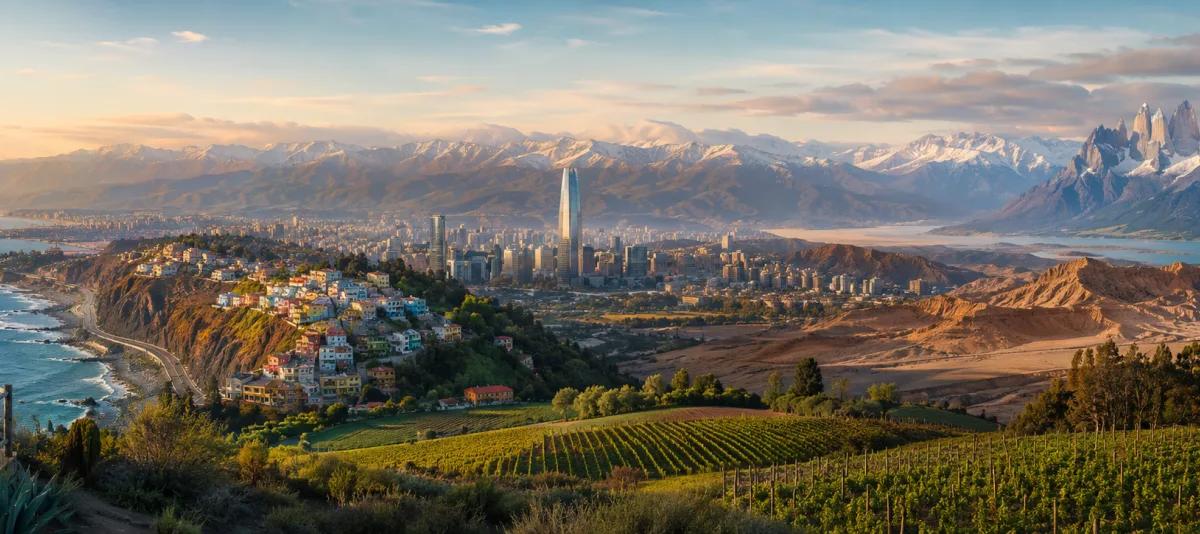
Chile's geography is extraordinary: deserts, the Andes, vineyards, lakes, volcanoes, forests, and thousands of kilometres of coastline. In the QS World University Rankings 2027, the Pontificia Universidad Católica de Chile is 119th worldwide (first in Chile and second in Latin America) and the Universidad de Chile is 185th; there are strong institutions throughout the country as well. The cost of living is significantly lower than in Europe or North America, especially outside Santiago, and the country combines modern infrastructure with easy access to some of the world's most dramatic natural landscapes.
Sistema educativo
Chilean higher education includes traditional universities (both public and private, some grouped in the prestigious CRUCH council), private universities, and professional institutes (IP) and technical training centres (CFT). Undergraduate degrees (pregrado) are long by international standards — professional titles often take 5 years — while Master's (magíster) and doctoral programs follow. The academic year runs March to December, divided into two semesters, with the long summer break in January–February.
Instruction is in Spanish, so a good command of the language is important (though some graduate programs and exchange courses are in English). Tuition varies widely: at regional public universities a typical undergraduate arancel for 2026 is about CLP 3.7–5.5 million a year, with medicine and dentistry around CLP 7.5–8 million. Regional universities, like the Universidad de Los Lagos in Osorno or the Universidad de Antofagasta, offer solid education at a lower cost than the capital. Chile has scholarship programs and exchange agreements, and international students are increasingly welcomed. Chilean gratuidad (free tuition) is generally for eligible Chilean students, not for most internationals.
Visado e inmigración
Students need Residencia Temporal as estudiantes de establecimientos reconocidos por el Estado. This is applied for online through Chile's immigration service (Servicio Nacional de Migraciones, SERMIG) from outside the country — you cannot normally convert a tourist entry into a study residence after arrival. Requirements include a passport valid for at least one year, proof of enrollment or admission at a recognized institution, proof of sufficient financial means, a recent photo, and a criminal-record certificate no more than 60 days old (for adults). The permit lasts up to two years and can be renewed.
Holders may work in lawful paid jobs for up to 30 hours a week without extra authorization. After the residence is granted, students have 30 days from when it takes effect to obtain a Chilean ID (cédula / RUT) at the Registro Civil, which is essential for daily life — banking, rental contracts, and phone plans. Always confirm current requirements with SERMIG or a Chilean consulate, as immigration rules have changed in recent years.
Coste de vida
Chile is considerably cheaper than Europe or North America, though costs vary a lot by city. Santiago, Viña del Mar, and the mining city of Antofagasta are among the most expensive, while southern cities like Osorno and Valdivia are much more affordable. A typical student budget ranges from around CLP 500,000–750,000/month in a cheaper southern city to CLP 800,000–1,000,000 in Santiago or Antofagasta.
Rent is the biggest variable: a room in a shared flat can be CLP 150,000–350,000 in the south but considerably more in Antofagasta or the capital. Food is affordable if you shop at markets ("ferias") and cook at home (CLP 200,000–280,000/month), and public transport is cheap, especially with a Tarjeta Nacional Estudiantil (TNE). Overall, Chile offers good value, especially for students based outside the capital.
Cultura
Chilean culture is warm, family-oriented, and welcoming, with a strong sense of hospitality toward newcomers. Chilean Spanish is famously fast and full of unique slang ("modismos") — even fluent Spanish speakers need time to adjust, but locals are friendly and patient. Social life revolves around family, friends, food, and the traditional "asado" (barbecue).
Chile is more reserved and orderly than some of its South American neighbours, reflecting its stability and development. National traditions include Fiestas Patrias in September (with cueca dancing, empanadas, and celebrations), a rich literary heritage (Nobel laureates Pablo Neruda and Gabriela Mistral), and a strong wine culture. Football is a national passion. The dramatic geography shapes lifestyle — Chileans love the outdoors, from beaches and deserts to the lakes, volcanoes, and mountains of the south. For Spanish-speaking students, the cultural familiarity makes Chile an especially smooth place to settle in.
Sanidad
Chile has a mixed healthcare system with a public option (FONASA) and private insurers (ISAPREs), plus a network of public and private hospitals and clinics. Care in private clinics is high-quality (especially in Santiago and major cities) but can be expensive without insurance. Universities typically require international students to hold health insurance for the whole stay — often a private policy taken out before arrival.
Once you have residence underway, FONASA affiliation is possible (sometimes first with a provisional number, then updated when the RUT arrives). Public healthcare is more affordable but can have longer waits, while private care is faster and pricier. Universities typically have basic health services for students and can advise on coverage. Pharmacies (Cruz Verde, Salcobrand, Ahumada) are widespread. The emergency number is 131 for ambulance (SAMU), 132 for firefighters, and 133 for police.
Ciudades
Universidades
- Universidad Católica del Norte (Antofagasta)
- Universidad de Los Lagos (Osorno)
Siguientes pasos
Fuentes
- serviciomigraciones.cl/residencia-temporal/subcategorias/estudiantes/
- serviciomigraciones.cl/residencia-temporal/
- uantof.cl/aranceles/
- educacionprofesional.ing.uc.cl/universidad-catolica-se-ubica-n-1-en-chile-y-segu
- nuevo.fonasa.gob.cl/tramites/afiliacion/
- admision.ulagos.cl/Carreras/derecho/
- ingenieria.uchile.cl/dam/jcr:8a4b4031-1fb5-441b-a5af-396d0c7cd348/Internacional_