Antofagasta, Chile
Datos rápidos
- País
- Chile
- Habitantes
- 401.000
- Idiomas
- Spanish
- Moneda
- CLP
- Zona horaria
- CLT/CLST (UTC-4/-3)
- Nota media de la guía
- 6,0/10
- Seguridad
- 6/10
Resumen
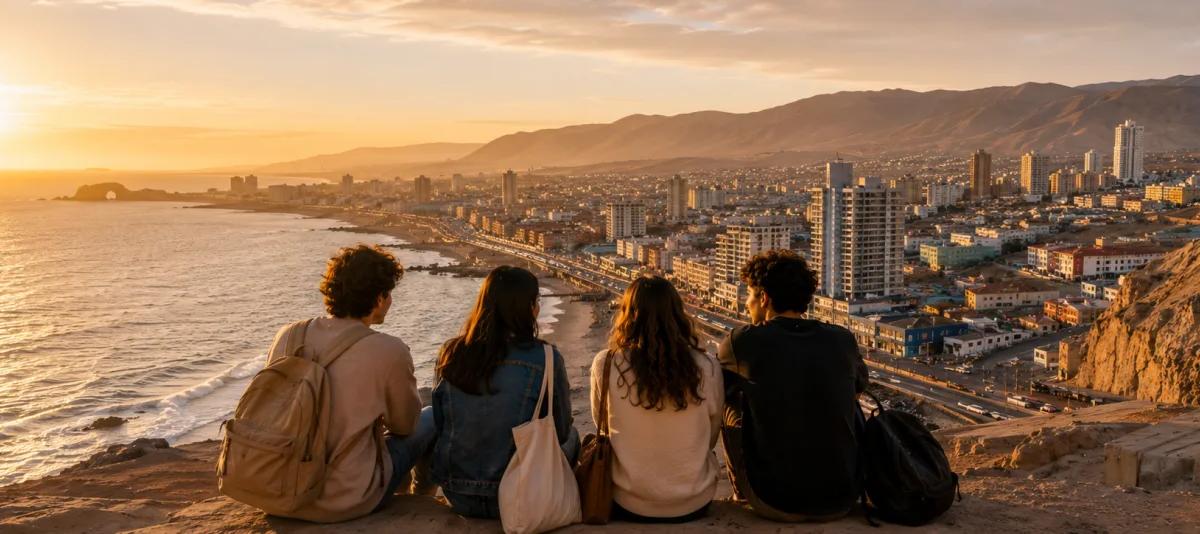
Antofagasta is a major port city in northern Chile, the capital of the Antofagasta Region and the heart of the country's mining industry. Home to about 401,000 people (Censo 2024), it stretches along a narrow strip of coast between the Pacific Ocean and the Atacama Desert — the driest desert in the world. The mining economy (copper, lithium) makes it one of Chile's wealthiest and, notably, most expensive cities, with rents rivalling the affluent eastern districts of Santiago.
For students, Antofagasta hosts the Universidad de Antofagasta and the Universidad Católica del Norte, among others, with strengths in engineering, mining, and marine sciences that connect directly to the regional economy. Typical 2026 undergraduate aranceles at the Universidad de Antofagasta run about CLP 4–5.4 million, with medicine around CLP 7.9 million. The setting is dramatic — desert, ocean, and clear skies (the region's observatories are world-famous for astronomy). It's a working city rather than a tourist gem, but it offers strong job prospects, sunshine year-round, and easy access to some of the Atacama's spectacular landscapes.
Vida estudiantil
Student life in Antofagasta is shaped by its universities' technical and scientific focus and by the city's mining-driven economy, which offers strong internship and job opportunities in engineering and related fields. The student community is smaller and more locally-oriented than in Santiago, centred on the campuses of the Universidad de Antofagasta and the Universidad Católica del Norte, the latter with a notable marine biology station.
Social life tends to revolve around the coast — the beaches, the seafront promenade (borde costero), and seafood are central to daily life. The desert and ocean setting means weekend trips to the Atacama, sandboarding, stargazing, and coastal spots. The city is more spread out and car-dependent than Chile's compact southern towns, and the pace of life reflects its industrial character. For students in mining, engineering, and marine sciences, the direct link between study and a booming regional industry is a major draw.
Barrios
Sector Sur (Avenida Angamos / borde costero) (higher rents, from ~13 UF / ~CLP 530,000 for a basic 1-bed): The most aspirational area — modern seafront buildings with ocean views, near traditional universities and good restaurants.
Centro (from ~13 UF / ~CLP 530,000 for a basic 1-bed): Central and convenient, close to services, though pricey by Chilean standards.
Sector Norte (more affordable rooms/shared flats): Older residential areas further from the coast, cheaper options for students.
Coviefi / Jardines del Sur (mid-range): Residential neighbourhoods popular with families and professionals.
Shared flats near campuses (CLP 200,000–350,000 per room): The realistic student option — sharing brings down Antofagasta's otherwise high rents.
Comida y restaurantes
Antofagasta's food scene is anchored by the sea — fresh fish and seafood are the local highlight, from ceviche to fried fish (pescado frito) and shellfish, best enjoyed along the coast and at the municipal market (Mercado Central). Empanadas, completos (Chilean hot dogs), and other Chilean staples are cheap and everywhere.
Cooking at home is the most economical route — the "ferias" (street markets) and supermarkets (Jumbo, Líder, Unimarc) keep grocery costs reasonable, though prices in Antofagasta run a bit higher than the Chilean average due to the mining economy. Casual meals cost CLP 5,000–9,000, and a sit-down restaurant meal CLP 10,000–18,000. The mining wealth supports a decent range of restaurants, cafés, and international options for a city of its size.
Vida nocturna y ocio
Antofagasta's nightlife is modest and locally-flavoured, with bars, pubs, and a handful of clubs concentrated in the centre and near the coast. The mining economy means there's disposable income around, supporting restaurants and bars, but this is not a party-tourism destination. Student nightlife tends to centre on university events, casual gatherings, and the seafront.
Entertainment leans toward the outdoors and the region's unique assets. The clear desert skies make northern Chile a global astronomy hub, and stargazing excursions are a highlight. The coastal promenade, beaches, and nearby natural landmarks (like La Portada, the iconic rock arch) offer weekend activities. The Atacama Desert — with San Pedro de Atacama, salt flats, geysers, and lagoons — is within reach for longer trips. Cultural life includes local museums and events, though it's more limited than in Santiago.
Transporte
Antofagasta is a long, linear city hugging the coast, so getting around relies on buses (micros) and colectivos (shared taxis running fixed routes). Since February 2026, regulated micro fares are CLP 650 for adults and CLP 210 for students with a TNE; colectivos cost more. The city is more spread out and car-oriented than Chile's compact towns, and many residents drive. Taxis and ride-hailing apps are available.
The Aeropuerto Andrés Sabella (formerly Cerro Moreno) connects Antofagasta to Santiago (about a 2-hour flight) and other Chilean cities, which is the main way to reach the rest of the country given the long distances of northern Chile. Long-distance buses also link to other cities but involve very long journeys across the desert. Within the city, living near your campus helps, because the linear layout means end-to-end commutes can be long.
Coste de vida
Monthly budget for a student in Antofagasta:
- Room in a shared flat: CLP 200,000–350,000
- 1-bedroom apartment (if not sharing): CLP 500,000–800,000
- Food & groceries: CLP 200,000–300,000
- Transport (bus/colectivo): CLP 15,000–40,000
- Phone & internet: CLP 20,000–35,000
- Leisure & personal: CLP 80,000–150,000
- Total: CLP 550,000–850,000/month
Antofagasta is one of Chile's most expensive cities because of the mining economy — used-apartment rents averaged around CLP 767,000 at the end of 2025, and a basic central 1-bed starts near 13 UF. Sharing a flat is essential to keep housing affordable. Watch out for high "gastos comunes" (building maintenance fees) in apartment blocks with pools, gyms, and security, which can add significantly to monthly costs.
Seguridad
Antofagasta has moderate safety levels typical of a larger Chilean industrial city. The central and coastal areas are generally fine during the day, but as with any port and mining city, there are neighbourhoods and times where extra caution is warranted, particularly at night. Petty theft and pickpocketing are the main concerns for students; keep an eye on valuables in busy areas and on public transport.
Overall, Chile is one of the safer countries in South America, and with normal urban precautions students manage well. Living in a safe, central neighbourhood and avoiding isolated areas late at night is sensible advice. Emergency numbers: 131 (ambulance/SAMU), 132 (firefighters), 133 (police/Carabineros).
Clima
Antofagasta has a mild desert climate moderated by the cold Pacific (Humboldt) current, giving it remarkably stable, pleasant temperatures year-round and almost no rain — it sits at the edge of the Atacama, the driest desert on Earth. Temperatures hover around 14–24°C most of the year, warmer in summer (Dec–Feb) and mild in winter (Jun–Aug), rarely extreme in either direction.
The coast often sees morning cloud and coastal fog (the "camanchaca") that burns off to sunshine. Rainfall is negligible — it essentially never rains — so the landscape is stark desert meeting ocean. The combination of warm, dry, stable weather and clear skies is one of the city's genuine perks (and the reason the region is a world centre for astronomy). Sun protection is important year-round given the strong UV levels.
Universidades en Antofagasta
Otras ciudades de Chile
Siguientes pasos
Fuentes
- censo2024.ine.gob.cl/wp-content/uploads/2025/03/02_PRESENTACION-R_REGIONAL-ANTOF
- carolina.cl/noticias/2026/06/16/arriendos-en-antofagasta-guia-de-precios-y-barri
- eldiarioinmobiliario.cl/destacadas/arriendo-departamentos-antofagasta-2025/
- antofagasta.cl/regional/aumento-pasaje-transporte-publico-antofagasta
- uantof.cl/aranceles/
- dgac.gob.cl/operatividad-aeropuerto-andres-sabella-antofagasta/