Universidad Antonio de Nebrija
Quick facts
- City
- Madrid
- Country
- Spain
- Type
- Private
- Founded
- 1995
- Students
- 14,956
- International students
- 19 %
- Tuition (local students)
- €12,180
- Guide score
- 7.2/10
Official website: www.nebrija.com
Overview
The Universidad Antonio de Nebrija is a private university in Madrid named after the Renaissance humanist Antonio de Nebrija, author of the first Spanish grammar. Founded in 1995, it has positioned itself as one of Spain's more internationally oriented private universities, with a strong emphasis on bilingual education, applied learning, and employability. The university operates across multiple campuses in Madrid: Princesa (city centre), Dehesa de la Villa, and La Berzosa in Hoyo de Manzanares.
Nebrija is not given an exact place in the QS World University Rankings 2027. It does appear in QS regional listings (Southern Europe 134th in the 2026 Europe ranking) and in 2026 U-Ranking (Fundación BBVA / Ivie) it was first in Spain for employability performance. Official titles enrolled 14,956 students in 2024-25; the university reports 19% international students in 2025-26 and students from more than 60 countries. Many programmes are taught entirely or partly in English. Class sizes are small, and the teaching approach prioritises projects and industry collaboration.
Academic programs
Standout areas include Communications and Digital Media, Business Administration (ADE), Languages and Translation, Education, International Relations and Law. The School of Communications has invested in studios and production facilities. Engineering is a growing offer: Nebrija was the first Spanish university to launch a bachelor's in Automobile Engineering, and it also teaches industrial and mechanical engineering linked to motorsport projects.
Most degrees incorporate mandatory internships. The published 2026-27 on-campus price for typical first-year bachelor's programmes such as ADE, Audiovisual Communication and International Business is €12,180 (pre-reservation, reservation and ten monthly teaching fees). Distance ADE is much cheaper. Journalism is listed at €9,990. The same published tables apply to domestic and international applicants; there is no separate international bachelor's rate.
Campus life
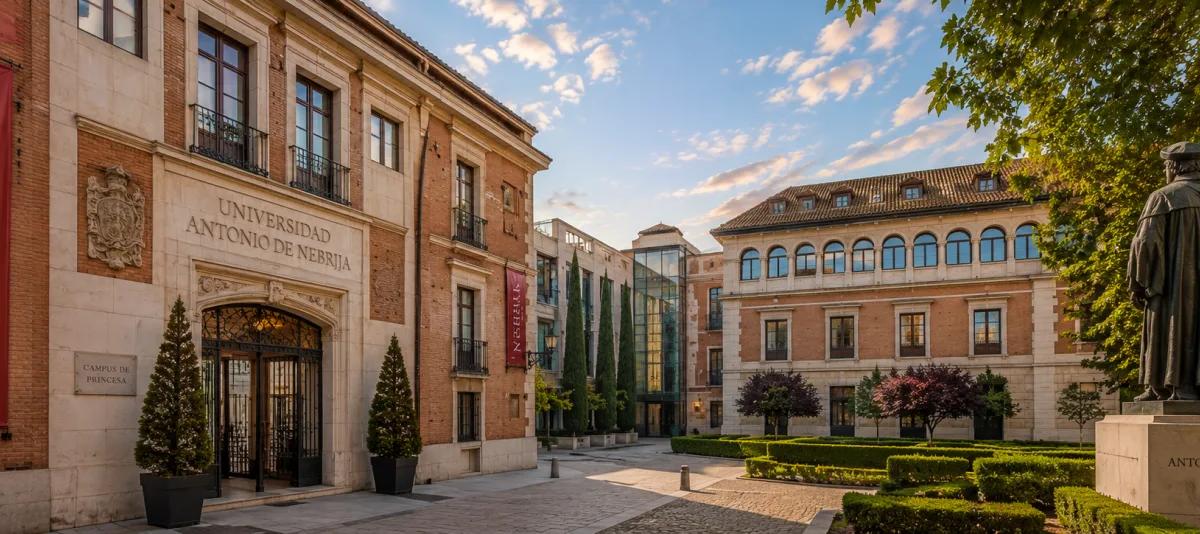
The Princesa campus, in central Madrid near the Royal Palace, offers convenience but limited space. It is an urban campus integrated into city blocks rather than a traditional enclosed campus. Dehesa de la Villa provides more green space and sports facilities, while La Berzosa (Hoyo de Manzanares) is the most campus-like setting, and QS lists it as the Life Sciences campus.
Student life revolves around language exchanges, faculty events and Madrid itself. The student body is notably international — English, French, Portuguese and Chinese are common in the hallways alongside Spanish. The Princesa campus puts students near Malasaña and Gran Vía. The trade-off is that the campus-based community feeling is weaker than at a single-campus university.
Exchange programs
International mobility is central to Nebrija's identity. The university advertises more than 400 international agreements and about 860 students on mobility, with partners in Europe, the Americas and Asia, plus BIP and summer programmes. Incoming exchange and Study Abroad students are received by the International Mobility Office, with welcome sessions covering academics and life in Madrid.
Outgoing bachelor's students apply to the annual mobility call (the ordinary 2026-27 window closed in January 2026). Incoming students need a place under an agreement or a Study Abroad route. An intensive Spanish course and a buddy-style welcome are part of the inbound offer. Coursework in English is widely available compared with most Spanish public universities.
Admissions
Admission is through Nebrija's own process: an online application, a skills test, and often a personal interview and a language-level test (or a B2 English certificate). EvAU/PAU scores are accepted but a national exam is not the main filter. After an offer, candidates typically have five days to reserve the place, then must meet official university-access requirements before the course starts.
There is no single published closing date for the 2027 autumn intake — applications are rolling until programmes fill — so applying early in the year is the practical advice, especially if you need a visa. Medicine has a separate admission test. The university does not publish a bachelor's acceptance rate. Scholarships and fee reductions exist; ask admissions for the current scale rather than assuming a fixed percentage.
Student housing
Nebrija does not operate its own residences but works with partner student residences near each campus. For Princesa, Moncloa and Argüelles are the usual areas. Idealista put the average Madrid room at about €550 a month in mid-2026; residences with meals cost more. Shared apartments in the same districts are the main alternative.
La Berzosa has fewer nearby flats; some students share houses in Hoyo de Manzanares or commute from the city. The housing service helps international students arriving without contacts. Housing fairs at the start of each semester connect students with vetted landlords. Start the search early — Madrid's rental market is tight.
Career services
Career support is a stated strength. Nebrija was first in Spain for employability performance in U-Ranking 2026 (100/100 on labour-market insertion) and advertises around 94% graduate employability and more than 17,000 active company agreements. Career mentoring, curricular internships from early on, and an entrepreneurship stack (Nebrija Emprende, Start Up Center) are part of the pitch.
The international focus helps in roles that need languages and cross-cultural skills. The alumni network is smaller than that of the old public universities but is growing in communications, translation, business and, increasingly, engineering. Students who want a corporate career in Madrid should still treat internships as the main door, not the ranking headline.
Academic programs
- Business
- Communications
- Languages & Translation
- Engineering
- Education
- Architecture
- Design
- International Relations
- Law
- Automobile Engineering
Application deadlines
- fall: Rolling until places fill (apply early 2027)
Exchange
400+ international mobility agreements and about 860 students on mobility; 19% of students are international; incoming via the International Mobility Office