University of the Philippines Diliman
Quick facts
- City
- Manila
- Country
- Philippines
- Type
- Public
- Founded
- 1908
- Students
- 26,349
- National ranking
- #1
- International ranking
- #402
- Guide score
- 7.6/10
Official website: upd.edu.ph
Overview
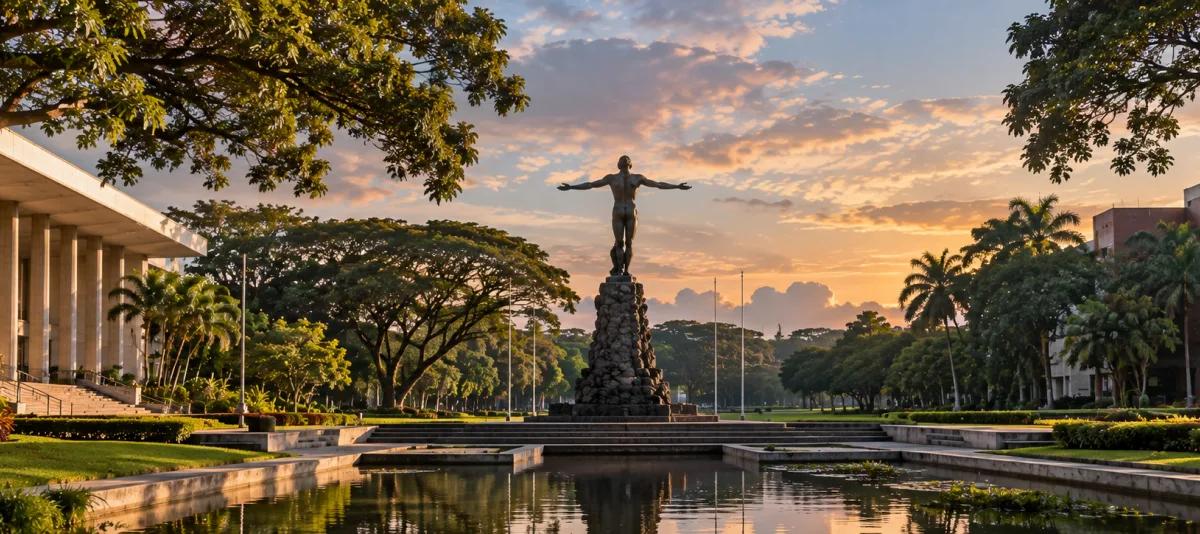
The University of the Philippines (UP) is the national university, founded in 1908. UP Diliman in Quezon City is the flagship campus — a 493-hectare gated city of colleges, dorms, jeepneys, the Sunken Garden and the Oblation statue. QS World University Rankings 2027 (June 2026) placed UP at =402 (down from 362nd in the 2026 edition), first in the Philippines. UP Diliman had about 26,300 students in 2023 (UP Statistics 2023).
Diliman is a public, politicised, English-medium research campus. "Isko/Iska" culture (orgs, activism, UAAP, tambay at the shopping center and Academic Oval) is the student identity. It is not a small liberal-arts college: undergraduate tuition is ₱1,500 per unit before Socialized Tuition discounts that make it free or nearly free for many Filipinos. International students pay that tuition plus the EDF (USD 300 undergrad / USD 500 graduate per semester), miscellaneous and laboratory fees.
The UP System also includes Manila (health sciences), Los Baños (agriculture), Cebu and other CUs; this wiki page is Diliman.
Academic programs
Colleges cover engineering, science, social sciences, business (Virata), law, fine arts, mass communication, architecture, education and more. A typical full load is 15–21 units. OIL Diliman's inbound page quotes ₱1,500/unit undergraduate tuition: 3–4 courses of 3 units each come to ₱13,500–₱18,000 in tuition before miscellaneous (~₱2,000), student fund, labs (₱100–₱1,500) and the dollar EDF.
The academic year is semestral (August and January starts, with a midyear option). Instruction is in English, with Filipino used socially and in some GE courses. International regular students are admitted by the academic units to full degrees; exchange students come through partners; visiting students pay fees for 1–2 terms without a partner agreement.
Campus life
Diliman is the most campus-like student experience in Metro Manila. You can live, eat and go to class without crossing EDSA. University residence halls exist (International Center under renovation as of OIL's latest note; Centennial and Acacia have taken international students in the interim). Off-campus rooms sit in Teacher's Village, Sikatuna, Krus na Ligas and Katipunan.
Orgs are the social operating system. UAAP athletics, college weeks, gigs at the Sunken Garden and a strong protest tradition are all normal. Campus jeepneys are how you move; Katipunan LRT-2 is the link to the rest of the metro. Nightlife leaks into Maginhawa, Cubao and Katipunan rather than into a single student street.
Exchange programs
OIL Diliman (Office of International Linkages) runs inbound exchange for partner and consortium students, supports the Registrar on international regular intake, and advises visiting students. Nomination comes from the home university. English is sufficient for coursework; no Spanish/Filipino proficiency exam is required for most units, though Filipino GE may appear on some plans.
Dorm applications for internationals go through OIL / OHRE; do not assume a bed. 9(f) student visa conversion is processed with the university's assistance after a Notice of Acceptance — start it on arrival, do not overstay a tourist stamp.
Academic programs
- Engineering
- Natural Sciences
- Social Sciences
- Business
- Law
- Fine Arts
- Mass Communication
- Architecture
- Education
- Public Administration
Application deadlines
- fall: Home university nomination; then OIL Diliman (semester 1 typically August)
- spring: Home university nomination for semester 2 (typically January)
Exchange
OIL Diliman hosts inbound exchange from partner universities and consortia, plus fee-paying visiting students and degree-seeking internationals via the units and the Office of the University Registrar. Instruction is in English. International students pay tuition plus an Educational Development Fee (USD 300 undergraduate / USD 500 graduate per semester).
Universities in Manila
Next steps
Sources
- international.upd.edu.ph/programs/student-mobility/study-in-upd/
- upd.edu.ph/admissions/fees-and-other-information/
- up.edu.ph/up-leads-ph-universities-in-latest-qs-world-university-rankings/
- philstarlife.com/amp/article/314513-up-remains-top-ph-university-in-qs-world-uni
- gmanetwork.com/news/topstories/nation/991825/up-ph-universities-qs-rankings/stor
- en.wikipedia.org/wiki/University_of_the_Philippines_Diliman