Ateneo de Manila University
Quick facts
- City
- Manila
- Country
- Philippines
- Type
- Private
- Founded
- 1859
- Students
- 15,000
- National ranking
- #2
- International ranking
- #581
- Tuition (local students)
- ₱273,218
- Tuition (international)
- ₱273,218
- Guide score
- 7.5/10
Official website: www.ateneo.edu
Overview
Ateneo de Manila University is a private Jesuit university in Loyola Heights, Quezon City, founded as a Spanish colonial college in 1859 and now the leading private university in the Philippines. QS World University Rankings 2027 (June 2026) placed it at 581st (down from 511th in the 2026 edition), second in the country after UP and first among private institutions. Employer reputation and employment outcomes are its strongest QS indicators.
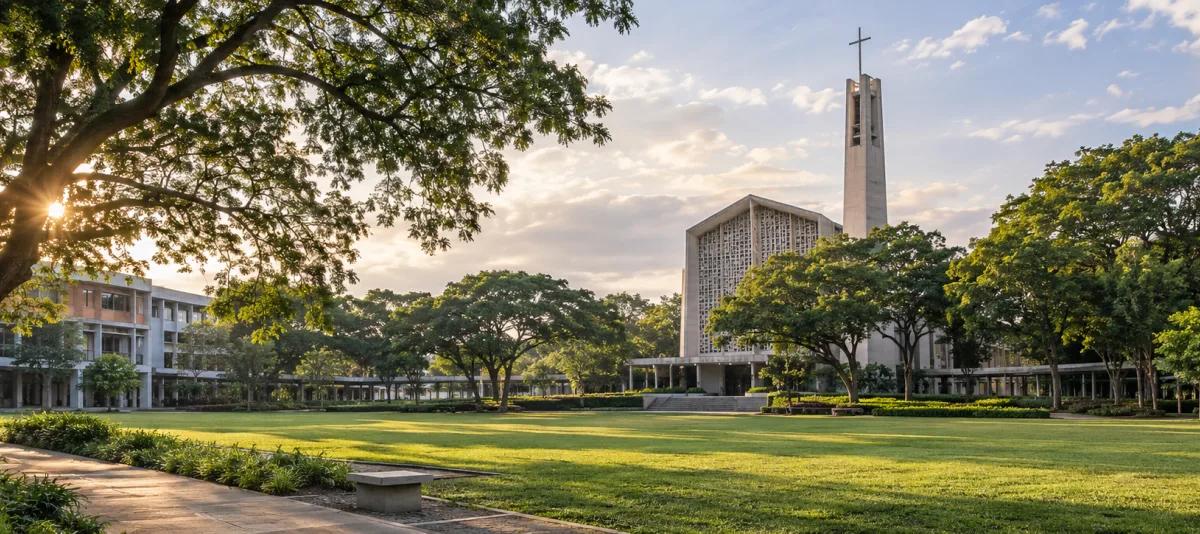
The Loyola Heights campus sits on Katipunan Avenue, next to Miriam College and a jeepney ride from UP Diliman. It is gated, green and more orderly than Taft or Sampaloc — a suburban hill campus inside the metro. College life is org-heavy, ID-gated and academically demanding, with a core curriculum in the Jesuit liberal-arts tradition.
Academic programs
Schools include the School of Humanities, School of Social Sciences, John Gokongwei School of Management, School of Science and Engineering, and the Law School (graduate). Undergraduate teaching is in English. International first-years must take two Filipino language courses.
Ateneo's published estimates for SY 2027–28 (updated 17 June 2026): ₱110,691 tuition for 20 units per semester, ₱17,394 basic fees, ₱8,524 other fees — about ₱136,600/semester before laboratory or overload charges (science and engineering run higher). That is roughly ₱273,000/year. An additional international student fee is collected from non-Philippine passport holders. Application fee for international first-years: ₱2,500. Scholarships (merit, academic, athletic, financial aid) exist; internationals should read the current aid rules rather than assume eligibility.
College admissions are online. For SY 2027–28 the first-year application dashboard reopened on 19 October 2026, the application deadline is 12 December 2026 for both the ACET and the IB/SAT routes, the Ateneo College Entrance Test is on 16 January 2027 in Metro Manila, and decisions are released through the portal in May 2027.
Campus life
Orgs, the Jesuit formation programme, varsity (UAAP), and Katipunan food/tambay culture structure the week. Dorms and nearby condos/boarding houses along Katipunan and in Loyola Heights are the housing map; many students commute from other QC or Marikina addresses. Campus is quieter at night than DLSU-Taft; Poblacion and Cubao are a Grab away.
Dress and ID culture is more formal than a European public campus. The surrounding barrio is one of Metro Manila's easier student neighbourhoods: residential, LRT-2 access, and generally treated as safer than downtown Manila.
Exchange programs
Inbound exchange is partner-based through Ateneo's University Partnerships and Internationalization (UPI) office. English-taught undergraduate modules are the norm. Exchange students still need a BI 9(f) (or SSP if they do not qualify) processed with the university. Confirm whether the Filipino-language requirement applies to one-semester exchange students — degree-seeking internationals definitely take those two courses.
Deadlines follow the August-centric college calendar: for AY 2026–27 the exchange application deadline was 30 April 2026 for the first semester and 30 September 2026 for the second, so expect similar dates for 2027 and check the UPI calendar. Home-university nomination comes first; do not apply as a free mover expecting Erasmus-style intake.
Academic programs
- Business
- Social Sciences
- Humanities
- Science
- Engineering
- Law
- Education
- Computer Science
Application deadlines
- fall: SY 2027-28 first years: 12 December 2026 (ACET, IB and SAT routes). Exchange: nomination by the home university to UPI; the AY 2026-27 deadline was 30 April 2026, so check the UPI calendar for 2027
- spring: Exchange (January start): nomination by the home university; the AY 2026-27 deadline was 30 September 2026, so check the UPI calendar for the next cycle
Exchange
Inbound exchange through the University Partnerships and Internationalization (UPI) office with partner universities. College instruction in English. International undergraduates must take two Filipino (National Language) courses. A separate international-student fee applies to non-Philippine passport holders.
Universities in Manila
Next steps
Sources
- ateneo.edu/news/2025/06/19/2026-qs-world-university-rankings-ateneo-rank-511
- ateneo.edu/college/tuition-fees
- ateneo.edu/college/admissions/apply/first-year/international
- ateneo.edu/college/admissions/calendar
- philstarlife.com/amp/article/314513-up-remains-top-ph-university-in-qs-world-uni
- gmanetwork.com/news/topstories/nation/991825/up-ph-universities-qs-rankings/stor
- uni-goettingen.de/de/document/download/d140dc869cc6309e8fbd21a421a82b4f.pdf/ADMU