Universidad de Salamanca
Quick facts
- City
- Salamanca
- Country
- Spain
- Type
- Public
- Founded
- 1218
- Students
- 29,057
- International students
- 6.2 %
- National ranking
- #16
- International ranking
- #560
- Tuition (local students)
- €625
- Guide score
- 7.8/10
Official website: www.usal.es
Overview
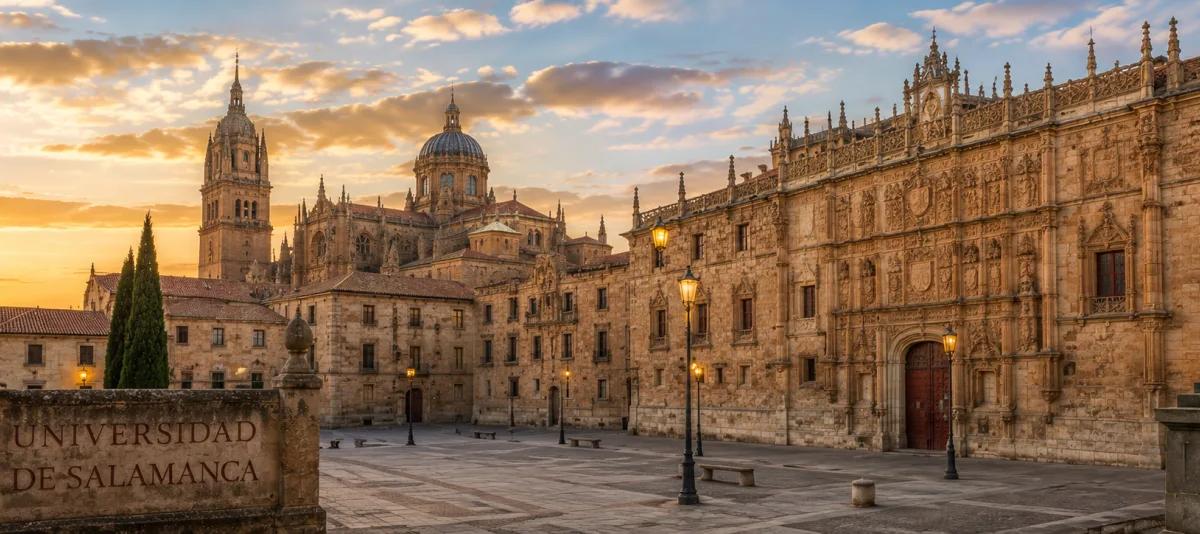
The Universidad de Salamanca (USAL) is the oldest university in Spain and one of the oldest in the world, founded in 1218 by King Alfonso IX of León. Its historic buildings — including the iconic Plateresque facade of the Escuelas Mayores — form part of Salamanca's UNESCO World Heritage Site. For over 800 years, USAL has been synonymous with Spanish language, culture, and intellectual tradition. The university was instrumental in codifying the Spanish language and remains a reference institution for Spanish language certification (DELE exams).
In 2025-26 it had 23,282 bachelor's, 2,475 master's and 3,300 doctoral students (about 29,000 on official degrees), plus Cursos Internacionales and other programmes that take the wider community toward 40,000. Foreign students are 6.2% of bachelor's enrolment, 24.5% of master's and 53.1% of doctoral students. In the QS World University Rankings 2027 it is joint 560th in the world and 16th in Spain. Salamanca is a true university town: the historic centre, safety and lower costs make it one of Europe's most immersive places to study Spanish.
Academic programs
USAL is strongest in humanities and social sciences, with Spanish Language and Literature, History, and Philology recognised internationally. The university created Spain's first course in Spanish as a foreign language and continues to be a reference in this field. The Law faculty is historically prestigious, and Pharmacy sits in the more expensive public-fee group.
Medicine at USAL is competitive and well-regarded, benefiting from the city's university hospital. Translation and Interpreting is another standout. Sciences (Biology, Chemistry, Physics) are solid if less internationally prominent. The Cursos Internacionales programme draws thousands of students each year for intensive Spanish — 5,100 on-site and more than 3,000 online in 2025-26 — and those certificates are widely respected.
Campus life
Salamanca's student life is legendary. The historic centre — with its golden sandstone buildings, tapas bars, and plazas — is where most of the action happens. The Plaza Mayor, one of Spain's most beautiful squares, functions as an outdoor living room for the student population. Bars, cafés, and bookshops cater to a student crowd, and the city's nightlife scene (centered on Calle Van Dyck and Gran Vía) is vibrant and affordable.
Student traditions run deep: the tuna (medieval music groups), academic processions, and fiestas integrate students into centuries-old customs. The start-of-year Nochevieja Universitaria and the Feria de Salamanca are highlights. Sports facilities are adequate but not exceptional, centered around the university's sports complex. The city's compact size means everything is walkable, creating constant social interaction. International students often describe their time in Salamanca as the most formative experience of their lives.
Exchange programs
USAL is one of Europe's most popular Erasmus+ destinations. In 2026-27 it enrolled a record 1,218 incoming students on Erasmus and other exchange routes: 976 Erasmus students from 23 European countries, 80 on bilateral exchange from 18 countries, and 162 on collaboration programmes such as USAL-Santander, Fundación Carolina and Coimbra Group awards. Incoming students apply through a partner university; the International Relations Service manages Erasmus+ KA131, bilateral exchange and the university's own inbound convenio programme.
The integration experience is exceptional — Salamanca's size and the mix of degree-seeking and language-course internationals mean exchange students become part of the city rather than living in a parallel bubble. Language exchanges (intercambios) with Spanish students are easy to arrange, and the university organises welcome activities and cultural excursions. Credit transfer is well-established and generally smooth.
Admissions
Spanish students enter through the national PAU/EvAU system and the joint Castilla y León preinscription (PRECYL). Medicine is among the most competitive degrees; many humanities programmes are more accessible. International degree-seekers from foreign school systems apply in the same PRECYL window, usually with UNEDasiss accreditation. Exchange students apply through their home institution.
There is no general spring intake for bachelor's degrees. The 2026-27 PRECYL window ran from 3 June to 3 July 2026; 2027-28 dates had not been published by late September 2026 but follow the same early-summer pattern. Cursos Internacionales have a separate open-enrolment process. First-year public tuition is set by Castilla y León: about €10.41–€18.45 per ECTS (€625–€1,107 for 60 credits), depending on the degree group. A typical humanities or law year is at the low end; Medicine is at the top. Erasmus students pay home-university fees. A published non-EU surcharge applies to some master's programmes; bachelor's non-EU rates are not separately listed in the same way.
Student housing
Housing in Salamanca is significantly more affordable and accessible than in Madrid or Barcelona. The university operates several Colegios Mayores and residences, with full-board options often in the €600–€850/month range — competitive prices given they include meals. These residences have strong community life and are a good way to integrate.
Shared apartments in the city centre are plentiful and cheaper than Spain's large capitals: a room in a shared flat is commonly a few hundred euros a month, sometimes including utilities. Popular student neighbourhoods are Barrio del Oeste, Van Dyck, and streets around the Mercado Central. The compact city means virtually any apartment is within walking distance of university buildings. International students often arrive during orientation week and find housing within days, assisted by the university's accommodation service and informal Facebook/WhatsApp groups.
Career services
USAL's career services office provides job boards, internship listings, and annual career fairs. The university's strength lies in its alumni network — graduates occupy prominent positions in Spanish law, politics, education, and healthcare. The connection to the Spanish language teaching industry is uniquely strong, and USAL credentials open doors in ELE (Español como Lengua Extranjera) teaching worldwide.
The trade-off of studying in a small city is that internship opportunities during your degree are more limited than in Madrid or Barcelona. Many students complete internships in larger cities during summer or after graduation. The career office has improved its offerings in recent years, with mentoring programmes and partnerships with Salamanca's growing tech sector, but students aiming for corporate careers should plan to relocate post-graduation.
Academic programs
- Spanish Language & Literature
- Law
- Medicine
- Pharmacy
- Translation & Interpreting
- History
- Biology
- Education
- Political Science
Application deadlines
- fall: Early July 2027 (the 2026-27 PRECYL window closed 3 July 2026)
Exchange
Record 1218 incoming Erasmus and exchange students in 2026-27 from 50 countries; Erasmus+ plus bilateral and collaboration programmes
Next steps
Sources
- indicadores.usal.es/portal/resultados-de-la-universidad-de-salamanca-en-el-qs-wo
- comunicacion.usal.es/universidad-consolida-su-crecimiento-global-ante-nuevo-curs
- usal.es/plazos-de-preinscripcion-admision-y-matricula-curso-academico-20262027
- usal.es/precios-academicos
- abc.es/espana/castilla-leon/usal-bate-record-estudiantes-internacionales-total-1
- internacional.usal.es/movilidad-in/