Trinity College Dublin
Quick facts
- City
- Dublin
- Country
- Ireland
- Type
- Public
- Founded
- 1592
- Students
- 22,000
- International students
- 36 %
- National ranking
- #1
- International ranking
- #75
- Tuition (local students)
- €2,500
- Tuition (international)
- €22,580
- Guide score
- 8.0/10
Official website: www.tcd.ie
Overview
Trinity College Dublin (officially "the University of Dublin, Trinity College") was founded in 1592 by royal charter of Elizabeth I and is Ireland's oldest and highest-ranked university. It sits at 75th in the QS World University Rankings 2027 (the same place as in 2026) and is Ireland's clear number one. Over 22,000 undergraduate and postgraduate students study across three faculties: Arts, Humanities and Social Sciences; Engineering, Mathematics and Science; and Health Sciences. Trinity is highly international, with about 36% of its students coming from outside Ireland, from 125 countries (Trinity International Prospectus 2026).
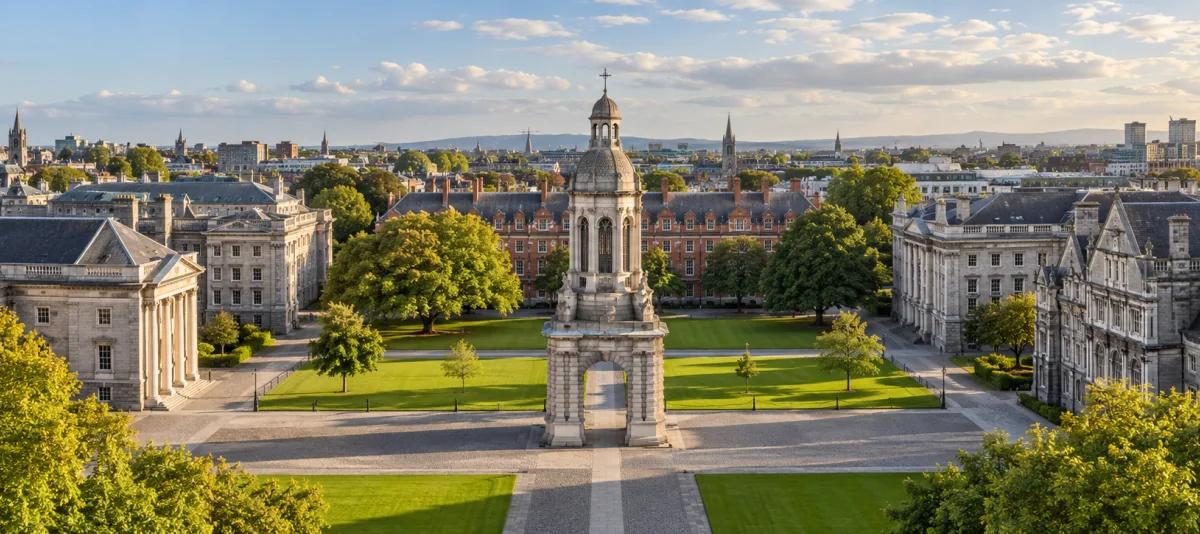
The historic 47-acre campus occupies the very centre of Dublin, opposite the Bank of Ireland on College Green, and is home to the Old Library and the Book of Kells, one of the country's most visited attractions. Everything the city offers is within a short walk: Grafton Street, Temple Bar, government buildings and the main shopping and nightlife districts. For EU students, tuition is covered by the Free Fees Initiative and only the annual student contribution is payable (reduced permanently from EUR 3,000 to EUR 2,500 from 2025/26 under Budget 2026). Non-EU undergraduate fees for 2026/27 run from about EUR 22,580 (Arts, Humanities and Social Sciences) to about EUR 29,570 (STEM), with clinical programmes such as Medicine considerably higher.
Academic programs
Trinity offers roughly 100 undergraduate courses and a large portfolio of taught master's and PhD programmes. Its strongest reputations are in Law, English and Classics, Nursing, Pharmacy, Computer Science, Engineering, Psychology, Natural Sciences and Business, with Trinity Business School (triple-accredited: AACSB, EQUIS, AMBA) among the fastest-growing in Europe. Teaching combines lectures with small tutorials and lab work, and the Trinity Education Project has introduced open modules and a common assessment structure so students can take electives outside their discipline.
The academic year is divided into two semesters (September to December and January to April/May), with exams at the end of each semester, which makes it straightforward for exchange students to come for a single term. Assessment is a mix of continuous assessment, essays and end-of-semester exams; the ECTS system is used and a full semester load is 30 ECTS. Facilities include the Trinity Biomedical Sciences Institute, the CRANN nanoscience institute and the new E3 Learning Foundry for engineering and environment.
Campus life
Student life at Trinity is unusually rich for its size: there are around 120 societies run by the Central Societies Committee and 47 sports clubs through Trinity Sport. The University Philosophical Society ("the Phil", 1683) and the College Historical Society ("the Hist", 1770) are among the oldest student debating societies in the world and host high-profile guest speakers. Trinity Ball, held on campus each April, is billed as Europe's largest private party, and Trinity Week and the Christmas markets on Front Square are fixtures of the calendar. The Sports Centre on campus has a pool, climbing wall and gym; rugby, rowing, GAA and boat club are the flagship sports.
Accommodation is the main practical challenge. On-campus rooms are limited (a few hundred places, mostly reserved for final-year and some postgraduate students), so most first-years and exchange students who receive Trinity housing are placed in Trinity Hall in Dartry, about 4 km south of campus on the Luas green line, with around 1,000 beds in shared apartments and prices starting at approximately EUR 178 per week for 2025/26. Private rooms in Dublin typically cost EUR 800-1,200+ per month and are scarce, so students are strongly advised to start searching early. Dublin is well connected by bus, Luas tram and DART rail, and the campus is fully walkable from most central neighbourhoods.
Exchange programs
Trinity Global manages inbound mobility through Erasmus+, bilateral exchange agreements and a Visiting Student programme, with over 300 partner universities. Exchange students are nominated by their home university and then apply online; for semester 1 or a full year, applications open around 20 January and close around 19 April, while for semester 2 they open around 1 August and close around 15 October (always after nomination by your home university; dates vary slightly by year and by school, so check the current factsheet). Erasmus+ students pay no tuition to Trinity; fee-paying Visiting Students exist for non-partner universities.
Spanish universities are well represented among Trinity's Erasmus partners. Agreements exist at school level with, among others, Universidad de Salamanca, Universidad de Sevilla, Universidad de Granada, Universidad de Barcelona, Universidad de Oviedo and Universidad de Zaragoza, and Trinity Business School and the School of Law maintain their own partner lists with Spanish business and law schools. Exchange students can take modules from a single school (some schools, such as Business and Law, restrict cross-registration), need a B2/C1 level of English (typically IELTS 6.5 or equivalent), and get access to the Global Room, orientation week and buddy programmes for international students.
Academic programs
- Business
- Engineering
- Computer Science
- Law
- Medicine
- Natural Sciences
- Humanities
- Social Sciences
- Languages
- Nursing
- Pharmacy
- Psychology
Application deadlines
- fall: February 1
- spring: October 15
Exchange
Erasmus+ and bilateral exchange agreements with 300+ universities worldwide. Spanish Erasmus partners include Universidad de Salamanca, Universidad de Sevilla, Universidad de Granada, Universidad de Barcelona, Universidad de Oviedo and Universidad de Zaragoza (varies by school). Incoming applications (after nomination by the home university) for semester 1 / full year close around 19 April; semester 2 applications close around 15 October.
Universities in Dublin
Next steps
Sources
- tcd.ie/academicregistry/fees-and-payments/annual-fee-rate/
- tcd.ie/global/mobility/inbound/how-to-apply/eu-and-erasmus-exchange/
- tcd.ie/accommodation/
- tcd.ie/news_events/articles/2026/trinityholds-75thpositionin-qs-world-university
- tcd.ie/courses/undergraduate/fees/
- tcd.ie/study/assets/PDF/TrinityInternationalProspectus2026.pdf
- tcd.ie/global/mobility/inbound/