Dublin, Ireland
Quick facts
- Country
- Ireland
- Population
- 592,000
- Languages
- English, Irish
- Currency
- EUR
- Time zone
- GMT (UTC+0)
- Guide score
- 7.1/10
- Safety
- 7/10
Overview
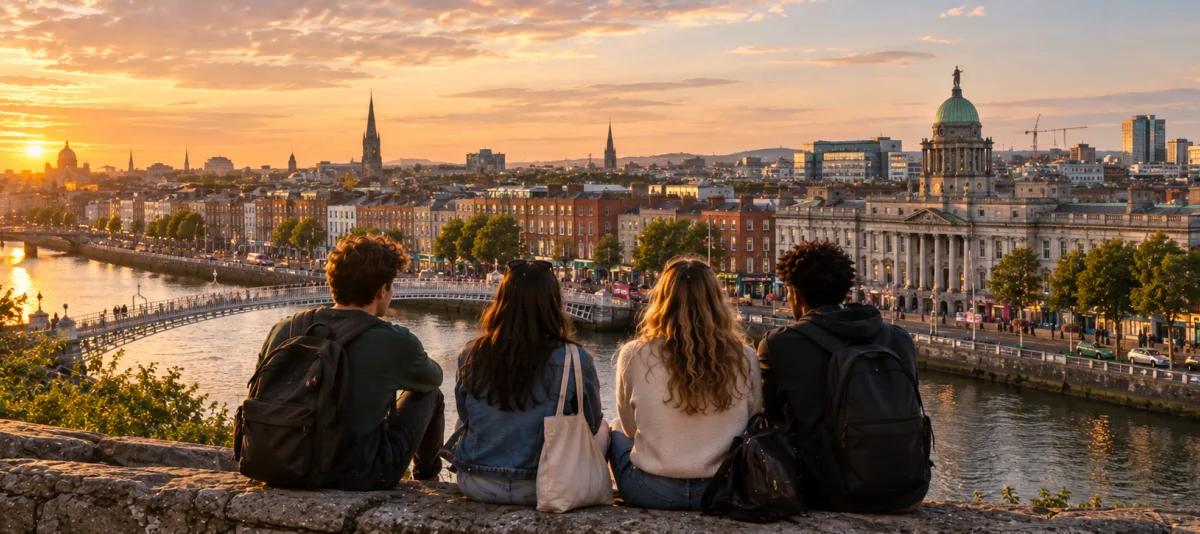
Dublin is the capital of Ireland and the only major English-speaking capital in the EU, straddling the River Liffey on the east coast. The city proper has about 592,000 inhabitants (2022 census) and the wider urban area roughly 1.3 million, which makes it compact enough to cycle across yet big enough to host the European headquarters of Google, Meta, LinkedIn, TikTok and most of the pharma and finance sector. Its universities — Trinity College Dublin (1592) in the very centre, UCD in Belfield to the south, DCU in Glasnevin to the north and TU Dublin in Grangegorman — bring in tens of thousands of students, plus a very large Erasmus and international contingent.
For students, Dublin is a city of contradictions: Georgian squares, world-class pubs, a young multicultural population and a social scene that is easy to break into, set against the worst student housing shortage in Western Europe and prices that rival London. If you secure a room early and budget for it, most people leave saying it was the friendliest place they have ever lived.
Student life
Trinity sits on College Green in the dead centre of the city, so its students live the most "urban" life; UCD's big green campus in Belfield (Dublin 4) has its own sports centre, bars and student residences and feels more like an American campus; DCU and TU Dublin have newer campuses on the northside. All of them have strong Students' Unions and hundreds of clubs and societies — Trinity's Phil and Hist debating societies, the DU Players theatre, GAA and rowing clubs — and Freshers' Week in September is when everyone joins everything.
Erasmus and international students are heavily catered for: ESN Dublin and the universities run orientation weeks, weekend trips to the Cliffs of Moher, Galway and Belfast, and weekly socials. Term-time nights out are cheap thanks to student nights, and Dublin's music scene (Whelan's, The Workman's Club, 3Olympia, the 3Arena for big acts) is excellent. Rugby at the Aviva, GAA at Croke Park and the Six Nations pub atmosphere are experiences worth planning around. The workload at Irish universities is moderate, with continuous assessment, so there is time for a part-time job — very common given the cost of living.
Neighborhoods
Rathmines / Ranelagh / Portobello (Dublin 6 / 8) (€800–€1,100/mo per room): The classic southside student belt, 20–30 minutes' walk from Trinity and on the Luas Green Line to UCD buses. Rathmines is lively and full of cheap takeaways, supermarkets and the Swan Centre; Ranelagh is leafier and pricier with good brunch spots; Portobello sits by the Grand Canal with a strong bar and café scene.
Drumcondra / Glasnevin (Dublin 9) (€700–€900/mo): Northside, next to DCU and Croke Park, 20 minutes on the bus from the centre. Red-brick terraces, quieter, and among the best value close to a university.
Phibsborough / Stoneybatter / Smithfield (Dublin 7) (€700–€950/mo): The most "up-and-coming" part of the northside. Stoneybatter has become the hipster village with craft bars and cafés, Smithfield has the Light House cinema and the Luas Red Line, and Phibsborough is a cheaper bus-corridor neighbourhood next to TU Dublin's Grangegorman campus.
City centre / Docklands / Dublin 1–2 (€900–€1,300/mo; purpose-built student halls €1,000–€1,450/mo): Walk everywhere, but rooms are scarce and expensive and most of the stock is private student accommodation (Aparto, Yugo, Kavanagh Court, Highlight) that must be booked by spring.
Dún Laoghaire / Blackrock (south coast) (€700–€950/mo): Seaside towns on the DART, 20–30 minutes into Pearse or Connolly stations. More space, sea swims at the Forty Foot, and popular with UCD students who can take the bus directly to Belfield.
Wherever you look, start 3–4 months before term on Daft.ie, Rent.ie, MyRoom.ie, HousingAnywhere and the university accommodation offices, and never pay a deposit before viewing in person or via a live video call.
Food & restaurants
Dublin's food scene has improved enormously and is now genuinely good, though not cheap. Student staples are the Asian and Middle Eastern places around Parnell Street and Capel Street (Chinatown, Korean, Vietnamese, Brazilian), Camden Street's kebab and pizza strip, and cheap lunch deals around Trinity and Aungier Street. A casual meal costs €15–€20, a decent mid-range dinner €25–€40, a coffee €3.50–€4.50 and a full Irish breakfast around €12–€15. Chipper (fish and chips) on the way home is an institution: Leo Burdock's is the famous one.
For groceries, Lidl and Aldi are the student choice (€50–€70 a week); Tesco, Dunnes Stores and SuperValu cost more but are everywhere; Fallon & Byrne on Exchequer Street is the upmarket deli. Grocery prices rose nearly 7% in early 2026, so budget €200–€300 a month. University canteens and the student bars serve lunch for €6–€10. Weekend markets worth knowing are Temple Bar Food Market (Saturday), Dún Laoghaire's People's Park market (Sunday) and the food stalls at Eatyard/Bernard Shaw when running.
Nightlife & entertainment
Dublin's nightlife is pub-first and legendary. Temple Bar is the tourist postcard — cobbled streets, live trad music every night — but pints there average €8+ and locals avoid it beyond a first visit. Students concentrate on Camden Street and Harcourt Street (Dicey's Garden with its €3–€5 drinks nights, Copper Face Jacks, The Bernard Shaw, Whelan's for live gigs, Opium, The Camden), Aungier / Wexford Street, South William Street and Dame Lane (cocktail bars, Pygmalion, The Grand Social across the river), and the more alternative Stoneybatter / Smithfield pubs such as L. Mulligan Grocer and The Cobblestone, Dublin's best trad-session pub. A standard pint is €6.50–€7.50 in 2026; The Clonliffe House in Drumcondra is famous for keeping Guinness at €5.
Beyond drinking, there is plenty: free museums (National Gallery, National Museum, Chester Beatty, the Hugh Lane), the Abbey and Gate theatres with student tickets from ~€15, Light House and Irish Film Institute cinemas, comedy at Vicar Street and the International Bar, and huge concerts at the 3Arena. Free events fill the calendar — St Patrick's Festival in March, Bloomsday in June, Culture Night in September, the Fringe and Theatre Festivals in autumn. Pubs close around 00:30–02:30 and clubs by 03:00, and the last bus/Luas is around midnight, so plan the taxi (Free Now app) or the night buses.
Transport
Dublin has three integrated modes: Dublin Bus / Go-Ahead (the workhorse, 24-hour routes on the main corridors), the Luas tram (Green Line north–south through St Stephen's Green, Red Line east–west via Heuston and Connolly) and the DART coastal train (Howth and Malahide in the north to Bray and Greystones in the south). Everything runs on the TFI Leap Card — get the Student Leap Card (apply at student.leapcard.ie with your enrolment letter, ~€10–€15), which roughly halves fares: the TFI 90-Minute Fare, covering unlimited bus, Luas and DART changes within 90 minutes, is €1 for Student and Young Adult Leap holders versus €2 standard, and spending is capped at €12 a week. Tag on and off every time, or you pay the maximum fare.
Traffic is bad and buses can be slow at rush hour, so a lot of students cycle: Dublin is flat, the Grand Canal and coastal cycle paths are pleasant, and Dublin Bikes (public bike share) costs about €35 a year with the first 30 minutes free. Bike theft is rampant — roughly 20,000 bikes a year stolen in Dublin — so use two locks. Dublin Airport is 30–40 minutes from the centre on the Dublin Express or Aircoach (€8–€10) or Dublin Bus route 41 (€2 with Leap). Intercity trains from Heuston (Cork, Galway, Limerick) and Connolly (Belfast) and cheap Bus Éireann / Citylink coaches make weekend trips easy, and Ryanair from its home airport keeps European flights cheap.
Cost of living
Monthly budget for a student in Dublin:
- Accommodation (room in shared house / student halls): €750–€1,300
- Groceries: €200–€300
- Utilities (share, shared house): €50–€100
- Transport (Student Leap Card / bike): €30–€50
- Phone & internet: €15–€30
- Social & leisure: €150–€300
- Total: €1,250–€1,900/month
Universities themselves estimate €1,200–€1,700 a month excluding fees. EU undergraduates pay only the €2,500 student contribution (Free Fees Initiative); non-EU tuition at Trinity, UCD or DCU runs roughly €18,000–€28,000 a year. Part-time work at the ~€14/hour minimum wage (20 h/week for non-EEA students on Stamp 2) is how most students make the numbers work.
Safety
Dublin is a safe city by capital standards, with very low violent crime against students, but street-level petty crime is a real nuisance. Pickpocketing and phone-snatching (often from bikes or e-scooters) happen on O'Connell Street, in Temple Bar and around Grafton Street, and the highest reported crime concentrates in the city-centre Garda districts of Store Street (O'Connell Street/Docklands), Pearse Street (Dublin 2) and Bridewell (Smithfield/Four Courts). Late at night, avoid walking alone along the quays and the north inner city around Talbot Street/Sheriff Street, and treat the Luas Red Line stops in the north inner city with the usual care.
Residential student areas — Rathmines, Ranelagh, Drumcondra, Glasnevin, Stoneybatter, Phibsborough, Dún Laoghaire — are safe and well used at night. Bike theft is the crime most likely to affect you, so buy a solid D-lock and never leave a bike outside overnight. Rental scams are the other big risk: use only established platforms and never transfer a deposit before seeing the property. Emergency number: 112 or 999; the Gardaí (police) are unarmed and approachable.
Weather & climate
Dublin has a mild temperate maritime climate with no extremes: winters (Dec–Feb) average 4–8°C with frost rare and snow very rare, and summers (Jun–Aug) 14–20°C, occasionally touching 25°C. The east coast is the driest part of Ireland at about 730 mm of rain a year — less than Cork or Galway — but it falls as frequent drizzle spread across 150+ days, with October to January the wettest months and April–May the driest. Wind off the Irish Sea makes it feel colder than the thermometer says.
The real adjustment is the light: in December the sun sets before 16:10 and it is dark and grey on the walk home from lectures, while in June it stays bright past 22:00 and the whole city moves outdoors to canal banks and beer gardens. Bring a proper waterproof jacket with a hood (umbrellas lose to the wind), layers, and shoes that survive puddles. Houses can be poorly insulated and damp, so check heating and windows when viewing a room.
Universities in Dublin
Other cities in Ireland
Next steps
Sources
- homescout.io/guide/finding-a-room-dublin-student-guide
- orla-student.com/international-student-accommodation-in-dublin-your-complete-202
- transportforireland.ie/fares/leap-card/tfi-90-minute-fare/
- about.leapcard.ie/dublin
- tudublin.ie/for-students/student-services-and-support/financial-support/cost-of-
- uniacco.com/blog/cost-of-living-in-dublin
- getpint.ie/county/dublin
- getmyhomereport.ie/dublin-crime-analysis
- dublincycling.com/campaign/bike-theft
- climatestotravel.com/climate/ireland/dublin