Technische Universität Berlin
Quick facts
- City
- Berlin
- Country
- Germany
- Type
- Public
- Founded
- 1879
- Students
- 33,990
- International students
- 30.6 %
- National ranking
- #8
- International ranking
- #145
- Tuition (local students)
- €0
- Tuition (international)
- €0
- Guide score
- 7.9/10
Official website: www.tu.berlin
Overview
Technische Universität Berlin (TU Berlin) is Berlin's engineering flagship and Germany's eighth-ranked university in QS 2026 (145th worldwide; 4th among German technical universities). Founded in 1879, it enrols about 34,000 students (33,990 in winter 2025/26), of whom about 31% are foreign nationals (10,386 students). Like other Berlin public universities it charges no tuition for bachelor's and consecutive master's; the winter 2026/27 semester contribution is €379.06 with the Deutschlandsemesterticket (€149.56 without it).
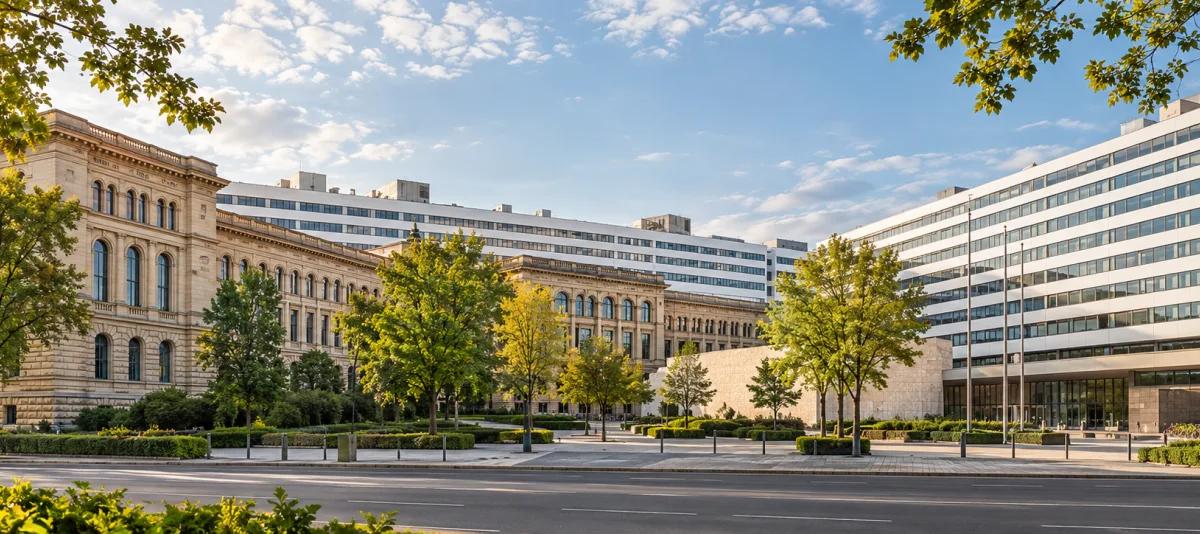
The main campus sits in Charlottenburg around Ernst-Reuter-Platz, a few stops from Zoologischer Garten and Kurfürstendamm — TU calls it the largest contiguous inner-city university campus in Europe. Further sites include Wedding, Schöneberg and the EUREF energy campus, plus a satellite in El Gouna, Egypt. For STEM Erasmus students it is usually a better English-language fit than Humboldt.
Academic programs
Around 100 programmes across engineering, computer science, architecture, planning, natural sciences and economics. Bachelor's remain mostly German; many master's (computer science, energy, urban planning, industrial engineering tracks) are English-taught. Workload is heavy by Spanish-university standards: Übungen, projects and labs sit on top of large lectures. TU Berlin is strong in employer reputation (QS places it above HU and FU on that indicator) and in engineering & technology subject ranks.
Non-consecutive / continuing-education master's can carry fees; check the specific programme. Exchange students take modules from the regular catalogue with a Learning Agreement.
Campus life
Charlottenburg is "City West": cafés on Savignyplatz, the large TU Mensa, and easy U2/U1 access to Kreuzberg nightlife. Student groups (AStA, ESN, faculty initiatives) are active; the campus feels more technical and international than HU Mitte. Berlin's housing crunch hits TU students the same as everyone else. English is the default in many labs and among internationals; German still helps for bureaucracy, WG life and internships at German Mittelstand firms.
Exchange programs
Wide Erasmus+ and bilateral network. Incoming students enrol like degree students for the semester contribution and receive the Deutschlandsemesterticket (local and regional transport nationwide; not ICE/EC). Nomination and application windows are faculty-specific — engineering partners should confirm with the TU International Office rather than assuming HU dates. Course registration (Moses / ISIS) has a learning curve; get a buddy or ESN help in week one.
Admissions
Restricted bachelor's programmes use NC / Hochschulstart; international degree applications often go through uni-assist. For restricted-admission (NC) programmes the summer 2027 window runs from 1 December 2026 to 15 January 2027 (open-admission programmes until 28 February 2027); the winter 2026/27 window ran from 1 June to 15 July 2026, and the winter 2027/28 dates are not yet published, so check the official calendar. Master's selection is programme-by-programme (transcript, sometimes GRE or a portfolio for architecture). German-taught degrees typically need DSH-2 / TestDaF 4; English master's usually IELTS 6.5 or equivalent. TU Berlin does not publish an overall acceptance rate (the figures on third-party sites are estimates that range from about 23% to 67%); admission is decided programme by programme, and architecture and the popular computer science master's are the most competitive.
Student housing
Apply to studierendenWERK Berlin as soon as you have an admission letter. Typical dorm €300–500/month; private WG in Charlottenburg/Wilmersdorf often €550–800. Cheaper rooms appear in Spandau, Wedding, Neukölln and Lichtenberg if you accept a longer U-Bahn ride. The main campus is well served by U-Bahn (Ernst-Reuter-Platz) and S-Bahn (Tiergarten / Zoologischer Garten).
Career services
TU's employer reputation is one of its strongest cards: engineering, software, energy, mobility and consulting recruit on campus. Berlin's startup scene (and corporate outposts of Google, SAP, Siemens, Deutsche Bahn) absorbs many graduates. Non-EU students can use the 18-month job-seeker title after a German degree. Career fairs and the TU Career Service are active; German language still lifts internship odds even in English-speaking teams.
Academic programs
- Engineering
- Computer Science
- Architecture
- Natural Sciences
- Economics
- Planning
- Electrical Engineering
- Mechanical Engineering
- Mathematics
- Sustainability
Application deadlines
- fall: Winter 2027/28: not yet published, check the official calendar (the winter 2026/27 window for restricted-admission programmes ran 1 June–15 July 2026)
- spring: 15 January 2027 (restricted-admission programmes; open-admission programmes until 28 February 2027)
Exchange
Erasmus+ and global partners; member of the Berlin University Alliance. Large share of English-taught master's. Incoming students pay the semester contribution (not tuition). Main campus Charlottenburg (Straße des 17. Juni / Ernst-Reuter-Platz).
Universities in Berlin
Next steps
Sources
- topuniversities.com/universities/technische-universitat-berlin-tu-berlin
- tu.berlin/en/about/profile/rankings
- tu.berlin/en/about/profile/tu-berlin-statistics
- tu.berlin/en/studying/applying-and-enrolling/dates-deadlines
- tu.berlin/en/studierendensekretariat/topics-a-z/semester-fees
- tu.berlin/studieren/studienorganisation/themen-a-z/semesterbeitraege