Humboldt-Universität zu Berlin
Quick facts
- City
- Berlin
- Country
- Germany
- Type
- Public
- Founded
- 1810
- Students
- 37,222
- National ranking
- #7
- International ranking
- #130
- Tuition (local students)
- €0
- Tuition (international)
- €0
- Guide score
- 7.9/10
Official website: www.hu-berlin.de
Overview
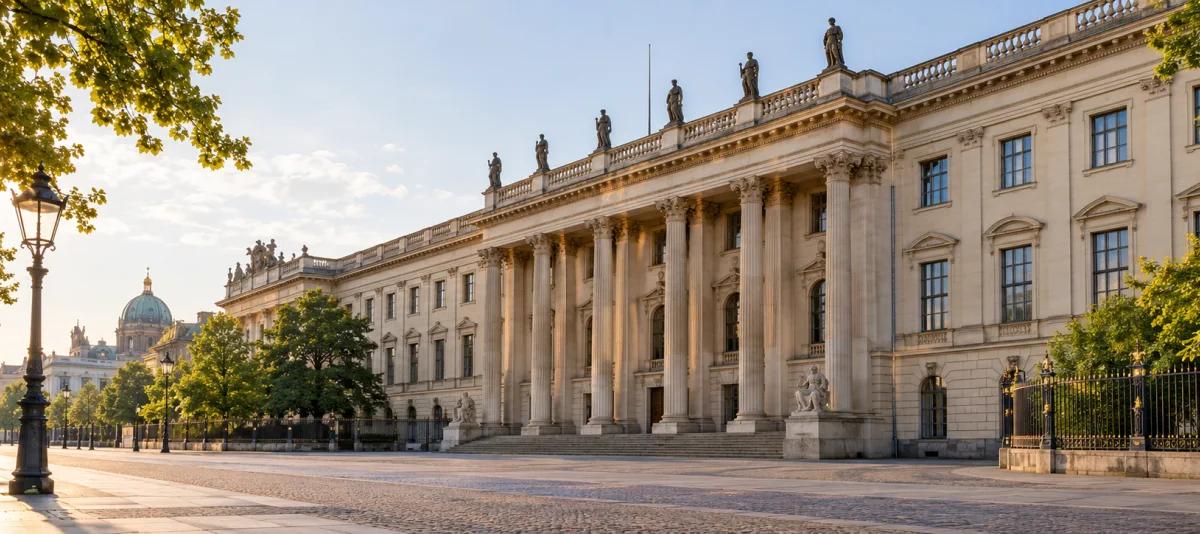
Humboldt-Universität zu Berlin (HU), founded in 1810 on Wilhelm von Humboldt's research-and-teaching model, is the historic heart of Berlin's university system and a member of the Berlin University Alliance of Excellence. It sits at 130th in the QS World University Rankings 2026 (7th in Germany). Around 37,000 students are enrolled (37,222 in winter 2025/26), and international students are a large part of them. There is no tuition for bachelor's and consecutive master's programmes — EU and non-EU students alike pay only the semester contribution, which includes the Deutschlandsemesterticket (for comparison, TU Berlin charges €379.06 for winter 2026/27; check HU's current amount).
HU is a full university rather than a technical school: humanities, law, economics and social sciences dominate Campus Mitte on Unter den Linden, while mathematics, physics, chemistry, computer science, geography and psychology sit at Campus Adlershof in the south-east (~6,000 students). Medicine is taught with Freie Universität at Charité. For Spanish and other Erasmus students it is one of Germany's most requested destinations, but German B2 is still the practical bar for most undergraduate classes.
Academic programs
Standout areas are history, philosophy, literature, law, economics and the natural sciences at Adlershof. Charité (joint medical faculty with FU) is among Europe's largest university hospitals. Bachelor programmes are mostly German-taught; a growing set of English master's (and a few specialised bachelor's) exists, plus credit-bearing German courses at the Language Centre. Teaching style is seminar-heavy in the humanities and lecture-plus-Übung in the sciences. Grade conversion and ECTS are standard Erasmus practice; without sitting exams you do not get credits.
Degree-seeking non-EU applicants usually go through uni-assist; NC (numerus clausus) programmes such as psychology are competitive. Exchange students are nominated by their home university and do not pay HU tuition.
Campus life
Campus Mitte is urban campus, not a gated quad: you study next to Museum Island, then take the U-Bahn to Neukölln or Prenzlauer Berg. Adlershof is a science park with its own S-Bahn stop — quieter, cheaper housing nearby, and a longer commute to Berlin nightlife. Student life is city-wide: ESN and faculty Fachschaften organise Stammtische; Mensen at both campuses are the cheap daily option. Berlin's club scene (Berghain, ://about blank, smaller spots in Kreuzberg/Neukölln) is the unofficial campus nightlife. English is widely spoken in the city even when coursework is in German.
Exchange programs
HU runs Erasmus+ and faculty-level partnerships (Erasmus code D BERLIN13). Law has its own incoming office. Typical winter/full-year nomination deadline is 31 May; summer 30 November (confirm on the current fact sheet). Incoming students pay the semester contribution after arrival; check HU's exchange pages for any fee exemptions. Housing is not guaranteed — apply early to studierendenWERK Berlin and search WG-Gesucht in parallel.
Admissions
German applicants use Hochschulstart / uni-assist depending on the programme. International degree-seekers need recognised secondary qualifications and, for German-taught degrees, DSH-2 or TestDaF 4×4 (approximate — check the faculty). English-taught master's typically want IELTS 6.5 or an equivalent TOEFL iBT score. Winter deadline for many restricted programmes is 15 July; summer 15 January. Exchange students follow the partner nomination calendar, not these dates.
Student housing
Berlin housing is the main stress point. studierendenWERK dorms are the affordable option (often €300–450/month) but waiting lists run months. Private WG rooms commonly cost €500–750/month in inner districts. For Mitte faculties, look at Prenzlauer Berg, Friedrichshain, Wedding and Moabit; for Adlershof, Treptow-Köpenick and nearby Köpenick are cheaper and on the S-Bahn. Sign nothing without a viewing if you can avoid it; scams targeting incoming internationals are common.
Career services
HU Career Center plus Berlin University Alliance events connect students to ministries, NGOs, media, research institutes and the city's startup scene. Humanities graduates often need German for local public-sector jobs; STEM and economics students have a wider English-speaking market (consulting, tech, research). 18-month job-seeker residence after a German degree (for non-EU graduates) is the usual post-study path.
Academic programs
- Humanities
- Law
- Economics
- Social Sciences
- Natural Sciences
- Computer Science
- Psychology
- Medicine (Charité)
- History
- Languages
Application deadlines
- fall: July 15
- spring: January 15
Exchange
Erasmus+ (D BERLIN13) and partner universities worldwide. Incoming nominations typically close 31 May for winter/full year and 30 November for summer. Most bachelor teaching is in German (B2 often expected); English options are stronger at master's level.
Universities in Berlin
Next steps
Sources
- topuniversities.com/universities/humboldt-universitat-zu-berlin
- hu-berlin.de/en/university/organisation/facts-figures
- hu-berlin.de/universitaet/international/an-die-hu/programme/austauschsemester
- hu-berlin.de/en/university/campus-university-life/campus-university-life-at-a-gl
- de.wikipedia.org/wiki/Humboldt-Universit%C3%A4t_zu_Berlin
- en.wikipedia.org/wiki/Humboldt_University_of_Berlin
- tu.berlin/en/studierendensekretariat/topics-a-z/semester-fees