FLACSO Ecuador
Quick facts
- City
- Quito
- Country
- Ecuador
- Type
- Public
- Founded
- 1974
- National ranking
- #30
- Tuition (local students)
- US$7,500
- Guide score
- 7.0/10
Official website: www.flacso.edu.ec
Overview
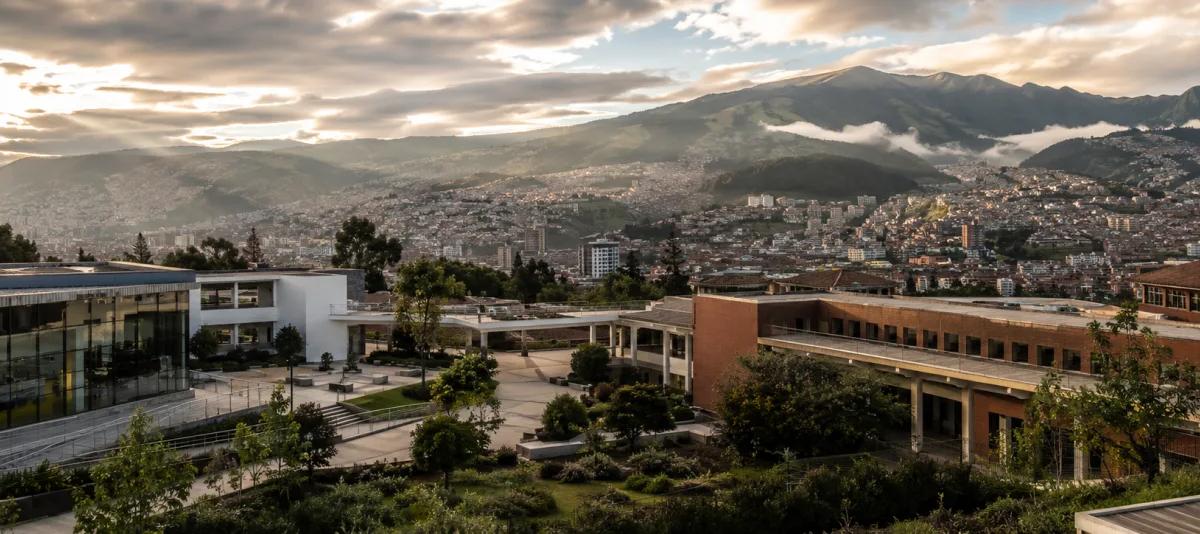
FLACSO Ecuador is the Quito seat of the Facultad Latinoamericana de Ciencias Sociales, an intergovernmental network of social-science institutions. It is a postgraduate-only university: there are no undergraduate degrees, only masters, doctorates, diplomas and research. The building is at Calle La Pradera E7-174 y Av. Diego de Almagro, in the La Pradera/La Mariscal area of north-central Quito, walking distance from La Floresta's cafés and the Av. 6 de Diciembre transport corridor.
It is accredited by CACES (Resolution 130-SE-33-CACES-2020); in October 2025 CACES extended all 2020 institutional accreditations until the next evaluation cycle, which starts from September 2026 onwards. In November 2025 CACES also granted FLACSO a six-year "superior quality in research" qualification for its doctoral offer in social and behavioural sciences. In the Webometrics July 2026 edition it sits 30th in Ecuador and 5,497th worldwide — a web-visibility ranking that undersells a small, research-heavy school. It does not appear in QS tables. Student headcount is not published on the pages we checked (a 2016 press figure was roughly 1,000 masters and 79 doctoral students); we leave it null.
Academic programs
The 2026-2028 masters call lists 17 programmes: Anthropology, Visual Anthropology, Political Science, Political Communication and Public Opinion, Territorial Development, Development Economics, SME Economics, Gender Studies, Socio-environmental Studies, two Urban Studies tracks (climate change; planning), History, Public Policy, two International Relations tracks (regional/global political economy; security and conflict), Sociology and Political Sociology. Programmes last 20 months, full-time, in Spanish, and end in a thesis. Seven doctoral programmes run on separate calls, and there are postdoctoral positions and continuing-education diplomas.
Campus life
This is a seminar-and-library place rather than a campus. There is a cinema (Sala Sur), a specialised social-sciences library and a busy calendar of public talks and book launches. The cohort is small and regionally mixed — a real advantage if you want a Latin American network in public policy, NGOs or academia. Sport facilities are essentially absent.
Exchange programs
There is no undergraduate exchange. Visiting researchers and postgraduate stays are arranged through faculty contacts, the FLACSO system and specific agreements; ask the relevant department first. Information pending on formal incoming-exchange windows — contributions welcome.
Admissions
The 2026 call: early application (no USD 30 fee) until 12 June; standard deadline 10 July; online aptitude test 11-17 July; scholarship applications until 7 August; interviews 12-25 August; results 3-4 September; confirmation by 18 September; classes 26 October 2026. The 2024-2026 and 2026-2028 labels suggest research masters open roughly every two years — check before planning.
Cost: USD 30 admission, USD 500 matrícula, USD 7,500 total colegiatura for the 20 months. No separate foreigner rate is published. Every admitted student is assessed for a socio-economic discount (the stated target average is 60%). Stipend scholarships pay USD 580/month for 20 months with 100% or 60% tuition waivers and health insurance, plus a one-off USD 500 relocation bonus for foreigners; they require full-time dedication with no paid work.
Foreigners need a bachelor degree (apostilled). For residence, apply for the visa de residencia temporal de estudiante through Cancillería's e-VISAS: passport valid 6+ months, apostilled criminal record, proof of means and the admission letter; it lasts as long as the programme, up to two years. To use an Ecuadorian degree later, or to register a foreign one, see SENESCYT's SIAU-Online process.
Student housing
FLACSO has no residences. Students rent in La Floresta, La Mariscal, La Carolina or around Av. América. Rooms near the nearby Universidad Central start around USD 120-180/month (≈ €100-155); La Floresta proper tends to cost more. Verify listings in person.
Career services
Information pending on a formal careers office — contributions welcome. In practice, graduates move into ministries, multilaterals, NGOs, think tanks and PhD programmes through faculty networks and research-assistant roles.
Academic programs
- Anthropology
- Visual Anthropology
- Political Science
- Political Communication
- Development Economics
- Gender Studies
- Socio-environmental Studies
- Urban Studies
- History
- Public Policy
- International Relations
- Sociology
- Doctoral Programmes
Application deadlines
- fall: Masters 2026-2028 call - admission applications until 10 July 2026, classes start 26 October 2026
- spring: Information pending
Exchange
Postgraduate-only; mobility runs through research agreements and the FLACSO system across Latin America, plus the Parlamento Andino network. Degree-seekers apply directly to a specific masters or doctorate.
Universities in Quito
Next steps
Sources
- flacso.edu.ec/maestria
- flacso.edu.ec/posdoc/registroPrin.flacso?param=1
- flacso.edu.ec/es
- eltelegrafo.com.ec/noticias/sociedad/220/las-matriculas-de-estudios-de-posgrado-
- es.linkedin.com/posts/flacso-ecuador-cuenta-oficial_noticiasflacso-activity-7395
- ug.edu.ec/wp-content/uploads/PLANIFICACION/ACREDITACION-INSTITUCIONAL/Resoluci%C
- webometrics.org/ecuador
- gob.ec/mremh/tramites/concesion-visa-residencia-temporal-estudiante
- gob.ec/minedec/tramites/reconocimiento-general-titulos-extranjero