Dublin City University
Datos rápidos
- Ciudad
- Dublin
- País
- Ireland
- Tipo
- Pública
- Fundada en
- 1975
- Estudiantes
- 20.000
- Estudiantes internacionales
- 19 %
- Ranking nacional
- #5
- Ranking internacional
- #410
- Matrícula (estudiantes locales)
- 2500 €
- Matrícula (internacionales)
- 15.900 €
- Nota media de la guía
- 7,5/10
Web oficial: www.dcu.ie
Resumen
Dublin City University (DCU) was founded in 1975 as the National Institute for Higher Education, Dublin, and gained full university status in 1989, making it Ireland's youngest university. It has grown quickly into a multi-campus institution of roughly 20,000 students, with around 19% (approximate) coming from more than 120 countries, and sits at 410th in the QS World University Rankings 2026 (up from 421), placing it among the top five universities in Ireland. DCU also performs strongly in the QS and THE "young universities" tables and is known for its close ties to industry and its emphasis on employability.
The main Glasnevin campus is in Dublin 9, about 5 km north of the city centre and roughly 20-25 minutes by bus (routes 4, 9, 11, 13 and 44 stop at or near the campus) or a 15-minute cycle. Since the 2016 incorporation of St Patrick's College, Mater Dei and the Church of Ireland College of Education, DCU also has the historic St Patrick's campus and the All Hallows campus in Drumcondra, about 1.5 km away, which house the Institute of Education and part of the humanities. EU students pay only the student contribution (EUR 2,500 from 2025/26 under the Free Fees Initiative after Budget 2026, plus a small student levy), while non-EU undergraduate fees for 2025/26 range from about EUR 15,900 (e.g. Environmental Science, Financial Mathematics) to about EUR 23,000 (Nursing), with most Business and Computing degrees in the EUR 16,000-18,000 range.
Oferta académica
DCU has five faculties: DCU Business School (AACSB and AMBA accredited, with the flagship BA in International Business and Languages), Engineering and Computing, Humanities and Social Sciences, Science and Health, and the Institute of Education (Ireland's largest teacher-education provider). Its best-known strengths are Computing, Data Science and Analytics, Communications and Journalism (the School of Communications is the leading media school in Ireland), Applied Languages and Translation, Biotechnology, Nursing and Sports Science. DCU pioneered the INTRA work-placement programme, and most undergraduate degrees include a paid placement of three to twelve months.
The year runs in two semesters (late September to December and late January to May) and uses ECTS, with a standard full-time semester of 30 credits. Teaching is practically oriented, with a strong dose of continuous assessment, group projects and lab work, and DCU's Future-Ready and "DCU Connected" online provision are well developed. Research centres such as Insight (data analytics), the National Centre for Sensor Research and the Water Institute anchor the science and computing schools.
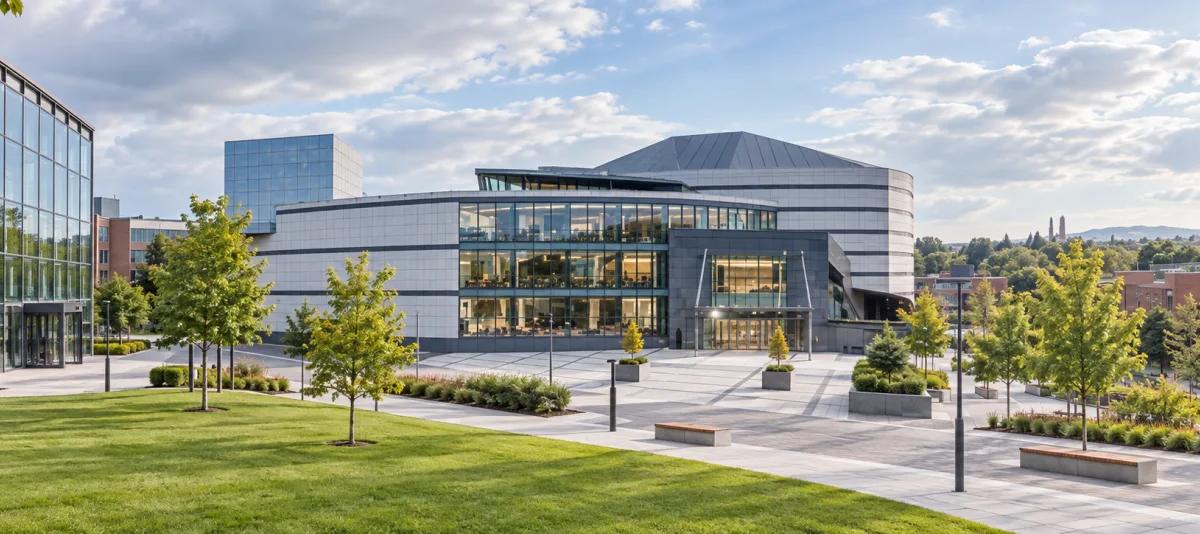
Vida en el campus
Glasnevin is a compact, modern campus with a large student centre (The U), the Helix performing arts venue, a sports complex with a 25-metre pool, a climbing wall, a fitness centre and all-weather pitches, and the Morton Stadium athletics track nearby in Santry. DCU Students' Union runs over 100 clubs and societies, from GAA, rugby, soccer, athletics and dance to drama, media and cultural societies, with an International Students Society and a well-attended Erasmus Student Network branch. Rag Week, the DCU Ball and MediaWeek are annual highlights, and the campus bar and the pubs of Drumcondra and Glasnevin provide the local social scene, with the city centre a short bus ride away.
DCU Accommodation manages roughly 1,500 beds across the Glasnevin campus (Larkfield, Hampstead, College Park and Postgraduate Apartments) and St Patrick's campus (Cara Halls and Purcell House), which is a comparatively high proportion of on-campus housing for Dublin. Rooms are single en-suite or standard rooms in shared apartments, and 2025/26 rates work out at approximately EUR 870-900 per month (roughly EUR 200-215 per week), with international undergraduates typically allocated to College Park and Hampstead. Demand is heavy, so exchange students are encouraged to apply as soon as they receive their admission, and the DCU accommodation office also lists approved private options in Glasnevin, Drumcondra, Santry and Whitehall, where rooms typically cost EUR 700-1,000 per month.
Intercambios
Inbound mobility is run by the DCU Placement International Mobility Team, which manages Erasmus+, bilateral exchange and a fee-paying Study Abroad programme with more than 200 partner universities. Home universities nominate students via the DCU portal; for 2026/27 nominations open on 1 March and close on 31 March for semester 1 or a full year, and open on 15 August and close on 15 September for semester 2, after which students complete an online application and module selection. Erasmus+ and bilateral exchange students pay no tuition to DCU, need a B2 level of English (IELTS 6.5 or equivalent) and receive an orientation programme, a buddy system and access to the DCU Global Lounge.
Spanish universities are among the most common partners. The School of Applied Language and Intercultural Studies exchanges with universities in Barcelona, Granada, Las Palmas de Gran Canaria and Salamanca, while DCU Business School's International Business and Languages programme partners with universities in Alcalá de Henares, Madrid, Valencia, Sevilla and Oviedo; other faculties such as Computing and Engineering hold their own agreements with Spanish technical universities. The full, searchable partner list is published on the DCU MoveOn portal. Exchange students usually enrol in one faculty but may request modules from others with approval, and the practical, English-taught curriculum combined with the campus's proximity to Dublin Airport makes DCU a popular Erasmus choice for Spanish students.
Oferta académica
- Business
- Engineering
- Computer Science
- Communications
- Journalism
- Languages
- Education
- Nursing
- Biotechnology
- Psychology
- Law
- Data Science
Plazos de solicitud
- fall: February 1
- spring: September 15
Intercambio
Erasmus+ and bilateral exchange agreements with 200+ universities. Spanish partners include universities in Madrid (e.g. Universidad de Alcala, Universidad Autonoma de Madrid), Barcelona, Valencia, Sevilla, Granada, Salamanca, Oviedo and Las Palmas de Gran Canaria, mainly via the Business School and the School of Applied Language and Intercultural Studies. Incoming nominations close around 31 March for semester 1 / full year and around 15 September for semester 2.