Singapore, Singapore
Datos rápidos
- País
- Singapore
- Habitantes
- 6.210.000
- Idiomas
- English, Mandarin, Malay, Tamil
- Moneda
- SGD
- Zona horaria
- SGT (UTC+8)
- Nota media de la guía
- 8,1/10
- Seguridad
- 10/10
Resumen
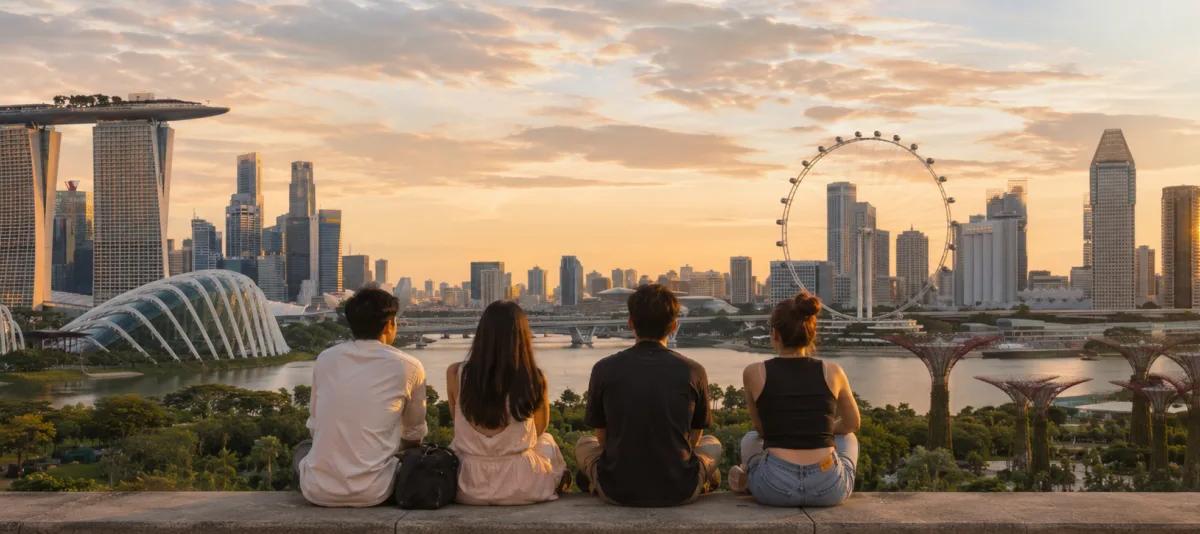
Singapore is both a country and its only city — a dense, futuristic city-state of about 6.2 million people at the southern tip of the Malay Peninsula. For international students it offers an almost frictionless landing: English is the working language, the city is spotlessly clean and among the safest in the world, and the public transport system is world-class. Home to NUS, NTU, SMU, and SUTD, Singapore attracts tens of thousands of international students every year.
The city blends gleaming skyscrapers with lush greenery ("City in a Garden"), hawker centres serving some of the best cheap food on Earth, and a multicultural mix of Chinese, Malay, Indian, and expat communities. It's expensive by Asian standards, but student housing subsidies and SGD 4–7 hawker meals make day-to-day life manageable.
Vida estudiantil
Student life clusters around the major campuses. NUS (Kent Ridge) and NTU (Jurong West) are large, self-contained campuses with residential colleges, sports facilities, and dozens of societies, while SMU sits right in the downtown core near Bugis and Bras Basah. Campus culture is academically intense but socially rich, with hall activities, freshman orientation camps, and interest clubs forming the backbone of student social life.
Beyond campus, students explore the city's neighbourhoods, hit the East Coast for cycling and beaches, and take advantage of cheap regional flights for weekend trips to Malaysia, Bali, or Thailand. The multicultural student body makes it easy to find community, and English fluency removes the isolation international students sometimes feel elsewhere in Asia.
Barrios
Clementi / Kent Ridge / Dover (SGD 700–1,100/mo for an HDB room): Closest to NUS, well-served by MRT and full of student-friendly food and amenities.
Jurong West / Boon Lay / Pioneer (SGD 650–850/mo): Around NTU in the west; more affordable and residential.
Buona Vista / Queenstown (SGD 900–1,200/mo): Central-west, great connectivity, near NUS and the one-north tech district.
Bugis / Little India / Chinatown / Outram (SGD 800–1,300/mo): Downtown areas near SMU, packed with food, culture, and nightlife.
Tampines / Simei / Expo (SGD 600–850/mo): East side near SUTD, family-oriented and affordable.
Comida y restaurantes
Food is Singapore's national obsession and a student's best friend. Hawker centres — open-air food courts subsidized as public infrastructure — serve full meals for SGD 4–7. Must-tries include Hainanese chicken rice, char kway teow, laksa, nasi lemak, roti prata, and chilli crab (a splurge). Famous hawker spots include Maxwell Food Centre, Old Airport Road, and Lau Pa Sat.
University canteens are even cheaper, with meals around SGD 3–5. Cooking at home is less common because eating out is so affordable, but supermarkets (FairPrice, Sheng Siong) and wet markets keep groceries reasonable. A restaurant meal in a mall runs SGD 12–25, and a Starbucks-style coffee is SGD 5–7.
Vida nocturna y ocio
Singapore's nightlife ranges from rooftop bars with skyline views to the clubs of Clarke Quay and Zouk. Drinks are expensive — a beer in a bar is SGD 11–18 — so students often pre-game or stick to happy hours (typically before 8–9pm). Cover charges at major clubs run SGD 20–35, often with student or ladies' nights.
Beyond drinking, entertainment includes the waterfront at Marina Bay, Gardens by the Bay light shows, Sentosa's beaches and attractions, night markets, and a strong live-music and arts scene. Many museums are free or discounted for students. Public spaces and events are abundant, and the city feels safe at any hour.
Transporte
Singapore's MRT (metro) and bus network is one of the best in the world — clean, punctual, air-conditioned, and cheap. Adult fares are distance-based, roughly SGD 1.20–2.80 per ride. Full-time undergraduates can buy a hybrid monthly concession pass for SGD 81 (unlimited basic bus and train), so a monthly budget of SGD 80–150 covers most students. Just tap in and out with a contactless card or phone (SimplyGo / EZ-Link).
The city is compact, so commutes are short. Cycling and e-scooters are options in some areas, and Grab (ride-hailing) is convenient for late nights at SGD 8–20 per trip. Car ownership is prohibitively expensive due to the Certificate of Entitlement system, so almost no students drive. Changi Airport, consistently rated the world's best, is about 20–40 minutes from the centre by MRT depending on the line.
Coste de vida
Monthly budget for a student in Singapore:
- On-campus hall or HDB room: SGD 400–1,200
- Food (hawker + some restaurants): SGD 400–700
- Transport: SGD 80–150
- Phone & internet: SGD 20–50
- Leisure & going out: SGD 150–400
- Total: SGD 1,400–2,800/month
Budget an extra SGD 3,000–5,000 for your first month to cover the rental deposit (1–2 months), advance rent, bedding, and setup. Hawker food and subsidized housing are the two biggest levers for keeping costs down. AY2026/27 hall rates at NTU, for example, run about SGD 412–835 for typical rooms, with ensuite rooms higher.
Seguridad
Singapore is one of the safest cities on the planet. Violent crime is extremely rare, and it's completely normal to walk alone at night or leave a laptop on a café table. Strict laws are enforced — including fines for littering, jaywalking, vaping (banned), and eating on the MRT — and drug offences carry severe penalties, so know the rules.
Petty theft is uncommon but still possible, so basic caution applies. The emergency number is 995 (ambulance/fire) and 999 (police). Overall, students and their families rank safety as one of Singapore's greatest advantages.
Clima
Singapore sits just north of the equator and is hot and humid year-round, with temperatures of 25–33°C every day and high humidity. There's no real winter or summer — just wetter and slightly drier periods. The monsoon seasons (roughly November–January and June–September) bring frequent heavy but short downpours.
Air conditioning is everywhere and essential. Students quickly adapt to dressing light, carrying an umbrella, and moving between air-conditioned buildings. The constant warmth means outdoor activities are possible year-round, but the humidity takes some getting used to.
Universidades en Singapore
Siguientes pasos
Fuentes
- population.gov.sg/files/Population_in_Brief_2026.pdf
- ntu.edu.sg/life-at-ntu/accommodation/undergraduate-housing/detail/hall-7
- simplygo.com.sg/concession-monthly-travel-cards/students/undergraduate-concessio
- numbeo.com/cost-of-living/in/Singapore
- ica.gov.sg/reside/STP/apply/ihl
- nus.edu.sg/registrar/docs/default-source/administrative-policies-procedures/ugtu