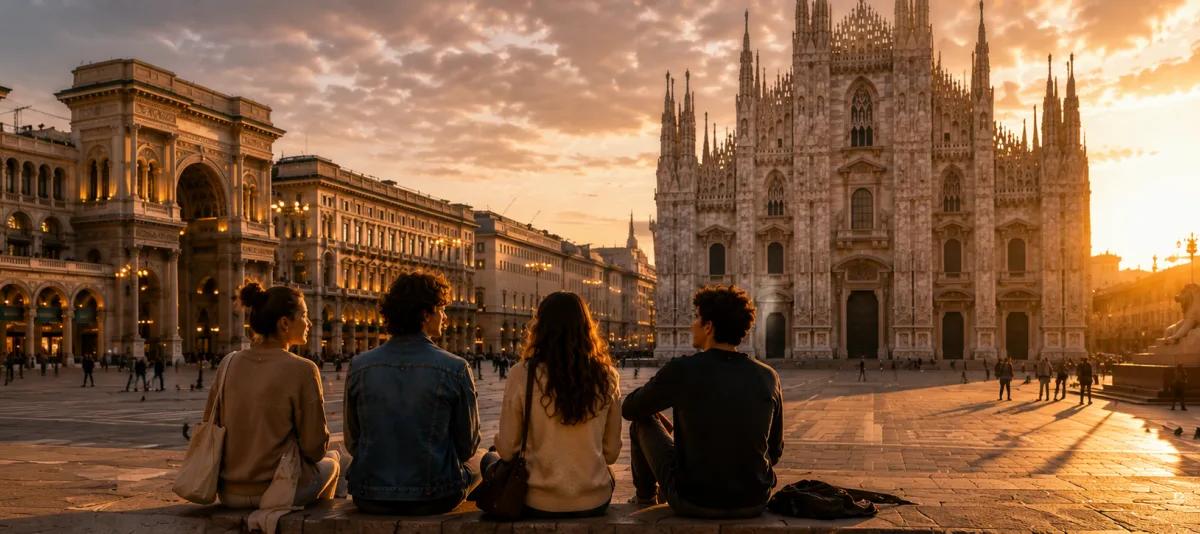
Milan, Italy
Datos rápidos
- País
- Italy
- Habitantes
- 1.400.000
- Idiomas
- Italian
- Moneda
- EUR
- Zona horaria
- CET (UTC+1)
- Nota media de la guía
- 6,8/10
- Seguridad
- 7/10
Resumen
Milan is Italy's economic and design capital — a fast-paced, international city of 1.4 million that stands apart from the rest of Italy in its energy, ambition, and cosmopolitan outlook. For students, Milan offers a unique combination of world-class universities (particularly in design, fashion, engineering, and business), a powerful professional network, and a lifestyle that blends Italian warmth with northern European efficiency. It's not the prettiest Italian city at first glance, but it reveals its beauty gradually — in hidden courtyards, Navigli canal reflections, design showrooms, and the energy of its aperitivo culture.
The city is home to globally ranked institutions: Politecnico di Milano (consistently the top Italian university for engineering and design), Università Bocconi (one of Europe's top business schools), Università degli Studi di Milano (the largest in the city), and Università Cattolica del Sacro Cuore. Milan is also the global capital of fashion and design education, hosting institutions like Istituto Marangoni, Domus Academy, and Nuova Accademia di Belle Arti (NABA). The city's concentration of corporate headquarters, design studios, and fashion houses means internship and job opportunities are abundant.
Milan is the most expensive city in Italy, particularly for housing, but it rewards the investment with career opportunities, cultural richness, and international connectivity. The city's northern Italian position provides easy access to the Alps (1.5 hours), Lake Como (1 hour), and international destinations via its two airports. The aperitivo tradition — where an €8–12 drink comes with a generous buffet spread — is not just a social ritual but a legitimate money-saving dinner strategy for students.
Vida estudiantil
Milan has approximately 210,000 university students, creating a vibrant academic community that drives the city's cultural and social life. Student life revolves around the interplay between rigorous academics and Milan's sophisticated social scene. Unlike smaller Italian university towns, Milan's student population is distributed across the city rather than concentrated in a single campus area, meaning students integrate fully into urban life.
Politecnico and Bocconi are the dominant academic brands, and their respective student communities have distinct cultures — Poli students tend toward the creative and technical, while Bocconiani lean international and career-focused. Student associations (associazioni studentesche) are active, organizing everything from career fairs to parties to cultural festivals. ESN Milano coordinates activities for exchange students. The university sport scene (CUS Milano) offers affordable access to facilities and teams. Study spots extend beyond libraries — cafés like Pavé, Orsonero, and the numerous specialty coffee shops that have transformed Milan's coffee culture make studying a pleasure. The city's aperitivo circuit serves as the primary social glue, bringing students together every evening from 6 to 9 PM.
Barrios
Città Studi is Milan's traditional student quarter, located around the Politecnico campus. It has the highest concentration of student housing, affordable restaurants, and a lively but unpretentious atmosphere. Rooms cost €450–650/month. The neighborhood has a working-class character with plenty of pizzerias, kebab shops, and student bars. Well served by the M2 metro line.
Navigli is Milan's most atmospheric neighborhood, centered around two canals (Naviglio Grande and Naviglio Pavese) lined with bars, restaurants, and vintage shops. It's the epicenter of aperitivo culture and nightlife. Rooms cost €550–800/month. The area can be noisy on weekends, especially along the canal banks, but the vibe is hard to beat.
Isola is a formerly industrial neighborhood north of Garibaldi station that has been transformed into one of Milan's trendiest areas. It blends new development (the Bosco Verticale towers) with old-school bars and a diverse community. Rooms cost €500–700/month. Great food scene with a mix of traditional trattorias and international restaurants.
Porta Romana is a well-connected southern neighborhood with a village-like feel, anchored by the beautiful Porta Romana gate and the Fondazione Prada nearby. It's popular with Bocconi students due to its proximity to that campus. Rooms cost €650–850/month. Good mix of local shops, parks, and dining options.
Lambrate is an emerging creative district east of Città Studi, known for design studios, galleries, and an increasingly vibrant food scene. It's still relatively affordable with rooms at €400–600/month and offers a more off-the-beaten-path experience. The neighborhood hosts part of Milan Design Week and has a growing reputation as a creative hub. Connected by the M2 metro.
Comida y restaurantes
Milan's food culture is a blend of traditional Milanese cuisine, pan-Italian regional food, and a growing international scene driven by the city's cosmopolitan population. Traditional dishes include risotto alla milanese (saffron risotto), cotoletta alla milanese (breaded veal cutlet), and ossobuco. These are available at classic trattorias for €10–16 per main course.
For student budgets, pizza al taglio (pizza by the slice) is everywhere and costs €2–5 for a filling portion. Spontini is the iconic Milanese pizza chain — a massive slice of thick, cheesy pizza costs about €5. Luini (near the Duomo) serves panzerotti (fried stuffed dough) for €3. Kebab shops and Asian restaurants in Città Studi and around Via Paolo Sarpi (Milan's Chinatown — excellent dumplings for €5–7) offer affordable variety. The aperitivo tradition is essential: for €8–12, you get a cocktail and access to a buffet that ranges from light snacks to a full dinner spread. Notable aperitivo spots include Navigli canal bars, Mag Café, Frida, and Rita & Cocktails.
Grocery shopping at Esselunga, Carrefour, or Lidl costs about €30–45/week. The Mercato Comunale covers various neighborhoods and offers fresh produce at fair prices. University canteens (mense) serve meals for €3–6 depending on income bracket.
Vida nocturna y ocio
Milan's nightlife has evolved significantly and now offers something for every taste, from elegant cocktail bars to underground clubs and live music venues. The evening starts with aperitivo (6–9 PM), which often transitions directly into the night out. Clubs typically open around 11 PM and stay open until 4–5 AM.
Navigli is the go-to area for canal-side drinks and bar-hopping. The entire stretch of Naviglio Grande is lined with bars and restaurants, and summer evenings see hundreds of people drinking along the canal banks. Colonne di San Lorenzo (near Porta Ticinese) is an open-air gathering spot where students bring drinks from nearby shops and socialize — it's essentially a free outdoor bar and one of Milan's most beloved social spaces. Corso Como is the upscale nightlife strip near Garibaldi, anchored by the iconic 10 Corso Como concept store and bar.
For clubs, Alcatraz is one of Milan's biggest venues for live music and club nights. Plastic is a historic LGBTQ+-friendly club with eclectic programming. Tunnel Club and Volt host electronic music events. Student nights (serate universitarie) with reduced entry (€5–10) happen weekly at various venues. Milan is also Italy's live music capital — the Mediolanum Forum and Ippodromo host major international acts, while smaller venues like Santeria and Circolo Magnolia (summer only, outdoor) offer intimate concerts.
Transporte
Milan's public transport system (ATM) includes five metro lines (M1-M5, with M4 being the newest), an extensive tram network (one of Europe's largest), buses, and a suburban rail system (Passante ferroviario and Trenord commuter trains). The metro runs from approximately 5:30 AM to 12:30 AM (1:30 AM on Fridays and Saturdays).
For students under 27, the ATM monthly pass costs €22/month (€200/year, agevolazione under-27), covering unlimited travel on metro, trams, and buses within the city. The standard monthly pass is €39. Milan's vintage orange trams are an iconic and practical way to get around — lines 1 and 19 traverse the city center and are useful for daily commutes. Milan is very bikeable despite occasional traffic chaos: BikeMi (bike-sharing) costs €36/year (€12 for holders of the annual under-27 ATM pass), plus per-ride fees. The city is also walkable for central distances.
For travel beyond Milan, the city has two airports: Malpensa (MXP, for international and long-haul flights, connected by Malpensa Express train for €15) and Linate (LIN, for short-haul European flights, connected by M4 metro). Milan is Italy's rail hub, with Centrale station connecting to high-speed Trenitalia Frecciarossa and Italo trains — Rome is 3 hours, Florence 1.5 hours, Turin 1 hour, and Venice 2.5 hours.
Coste de vida
Milan is Italy's most expensive city, but it's still significantly cheaper than Paris or London. A realistic monthly student budget is €950–1,400.
Monthly breakdown:
- Room in shared apartment: €570–820 (around €700 on average)
- Groceries: €120–170
- Transport (ATM under-27 pass): €22
- Mobile phone: €8–15 (Iliad offers a competitive €8/month plan)
- Entertainment & dining out: €100–180
- Aperitivo budget (essentially dinner 2-3x/week): €30–50
- Gym: €25–40
- Utilities (shared): €30–50
DSU (Diritto allo Studio Universitario) provides scholarships and benefits for eligible students, including free meals, housing subsidies, and tuition waivers based on ISEE (family income declaration). Even non-EU students can apply for DSU benefits. The aperitivo-as-dinner strategy genuinely saves money — a €10 Spritz with a buffet replaces a €15 restaurant meal several nights a week.
Seguridad
Milan is a generally safe city with a significantly lower crime rate than Rome or Naples. Violent crime is rare, and most neighborhoods are safe to walk in at any hour. The main concern is pickpocketing, particularly on the metro (especially the M1 red line), around the Duomo, Milano Centrale train station, and on crowded trams.
Milano Centrale and the surrounding area (especially around Via Sammartini) can feel sketchy at night due to street-level drug activity and homeless encampments. Parco Sempione should be avoided after dark. The Navigli area is safe but rowdy on weekend nights. Overall, Milan is safer than most European cities of comparable size, and common-sense precautions are sufficient. Emergency numbers: 112 (general emergencies), 113 (Polizia di Stato), 118 (medical emergency). The Carabinieri (military police) also handle civilian safety matters.
Clima
Milan has a humid subtropical climate that differs markedly from the Mediterranean weather most people associate with Italy. Summers (June–August) are hot and humid, with temperatures of 28–35°C and high humidity that can make it feel oppressive. Air conditioning is increasingly common but not universal in older apartments.
Winters (December–February) are cold, foggy, and grey, with temperatures between 0–7°C. Milan is famous for its winter fog (nebbia), which can persist for days and creates an atmospheric but gloomy ambiance. Occasional snow falls but rarely sticks. Spring (March–May) and autumn (September–November) are the best seasons — mild, with temperatures around 12–22°C — though rain is possible year-round. Milan averages about 1,250 hours of sunshine per year, making it one of the cloudier cities on this list. The proximity to the Alps means weekend ski trips are possible in winter (resorts are 1.5–2.5 hours away), and Lake Como and Lake Garda provide summer escapes.
Universidades en Milan
Siguientes pasos
Fuentes
- dati.comune.milano.it/web/portale-del-dato/w/la-popolazione-a-milano-nel-2025
- musascarl.it/primo-rapporto-mheo-a-milano-e-record-di-iscritti-negli-atenei-la-c
- atm.it/EN/VIAGGIACONNOI/ABBONAMENTI/Pages/PublictransportinMilanhowtosubscribe.a
- atm.it/it/ViaggiaConNoi/Biglietti/Pagine/Tipologie.aspx
- malpensaexpress.it/biglietti/biglietti-e-tariffe/prezzi/
- bikemi.com/compra
- monitorimmobiliare.it/monitorimmobiliare/notizia/stanze-in-affitto-prezzi-in-cal
- milanotoday.it/attualita/stanze-universitari-prezzi-2026.html