Lisbon, Portugal
Datos rápidos
- País
- Portugal
- Habitantes
- 658.000
- Idiomas
- Portuguese
- Moneda
- EUR
- Zona horaria
- WET (UTC+0)
- Nota media de la guía
- 6,9/10
- Seguridad
- 7/10
Resumen
Lisbon is one of Europe's most captivating capitals — a sun-drenched, hilly city of about 660,000 people perched on the banks of the Tagus River (Tejo), where centuries of history coexist with a booming tech scene, vibrant nightlife, and a warmth of character that makes international students feel welcome from day one. The city has undergone a remarkable transformation over the past decade, emerging as a major European hub for innovation, culture, and quality of life while maintaining its distinctive charm and a cost of living that, though rising, remains lower than most Western European capitals.
Lisbon is home to the University of Lisbon (Universidade de Lisboa, the country's largest), NOVA University of Lisbon (NOVA SBE is particularly renowned for business and economics), ISCTE – University Institute of Lisbon, and Universidade Católica Portuguesa, among others. These institutions offer strong programs across disciplines and have been expanding their English-taught offerings to attract international students. The city's emergence as a tech hub — anchored by the Web Summit (hosted annually since 2016) and a thriving startup ecosystem in hubs like Fábrica de Startups and Second Home — creates opportunities for students interested in entrepreneurship, tech, and innovation.
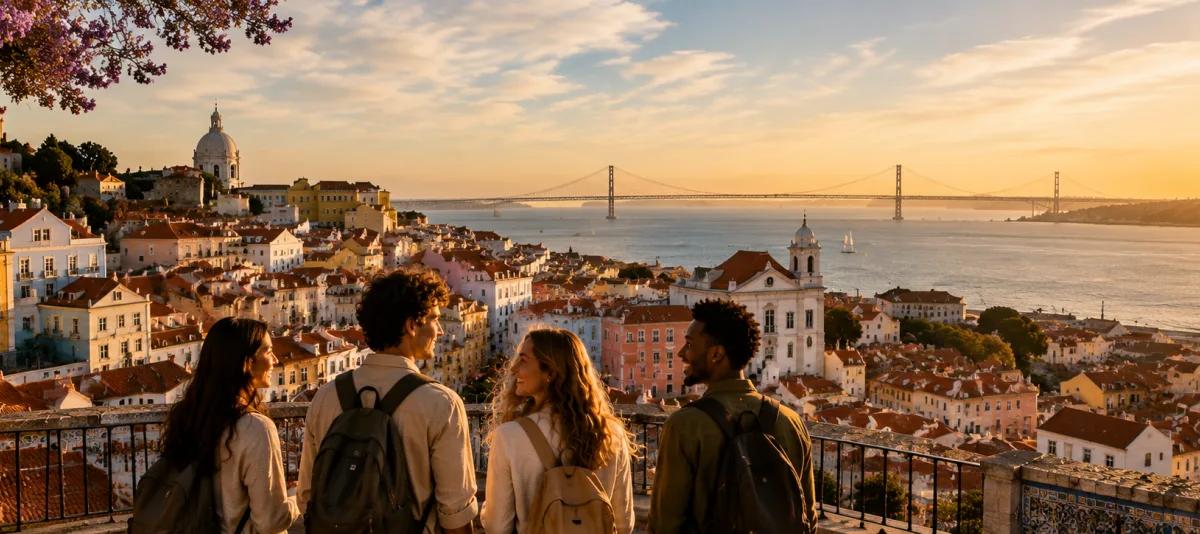
What makes Lisbon special is its livability: the light is extraordinary (over 300 days of sunshine), the food is exceptional and affordable, the people are genuinely kind, and the Atlantic coast is 20 minutes away by train. The city's seven hills provide dramatic viewpoints (miradouros) at every turn, and neighborhoods each have distinct personalities. Safety is a major advantage — Portugal consistently ranks among the world's safest countries, and Lisbon reflects this with a relaxed, low-crime atmosphere that lets you explore freely at nearly any hour.
Vida estudiantil
Lisbon's student population is concentrated but tightly knit, with approximately 130,000 students across the metropolitan area. The city has embraced its growing international student community, and integration is facilitated by the naturally welcoming Portuguese temperament. Unlike larger capitals where students can feel anonymous, Lisbon's compact size means you run into familiar faces regularly, and the student community develops a village-like quality within a capital city.
Academic traditions in Lisbon include the praxe — a hazing-like initiation tradition for first-year students that is controversial but deeply embedded in Portuguese university culture. International students are generally not pressured to participate. Student associations (Associações de Estudantes and Tunas — traditional musical groups) are active and welcoming. ESN Lisbon organizes regular events for exchange students, from city tours to surf trips to the coast. The city's café culture provides natural study spaces — places like Copenhagen Coffee Lab, Fabrica Coffee Roasters, and the many pastéis de nata-scented cafés throughout the city double as productive study environments. Lisbon also has excellent free or cheap cultural programming: free concerts at Fundação Calouste Gulbenkian gardens, First Sundays free at many museums, and outdoor cinema in summer.
Barrios
Alameda is a favorite among students, especially those attending the University of Lisbon (Cidade Universitária is nearby). It's a residential area with a large green esplanade (Alameda Dom Afonso Henriques), good metro connections (green and red lines), and a calm, local atmosphere. Rooms cost €400–550/month. The neighborhood has affordable restaurants and is within walking distance of the university campuses.
Saldanha is a central, well-connected neighborhood at the intersection of two metro lines (yellow and red). It has a mix of offices, shops, and residential buildings, with the El Corte Inglés department store and Parque Eduardo VII nearby. Rooms cost €450–650/month. It's a practical, central location with excellent access to the rest of the city.
Arroios has been called "the most multicultural parish in Lisbon" — and it lives up to the label. This neighborhood is a melting pot of cultures with incredible food diversity (Indian, Bangladeshi, Chinese, African, Brazilian restaurants), affordable rents (rooms €400–600/month), and a genuine neighborhood feel. The Mercado de Arroios and the streets around Rua do Benformoso are the heart of the area. Excellent value for students.
Bairro Alto is Lisbon's nightlife district — a grid of narrow streets on a hilltop filled with bars, restaurants, and music venues. Living here means being at the center of the action, which is exhilarating but noisy. Rooms cost €450–700/month. It's more suited to students who prioritize social life and don't mind the noise (and the climb). Beautiful but hectic on Thursday through Saturday nights.
Santos / Cais do Sodré is the waterfront area that has become Lisbon's trendiest nightlife and dining strip, centered around the Pink Street, Time Out Market, and the riverside. Rooms cost €450–650/month. The Cais do Sodré train station provides direct access to the Cascais coastal line. A great balance of central location, riverside charm, and access to nightlife.
Comida y restaurantes
Lisbon's food scene is one of its greatest assets — unpretentious, generous, and remarkably affordable. Portuguese cuisine is built on simple, high-quality ingredients: fresh fish, olive oil, garlic, coriander, and bread. The daily lunch menu (prato do dia) at a local tasca or restaurante costs €7–10 and typically includes soup, a main course (often grilled fish or meat with rice and salad), bread, and sometimes a coffee — it's the best deal in the city for a full meal.
Bacalhau (codfish) is the national obsession, prepared in supposedly 365 different ways. Pastéis de nata (custard tarts) are essential — the original Pastéis de Belém costs €1.30, but excellent versions are available at every neighborhood pastelaria for €1–1.20. Bifanas (pork sandwiches) at O Trevo or Casa das Bifanas cost €2.50–3.50 and are a beloved quick meal. For fresh seafood, the Cervejaria Ramiro is legendary (budget €25–35/person), while more affordable options exist throughout the Intendente and Arroios neighborhoods.
Groceries are affordable: a weekly shop at Pingo Doce, Continente, or Lidl costs €25–40. The Mercado da Ribeira (Time Out Market) is excellent but tourist-priced for sit-down meals — the surrounding streets offer better value. Coffee culture is strong and cheap: a bica (espresso) costs €0.65–1 at any neighborhood café, and a galão (latte-style) is about €1.20. For international food, Arroios and Martim Moniz offer incredible variety at budget prices.
Vida nocturna y ocio
Lisbon's nightlife is one of the best in Europe — diverse, affordable, and extending until dawn. The city has distinct nightlife zones, each with their own character, and the warm climate means outdoor socializing extends well into the autumn months.
Bairro Alto is the most famous nightlife area — dozens of small bars crammed into narrow streets, with people spilling out onto the cobblestones. Drinks are cheap (€3–5 for a beer, €5–7 for cocktails). Bars close at 2–3 AM, and the crowd migrates to clubs. Cais do Sodré / Pink Street is the club and late-night bar strip along the waterfront. Pensão Amor (a former brothel turned cocktail bar), Music Box (live music and club nights), and Bar da Velha Senhora are essentials. Santos has larger clubs like Lux Frágil — co-owned by John Malkovich, it's one of Europe's best clubs with a terrace overlooking the Tagus River.
Lisbon is also famous for live fado performances — traditional Portuguese music that ranges from tourist-trap dinner shows (€30+) to authentic performances at small tasca venues in Alfama and Mouraria where you can listen for the price of a drink. Student nights (noites universitárias) happen throughout the week with discounted entry (€3–8). The LX Factory complex (in Alcântara) hosts markets, concerts, and cultural events in a converted industrial space. Summer brings outdoor festivals, rooftop bars, and music events to various locations across the city.
Transporte
Lisbon's public transport network includes metro (4 lines), buses, trams, ferries across the Tagus, and commuter trains (CP). The iconic yellow Tram 28 is a tourist attraction but also a functioning (and very crowded) transit line. The metro runs from approximately 6:30 AM to 1:00 AM and covers the main city areas effectively.
The Navegante Metropolitano monthly pass costs €30 for Lisbon city (covering metro, buses, trams, and elevadores) or €40 for the metropolitan area (adding trains and ferries to Almada, Cascais, Sintra, etc.). Young people up to 23 (24 for integrated Master's programs such as Medicine or Architecture) can get the Navegante pass for free, and the metropolitan version is exceptional value if you plan to explore beyond the city — a day trip to Sintra or Cascais is included. A single Carris/Metro ticket costs €1.90 (valid for one hour) on a reloadable navegante card.
Lisbon is walkable in terms of attractions but the hills are real — comfortable shoes are essential. The Gira bike-sharing system (€25/year, free for Lisbon residents with an active Navegante pass) is useful for flatter routes along the riverfront. For intercity travel, Santa Apolónia and Oriente stations connect to trains across Portugal and Spain. Lisbon Humberto Delgado airport (LIS) is conveniently located within the city and accessible by metro (red line) — budget airlines like Ryanair, easyJet, and TAP's low-cost subsidiary offer cheap European flights.
Coste de vida
Lisbon has become more expensive in recent years but remains one of the most affordable Western European capitals. A realistic monthly student budget is €750–1,100.
Monthly breakdown:
- Room in shared apartment: €400–700
- Groceries: €100–150
- Transport (Navegante pass): €30–40 (free up to age 23)
- Mobile phone: €10–15 (NOS, MEO, and Vodafone offer competitive student plans)
- Entertainment & dining out: €80–150
- Gym: €20–35
- Utilities (shared): €25–40
Lisbon's affordability shines in food and drink: a coffee is under €1, a beer at a bar is €2–3, and a full lunch is €7–10. The city's free cultural offerings are extensive — many museums have free admission on Sundays until 2 PM, miradouros (viewpoints) are free, and the Gulbenkian gardens are a free oasis. Scholarships through DGES (Direção-Geral do Ensino Superior) are available for eligible students, and some universities offer specific grants for international students.
Seguridad
Lisbon is one of the safest capitals in Europe, reflecting Portugal's broader reputation as one of the world's most peaceful countries. Violent crime is extremely rare, and the city has a relaxed, unthreatening atmosphere even late at night. Most neighborhoods are safe to walk through at any hour, and the presence of people on the streets until late adds natural security.
The main concern is petty theft — pickpocketing occurs on Tram 28 (extremely crowded with tourists), in the Baixa/Chiado shopping area, at viewpoints, and on the metro during rush hour. Scams targeting tourists exist around Rossio and Terreiro do Paço but are generally mild. The Martim Moniz area and parts of Intendente can feel less safe at night, though the situation has improved considerably with urban renewal. Mouraria (Lisbon's oldest neighborhood) has some rougher edges but is generally safe.
Emergency numbers: 112 (general emergencies). The PSP (Polícia de Segurança Pública) is the main urban police force and has a tourism-focused unit. Portugal's relaxed drug decriminalization policy (since 2001) means personal use of small quantities is treated as a public health issue rather than a criminal offense — this is worth understanding as context for the social environment.
Clima
Lisbon has one of the best climates of any European capital — a Mediterranean climate with hot, dry summers and mild, wet winters. The city enjoys over 300 days of sunshine per year (approximately 2,800 hours), more than almost any other capital in Europe.
Summers (June–August) are warm and dry, with temperatures of 25–33°C. The Atlantic coast provides a moderating breeze, and the beach towns of Cascais, Estoril, and Costa da Caparica are 20–40 minutes away by train or ferry. Winters (December–February) are mild by European standards, with temperatures around 8–15°C. Rain is concentrated in winter months, and while it can be persistent, it rarely ruins more than a few consecutive days. Snow is virtually unheard of.
Spring (March–May) and autumn (September–November) are gorgeous — warm, sunny, and perfect for exploring the city on foot. The ocean is cold year-round for swimming (15–20°C) but wetsuit-wearing surfers brave it year-round. Lisbon's climate is a major draw for students from Northern Europe and is regularly cited as one of the top reasons international students choose Portugal.
Universidades en Lisbon
Siguientes pasos
Fuentes
- retratos.pordata.pt/populacao/lisboa
- metrolisboa.pt/wp-content/uploads/2025/12/Tarifas_site_2026_PT.pdf
- aml.pt/iniciativas/navegante/
- tmlmobilidade.pt/en/comunicacao/noticias/passe-navegante-mantem-preco-em-2026-e-
- informacao.lisboa.pt/dossies-tematicos/transportes-publicos-gratuitos
- gira-bicicletasdelisboa.pt/en/subscriptions-and-pricing/
- diarioimobiliario.pt/Quartos-em-casas-partilhadas-sob-pressao-Procura-dispara-27
- portugalglobal.pt/en/news/2026/junho/portugal-retains-spot-as-world-s-7th-safest