Galway, Ireland
Datos rápidos
- País
- Ireland
- Habitantes
- 85.000
- Idiomas
- English, Irish
- Moneda
- EUR
- Zona horaria
- GMT (UTC+0)
- Nota media de la guía
- 6,9/10
- Seguridad
- 8/10
Resumen
Galway is a small, colourful harbour city on Ireland's Atlantic west coast, with about 85,000 residents in the city and a large student population that noticeably changes the feel of the place between September and May. It is the gateway to Connemara, the Aran Islands and the Wild Atlantic Way, and it is also the most bilingual of Ireland's cities: the Connemara Gaeltacht (Irish-speaking region) starts just west of town, and you will hear Irish on the street and on local radio.
The city is home to the University of Galway (formerly NUI Galway), with around 19,000 students on a riverside campus ten minutes' walk from the centre, and Atlantic Technological University (ATU), whose Galway campus is in Wellpark on the east side. Galway is known across Ireland as the fun, bohemian, festival city — European Capital of Culture in 2020 — and it consistently tops "best student city" polls in Ireland. The trade-offs are a severe housing shortage, a lot of rain, and a smaller job market than Dublin or Cork, though a strong medtech cluster (Boston Scientific, Medtronic) is based here.
Vida estudiantil
Galway's social life is famous. The University of Galway Students' Union runs a packed calendar — Freshers' Week, RAG Week, Sóc Week — and the university has more than 100 societies and 40 sports clubs, including strong GAA, rugby, rowing on the Corrib, surfing (Lahinch and the Connemara beaches are close), and mountaineering clubs. The international office is used to large Erasmus and study-abroad intakes and runs orientation, buddy programmes, and help with immigration (IRP) registration. ATU has its own SU and societies and shares the same city-centre scene.
The academic year runs mid-September to May in two semesters, with exams in December and April–May. Because the city is so small, students dominate the centre: you will run into course-mates on Shop Street daily, and the walk from campus into town along the Corrib is part of the routine. Galway's culture of live music, street performers and sessions makes it easy to meet people even if you do not drink. The main complaint from students is housing, not the social scene.
Barrios
Galway has one of the worst student housing shortages in Ireland; begin searching in May–June for September and be ready with references and a deposit. Rent figures below are approximate for a room in a shared house (2025/26 listings on Daft.ie and the University of Galway StudentPad):
Newcastle (€550–€800/mo): Right beside the University of Galway campus and the hospital. The most convenient and most contested area; older houses, quick walk to the centre.
Salthill (€550–€800/mo): The seaside suburb on Galway Bay with the famous promenade (the "Prom"), sea swimming at Blackrock, and a good pub scene. A 20–25 minute walk or short bus ride to campus. Very popular with international students.
Knocknacarra (€500–€700/mo): A large residential suburb west of Salthill with newer housing, supermarkets and the 401/402 buses to town. Cheaper and quieter; 35–45 minutes to campus on foot, 15–20 by bus.
Renmore (€500–€700/mo): East of the centre near ATU's Wellpark campus and Galway Docks. Good for ATU students; a 20–30 minute walk to Eyre Square.
Rahoon / Shantalla (€500–€700/mo): Working-class residential areas west of the campus with plenty of student houses, 15–20 minutes' walk to university.
Purpose-built and campus accommodation: University of Galway's on-campus residences (Corrib Village, Goldcrest, Dunlin) cost roughly €6,000–€8,500 for the academic year (Corrib "Basic" rooms are the cheapest; utilities are prepaid separately at €450–€600). Private complexes such as Gort na Coiribe, Cúirt na Coiribe, Westwood, Dún Ard and Nido / Bonham Quay start from about €160–€200/week for a shared apartment room and reach €300+/week for studios, i.e. roughly €700–€1,300/month. Digs (rooms in family homes, often meals included and Monday–Friday only) cost about €600–€900/month and are actively promoted by both universities as a practical option for first-years.
Comida y restaurantes
Galway punches above its size for food. The Saturday Galway Market on Church Lane beside St Nicholas' Church is the student breakfast spot (crêpes, falafel, doughnuts, sushi for €5–€10), and the city has a strong seafood tradition — Galway Bay oysters and fish and chips from McDonagh's on Quay Street are rites of passage. Groceries at Lidl, Aldi, Tesco, Dunnes and SuperValu cost €200–€300/month; the Aldi and Lidl near Terryland/Headford Road and in Knocknacarra are the cheapest. Campus canteens serve hot meals for €6–€9.
Eating out, a lunch or takeaway is €8–€14, a pub meal €15–€22 and a mid-range restaurant main €18–€30. The West End (across the Corrib over Wolfe Tone Bridge — Dominick Street, Sea Road) has the best independent restaurants and cafés, from cheap Asian and Mexican spots to Michelin-recognised places like Kai and Aniar if someone is visiting and paying. The Latin Quarter (Quay Street, High Street) is busier and more touristy. Coffee culture is big: Coffeewerk + Press and Ground & Co are local favourites.
Vida nocturna y ocio
Galway is arguably Ireland's best nightlife city for students. The Latin Quarter — Quay Street, High Street, Shop Street — is a continuous strip of pubs with live trad sessions almost every night: Tig Cóilí, The Quays, Taaffes and The Kings Head are the classics. The West End is more alternative, centred on Róisín Dubh (Dominick Street), the city's best venue for gigs, comedy and the student-favourite Tuesday/Wednesday silent disco. Other student staples are An Púcán (beer garden, DJs), Carbon and Electric nightclubs (Eglinton Street / Abbeygate Street), and the Salthill pubs like O'Connor's. A pint is €5.50–€7; club entry €5–€15. Pubs close around 12:30–2am, clubs around 2:30–3am on weekends.
Culturally, Galway is Ireland's festival capital: the Galway International Arts Festival (July), Galway Film Fleadh (July), Galway Races (late July–August, when the city goes wild), the Oyster Festival (September) and Cúirt literature festival (April). The Town Hall Theatre, Druid Theatre and Pálás cinema cover the arts year-round. Weekend trips to the Aran Islands, Connemara, the Burren and the Cliffs of Moher are cheap and easy — the university clubs and Citylink/Bus Éireann day tours run constantly.
Transporte
Galway is compact and most students walk or cycle everywhere; the centre, campus, Newcastle and Salthill are all within 25 minutes' walk of each other. A second-hand bike costs €80–€150 and there are plenty of cycle lanes along the Corrib and the Salthill Prom, though the wind and rain test your resolve. City buses are run by Bus Éireann (routes 401–409 under the TFI brand); the 401 to Salthill and 402 to Knocknacarra are the student workhorses. A single fare with a Student TFI Leap Card is €0.75 (adult Leap €1.50), with daily and weekly fare caps. Traffic congestion is Galway's notorious weak point — buses can be slow at peak times, and the city has no rail or tram network.
Ceannt Station has trains to Dublin Heuston (about 2h30, €20–€45, cheaper with a Student Leap Card) and to Limerick. Citylink and GoBus coaches run to Dublin city and Dublin Airport around the clock for €15–€25 and are often the better option. The nearest airports with real route networks are Shannon (about 90 minutes by bus) and Dublin (2.5–3 hours), so international travel takes a bit more planning than from Cork or Dublin. A car is unnecessary for city life.
Coste de vida
Monthly budget for a student in Galway (approximate, 2025/26):
- Accommodation (room in shared house): €500–€800
- Student complex / on-campus: €700–€1,300
- Groceries: €200–€300
- Transport (walking + Student Leap Card): €10–€50
- Phone & internet: €15–€35
- Social & leisure: €150–€300
- Total: €1,000–€1,500/month
Galway is roughly a quarter cheaper than Dublin, mainly on rent, but housing is scarce rather than cheap. EU students pay the €3,000/year Student Contribution at the University of Galway and ATU (reduced in some recent budgets; check the current figure); non-EU undergraduate fees are roughly €16,000–€25,000/year at the University of Galway (higher for Medicine) and somewhat less at ATU. Visa-required students must show access to at least €10,000. Part-time work in bars, cafés and shops is plentiful in term time and especially in summer when tourism peaks; minimum wage is €13.50/hour.
Seguridad
Galway is a safe, small city with low violent crime. The usual student issues apply: house burglaries over holiday periods, bike theft (use a D-lock), and drunken hassle in the Latin Quarter and Eyre Square at closing time on Thursday–Saturday nights. Walk home along the main streets and the Prom in groups; the Corrib river walks and the docks are best avoided alone late at night. Be careful around the water when swimming or after drinking — the river and bay currents are strong.
Emergency number: 112 or 999. Both universities have campus security and student health units offering subsidised GP visits (around €25–€35). University Hospital Galway in Newcastle is the region's main A&E. EU students should carry an EHIC; non-EU students need private health insurance for their immigration permission.
Clima
Galway is wet and windy, facing the Atlantic head-on. It receives around 1,150–1,200 mm of rain a year spread over about 225 days, and Atlantic storms with strong gales are common from October to March. Winters (Dec–Feb) are mild but grey at 3–9°C, with darkness by 4:30pm and very little snow. Spring (Mar–May) is 6–14°C and can be the driest, brightest season. Summers (Jun–Aug) are cool at 13–19°C, rarely above 24°C, with daylight until after 10pm. Autumn (Sep–Nov) is 8–14°C and stormy.
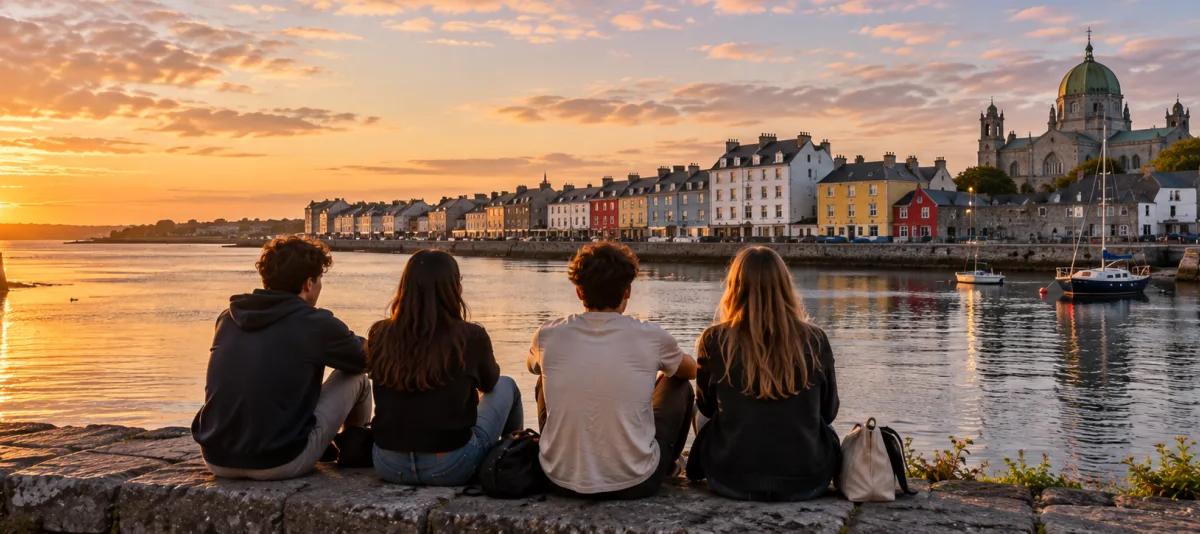
A waterproof, windproof jacket and boots are essential — umbrellas are useless on the Prom. Student houses are often draughty, so budget for heating in winter. The reward is sunsets over Galway Bay from Salthill and easy access to some of Europe's most dramatic coastal scenery; locals swim in the sea year-round at Blackrock, and many students join them.
Universidades en Galway
Otras ciudades de Ireland
Siguientes pasos
Fuentes
- myroom.ie/blog/galway-student-accommodation-2026
- coursecompass.ie/accommodation/university-of-galway
- uniofgalwaystudentpad.ie/SearchResults/Print/All
- thisisgalway.ie/heading-to-university-in-galway-read-the-ultimate-student-surviv
- sin.ie/2023/11/13/five-of-the-best-student-pubs-in-galway/
- transportforireland.ie/fares/bus-fares/
- college-council.com/en/blog/cost-of-living-for-students-in-ireland
- caopoint.com/non-eu-tuition-fees-universities-ireland/