Copenhagen, Denmark
Datos rápidos
- País
- Denmark
- Habitantes
- 666.678
- Idiomas
- Danish, English
- Moneda
- DKK
- Zona horaria
- CET (UTC+1)
- Nota media de la guía
- 7,9/10
- Seguridad
- 9/10
Resumen
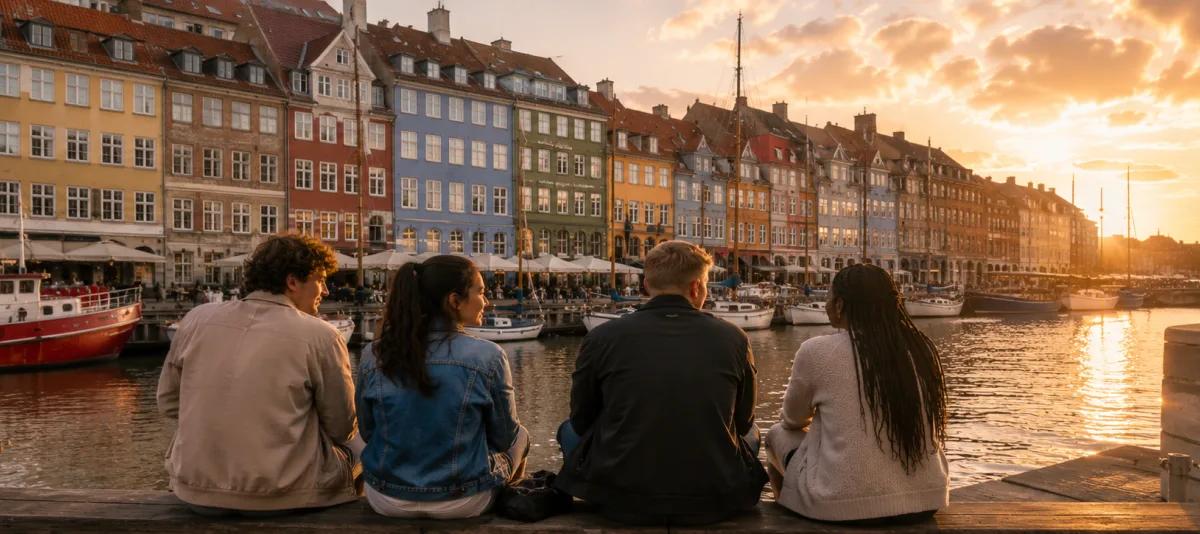
Copenhagen is Denmark's capital and largest city, a clean, design-forward, bike-obsessed metropolis of about 667,000 in the municipality (well over 1.3 million in the greater area) on the islands of Zealand and Amager. It's regularly ranked among the world's happiest, safest, and most liveable cities. Home to the University of Copenhagen, the Technical University of Denmark (DTU), and Copenhagen Business School, it attracts large numbers of international students.
For students, Copenhagen offers world-class education, a strong startup and life-sciences scene, and an exceptional quality of life — waterfront swimming spots, world-famous restaurants, and cycling infrastructure that's the envy of the world. English is spoken universally. The main downsides are the high cost of living (especially housing) and the long, dark, grey winters. But the culture of "hygge," the flat social hierarchies, and the walkable, cyclable city make it a favourite for many international students.
Vida estudiantil
Copenhagen's student life is vibrant, international, and socially open despite Danes' initially reserved reputation. Universities run extensive orientation and buddy programs, and the flat, informal academic culture — first-name terms with professors, group projects, and discussion-based classes — helps students integrate quickly. The city hosts a large exchange and Erasmus community.
Cycling defines daily life — students commute, socialize, and explore by bike year-round. Social life centres on shared "kollegium" dorms and flats, café culture, and the city's canals and harbour baths (you can swim in the clean harbour in summer). Free and cheap student events, "fredagsbar" (Friday bars) at universities, and a strong music and festival scene fill the calendar. The relaxed, egalitarian, design-conscious lifestyle is a big part of the appeal.
Barrios
Nørrebro (DKK 4,500–7,000/mo for a room): The most popular student area — lively, multicultural, affordable, and full of cafés, bars, and street life.
Vesterbro (DKK 5,000–8,000/mo): Trendy and central, with excellent food and nightlife (the Meatpacking District), walkable and buzzing.
Amager / Islands Brygge (DKK 4,000–7,000/mo): Waterfront, newer buildings, metro-connected, near DTU and the airport, with harbour swimming.
Frederiksberg (DKK 5,000–8,000/mo): Leafy, quieter, and upscale but central, near the University of Copenhagen.
Kollegier (student dorms) (usually the cheapest option): Often furnished and social — the famous Tietgen dorm on Amager is iconic — but with long waiting lists, so sign up with the central office KKIK early and renew your application every month. Rooms that universities reserve for exchange students cost more, around DKK 5,000–9,000 plus service charges at CBS partner residences.
Comida y restaurantes
Copenhagen is a global food capital (birthplace of noma and the New Nordic movement), but fine dining is a splurge. For students, everyday eating means cooking at home — groceries at Netto, Fakta, Lidl, and Rema 1000 run DKK 2,500–4,000/month — supplemented by cheap eats. Shawarma and falafel are the classic student staples (DKK 40–70), and Copenhagen's street-food markets (Reffen on Refshaleøen and Broens Street Food by the Inderhavnsbroen bridge, both mainly seasonal) offer affordable variety.
A restaurant meal runs DKK 100–200, and a beer DKK 50–80, so eating and drinking out adds up fast. University canteens offer reasonable lunches. Smørrebrød (open-faced sandwiches) and Danish pastries are local must-tries. The tap water is excellent and free. Overall, self-catering is essential to managing food costs in this pricey city.
Vida nocturna y ocio
Copenhagen's nightlife is lively and varied, from cosy cocktail bars and craft-beer spots to clubs in Vesterbro's Meatpacking District (Kødbyen) and around Nørrebro. Drinks are expensive (a beer out is DKK 50–80), so pre-drinking at home is standard. University "fredagsbar" Friday bars are a cheap, social institution. The scene is relaxed and unpretentious.
Beyond bars, entertainment includes the historic Tivoli Gardens amusement park, the free-spirited Freetown Christiania, world-class museums and design (many with student discounts), and summer festivals like Distortion and Roskilde (one of Europe's biggest, just outside the city). In summer, life moves to the harbour baths, parks, and canalside. The excellent bike and metro network makes getting home late easy and safe.
Transporte
Copenhagen is the world's premier cycling city — over half of residents commute by bike on extensive, safe, separated cycle lanes. A second-hand bike is the single best transport investment a student can make. For the rest, the integrated network of a driverless 24/7 Metro, S-tog trains, and buses is clean, efficient, and reliable. In 2026 a two-zone trip costs DKK 22 with Rejsekort (DKK 24 for a single ticket), and a 30-day two-zone commuter pass (Pendlerkort) costs DKK 530; students in higher education can get the discounted Ungdomskort, which is most worthwhile for longer commutes. Cycling everywhere costs nothing.
The compact city means most trips are short. The Metro connects directly to Copenhagen Airport in about 15 minutes, and trains link to the rest of Denmark and across the Øresund Bridge to Malmö, Sweden (about 35 minutes). Cars are unnecessary and expensive. Cycling year-round — including through winter — is normal here, so a good rain jacket and lights are essential.
Coste de vida
Monthly budget for a student in Copenhagen:
- Accommodation (room or kollegium): DKK 4,000–10,000 (kollegier can be cheaper)
- Food & groceries: DKK 2,500–4,000
- Transport (bike, or DKK 530 two-zone pass): DKK 0–530
- Phone & internet: DKK 150–250
- Leisure & going out: DKK 1,000–2,000
- Total: DKK 10,500–15,000/month (≈ EUR 1,400–2,000)
The killer is upfront housing costs — the University of Copenhagen notes it is common to pay three months' rent in advance plus a deposit of three months' rent, which can mean DKK 12,000–42,000 before you've paid your first month. Apply for a kollegium (student dorm) the moment you're accepted, as waiting lists are long; note that CBS only helps exchange students and freemovers with housing, so full-degree students must search on their own. Cycling and cooking at home are the two biggest money-savers.
Seguridad
Copenhagen is one of the safest capital cities in the world. Denmark's high social trust is visible everywhere — people leave bikes and prams unattended, and violent crime is very rare. Students, including women alone, generally feel safe walking or cycling at any hour. The main risks are bike theft (lock your bike well) and petty pickpocketing in tourist-heavy or nightlife areas.
Parts of outer Nørrebro have occasionally seen gang-related incidents, but these rarely affect students and the central areas are very secure. The emergency number is 112 (and 1813 for non-urgent medical help in the region). Overall, safety is one of Copenhagen's standout qualities and a major reassurance for students and families.
Clima
Copenhagen has a temperate maritime climate with cool summers, cold winters, and a lot of grey, wind, and rain — the weather is often cited as the city's main drawback. Winters (Dec–Feb) are cold, dark, and damp at -1 to 4°C, with very short days (dark by mid-afternoon) and occasional snow; this is when "hygge" and cosy indoor life come into their own. Spring (Mar–May) is slow and variable at 5–15°C.
Summers (Jun–Aug) are mild and pleasant at 18–23°C, with famously long days (light until nearly 11pm) — the whole city moves outdoors to the harbour and parks. Autumn (Sep–Nov) is cool, windy, and wet at 6–14°C. It's rarely extreme, but the persistent grey and short winter days require adjustment. Invest in warm, waterproof, windproof clothing and good bike lights.
Universidades en Copenhagen
Siguientes pasos
Fuentes
- kk.dk/index%2ephp/dagsordener-og-referater/%C3%98konomiudvalget/m%C3%B8de-210420
- ku.dk/studies/student-life/housing
- kollegierneskontor.dk/default.aspx?func=article.view&id=53&lang=GB&mid=33&topmen
- dinoffentligetransport.dk/media/wlfdfnbo/dot-takstblad-2026-a.pdf
- ungdomskort.dk/priser-og-satser/ungdomskort-priser
- broensstreetfood.dk/en/food/
- reffen.dk/nye-street-food-koekkener/
- cbs.dk/en/study-programmes/international-students/exchange-students/housing