University of Oxford
Quick facts
- City
- Oxford
- Country
- United Kingdom
- Type
- Public
- Founded
- 1096
- Students
- 26,800
- International students
- 43 %
- National ranking
- #2
- International ranking
- #4
- Tuition (local students)
- £10,050
- Tuition (international)
- £46,210
- Acceptance rate
- 17 %
- Guide score
- 8.1/10
Official website: www.ox.ac.uk
Overview
The University of Oxford is the oldest university in the English-speaking world, with evidence of teaching dating back to 1096. It is ranked 4th in the world in the QS World University Rankings 2027 and 2nd in the UK in the Complete University Guide 2027. Oxford operates through a distinctive collegiate system of 43 colleges and halls: 36 self-governing colleges, 3 societies and 4 permanent private halls. The university is renowned for its tutorial-based teaching model, where students receive personalised instruction in very small groups.
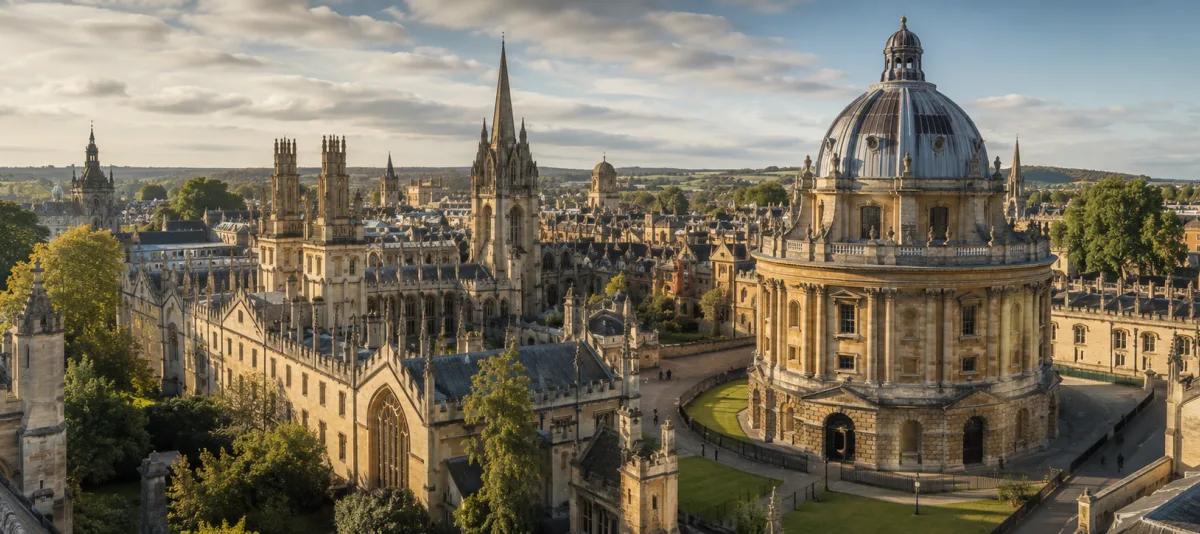
Oxford has around 26,800 students (about 12,500 undergraduates and 13,800 postgraduates), and international students make up 43% of the total, coming from more than 170 countries. Its research output is world-leading across virtually every discipline, from quantum computing and vaccine development to literary criticism and philosophy. The city of Oxford itself is compact and walkable, revolving around university life, with the iconic Bodleian Library, Radcliffe Camera, and college quads defining its skyline.
Academic programs
Oxford offers a broad range of undergraduate courses and hundreds of graduate programmes. Standout programmes include Philosophy, Politics and Economics (PPE), Medicine, Law, Computer Science, Mathematics, Economics and Management, and English Literature. The university pioneered the tutorial system, where undergraduates meet regularly with tutors for intensive small-group sessions. Graduate research programmes benefit from world-class facilities including the Weston Library, the Blavatnik School of Government, and the Big Data Institute.
Campus life
Life at Oxford revolves around the colleges, each with its own dining hall, library, common rooms, and traditions. Students enjoy a vibrant social scene with hundreds of student clubs and societies, from the famous Oxford Union debating society to niche academic clubs. Rowing ("bumps") is an iconic tradition, and college rivalries fuel friendly competition. The city has a good selection of pubs, independent cafés, and cultural venues including the Ashmolean Museum (Britain's first public museum) and the Oxford Playhouse.
Exchange programs
Oxford's exchange and visiting student options are limited compared to many European universities. Incoming study exchanges, including Erasmus-funded ones, are only possible where a current agreement exists between the relevant departments or colleges and a partner university, so students should first ask their home university's exchange office. Students without an exchange agreement can apply independently to college Visiting Student programmes, which charge fees (Oriel College, for example, charged about £37,500 for the full 2026/27 year) and have deadlines from January to March. Graduates can come as Recognised Students. Oxford has applied for the Erasmus Charter for 2027/28, as the UK rejoins Erasmus+ from 2027.
Admissions
Undergraduate admission is highly competitive: in 2025 Oxford received 23,329 applications and made 3,891 offers, an offer rate of about 17% (roughly 14% of applicants ended up admitted), with much lower rates for international applicants. For 2027 entry you apply through UCAS by 6pm UK time on 15 October 2026; many courses require a UAT-UK admissions test sat on 12–16 October 2026 (or the LNAT for Law and UCAT for Medicine), shortlisted candidates have online interviews in December, and decisions are released on 12 January 2027. International students need strong A-level equivalents and, if English is not their first language, typically IELTS Academic 7.5 with at least 7.0 in each component. Annual course fees for 2027 entry are £10,050 for Home students and between £39,620 and £66,580 for Overseas students depending on the course (for example £46,210 for English). Graduate admissions are handled through the university's online application, with deadlines varying by programme.
Student housing
All colleges provide rooms for their undergraduates during term time for the first year and for at least one other year of the course. Quality and style vary significantly between colleges, from medieval rooms overlooking quads to modern purpose-built blocks. The university estimates accommodation at £825–£990 per month including bills in 2026-27, with total living costs of £1,405–£2,105 per month. For the remaining years many students move into private rented housing in areas like Jericho, Cowley, or East Oxford, which usually requires paying rent for the full year. Graduate students can access accommodation through colleges or dedicated university graduate housing.
Career services
Oxford's Careers Service is comprehensive, offering personalised coaching, employer events, and internship databases. The Oxford brand carries enormous weight globally, and graduates enjoy exceptional employment prospects. The university has strong recruitment pipelines into consulting, finance, law, tech, and the civil service. The Saïd Business School adds entrepreneurship programmes and startup support, and Oxford's alumni network spans the globe.
Academic programs
- Medicine
- Law
- Philosophy Politics and Economics
- Engineering
- Computer Science
- Natural Sciences
- Mathematics
- History
- English
- Modern Languages
- Economics and Management
- Social Sciences
Application deadlines
- fall: 15 October 2026 (UCAS deadline for 2027 entry)
Exchange
Incoming exchange (including Erasmus-funded students) only through current departmental or college agreements with partner universities; others can apply to fee-paying college Visiting Student programmes; non-native speakers typically need IELTS 7.5 or equivalent.
Next steps
Sources
- ox.ac.uk/admissions/undergraduate/fees-and-funding/course-fees
- ox.ac.uk/about/the-university/facts-and-figures/student-numbers
- ox.ac.uk/admissions/graduate/colleges/introducing-colleges
- ox.ac.uk/admissions/undergraduate/applying-to-oxford/guide/admissions-tests
- ox.ac.uk/admissions/undergraduate/applying-to-oxford/for-international-students/
- ox.ac.uk/students/fees-funding/international/erasmus/incoming
- ox.ac.uk/admissions/undergraduate/fees-and-funding/living-costs
- qs.com/insights/qs-world-university-rankings
- thecompleteuniversityguide.co.uk/student-advice/where-to-study/league-tables-wha
- uniadmissions.co.uk/application-guides/oxford-acceptance-rates/