University College Cork
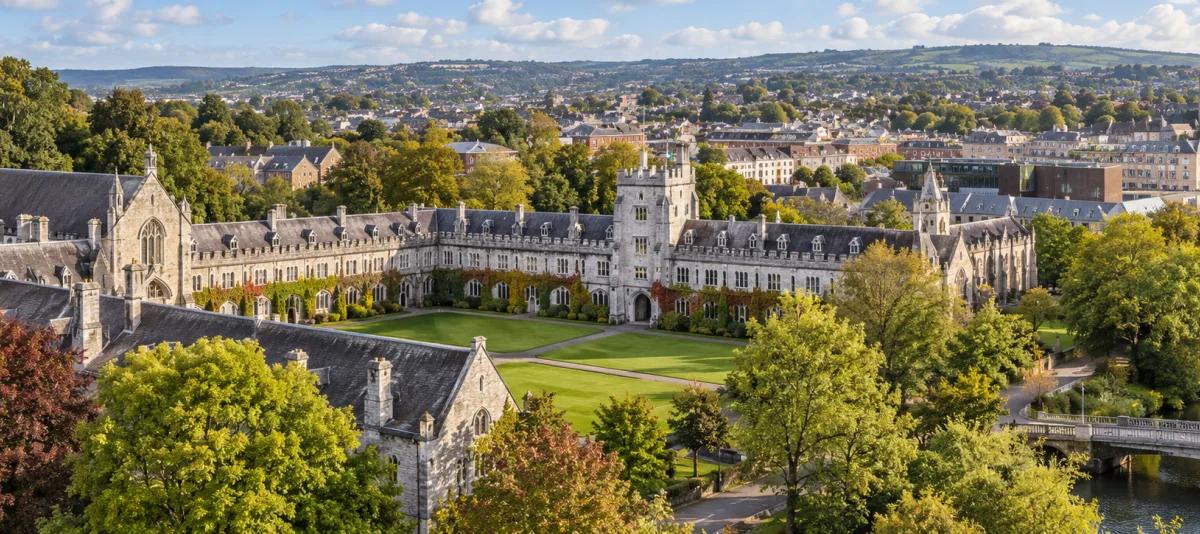
Quick facts
- City
- Cork
- Country
- Ireland
- Type
- Public
- Founded
- 1845
- Students
- 26,000
- International students
- 15 %
- National ranking
- #3
- International ranking
- #220
- Tuition (local students)
- €2,500
- Tuition (international)
- €22,000
- Guide score
- 7.7/10
Official website: www.ucc.ie
Overview
University College Cork (UCC) was founded in 1845 as one of the three Queen's Colleges of Ireland and today enrols roughly 26,000 students, including nearly 4,000 international students from 104 countries. It ranks 220th in the QS World University Rankings 2027 (up 26 places from 246th), third in Ireland behind Trinity College Dublin and UCD. The historic main campus, with its Tudor-Gothic Quadrangle and riverside grounds, sits a 10–15 minute walk from Cork city centre.
UCC is best known internationally as a "Green Campus": in 2010 it became the first university in the world to be awarded the international Green Flag for environmental sustainability, and it has retained it since. Cork itself is Ireland's second city, compact, student-friendly and noticeably cheaper than Dublin, with a strong food scene (the English Market) and a large pharma and tech employer base (Apple's European headquarters is in the city).
Academic programs
UCC is organised into four colleges: Arts, Celtic Studies and Social Sciences; Business and Law; Medicine and Health; and Science, Engineering and Food Science. Standout areas include Food Science and Nutrition (UCC is Ireland's leading food research university), Pharmacy, Nursing, Medicine, Law, Computer Science and Business (Cork University Business School). Teaching is in English and the academic year runs in two semesters (September–December and January–May), which maps easily onto Spanish exchange calendars.
EU undergraduates covered by the Free Fees Initiative pay only the student contribution, cut to €2,500 for 2025/26 (it was €3,000 before Budget 2026). Non-EU undergraduate fees vary widely by programme, from roughly €11,400 for some Arts degrees to €22,000–€25,000 for Business, Engineering and Science and over €50,000 for Medicine; the tuition figure on this page is a typical mid-range value.
Campus life
Student life is run through the UCC Students' Union, around 78 active societies and about 59 sports clubs. The Mardyke Arena, adjacent to campus, offers a 25 m swimming pool, climbing wall, indoor courts and a running track. Campus accommodation (University Hall, Victoria Lodge and the new Crow's Nest) is limited and prioritises first-year and full-year international students; Crow's Nest cost about €225 per week (around €975 per month) for 2025/26, and Cork's private student rentals typically run €600–€900 per month for a room, so exchange students should start searching early. Cork has a lively pub and live-music scene on Oliver Plunkett Street and Washington Street, and the campus is walkable from most student neighbourhoods.
Exchange programs
UCC has one of the largest Erasmus+ networks in Ireland, with several hundred European partners listed by department, including Spanish universities such as Universidad Carlos III de Madrid (Engineering), Universidad de Granada, Universidad de Salamanca and others in the Hispanic Studies, Business and Law areas. Outside Europe it runs bilateral exchanges with universities in the US, Canada, Australia, Japan and China, and hosts visiting students via the Study Abroad programme. Incoming Erasmus students are nominated by their home university and then apply online; nomination deadlines are approximately April–May for the autumn semester and October for spring. Exchange students take modules across faculties, subject to prerequisites, and receive full support from the International Office, including an orientation week and a buddy programme.
Academic programs
- Business
- Engineering
- Medicine
- Law
- Computer Science
- Pharmacy
- Nursing
- Food Science
- Arts and Humanities
- Social Sciences
- Natural Sciences
- Dentistry
Application deadlines
- fall: February 1
- spring: October 15
Exchange
Large international network with 300+ university partnerships worldwide, including Spanish universities such as Universidad Carlos III de Madrid, Universidad de Granada and Universidad de Salamanca, plus bilateral exchanges in North America, Asia and Australia. Incoming exchange nominations are typically due in spring for Semester 1 and in October for Semester 2.