Universidad Técnica de Ambato
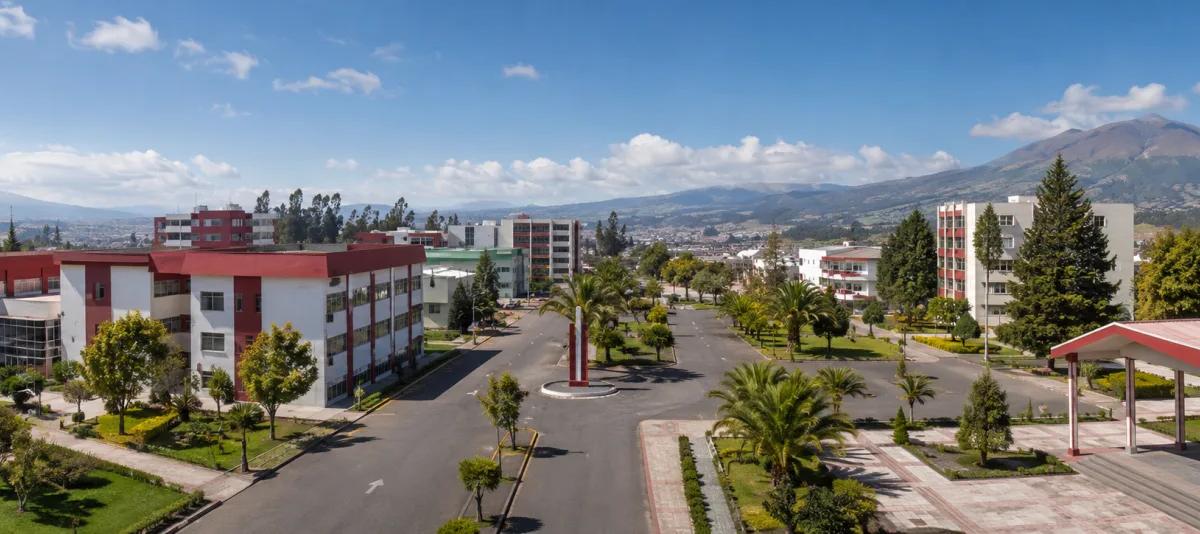
Quick facts
- City
- Ambato
- Country
- Ecuador
- Type
- Public
- Founded
- 1969
- Students
- 17,000
- National ranking
- #14
- Tuition (local students)
- US$0
- Tuition (international)
- US$0
- Guide score
- 6.6/10
Official website: www.uta.edu.ec
Overview
The Universidad Técnica de Ambato (UTA) was created by law on 18 April 1969, growing out of an accounting institute founded in 1959. It is the main public university of central Ecuador, with more than 17,000 students in the August 2025-January 2026 cycle (the figure above is that rounded number), about 900 teachers, 10 faculties and 42 degree programmes. It is CACES-accredited (165-SE-33-CACES-2020, extended by 216-SO-29-CACES-2025). Webometrics July 2026 ranks it 14th in Ecuador and 3,639th worldwide; it also appears in Scimago Institutions Rankings 2026 (8,383rd worldwide, around 14th in Ecuador).
Ambato, capital of Tungurahua, is a busy mid-sized Andean city at about 2,580 m, with a mild, dry climate — warm days, cool nights. Known as the city of flowers and fruit, it hosts the Fiesta de la Fruta y de las Flores every February and sits under the Tungurahua volcano, about 45 minutes from the adventure town of Baños. It is a commercial hub with big markets; safety is average for a Sierra city — take normal precautions around the bus terminal and markets.
Academic programs
Faculties: Administrative Sciences; Accounting and Auditing; Food Science, Engineering and Biotechnology; Agricultural Sciences; Design, Architecture and Arts; Civil and Mechanical Engineering; Systems, Electronics and Industrial Engineering; Human Sciences and Education; Law and Social Sciences; and Health Sciences. The UTA highlights that its Food Engineering programme holds an internationally recognised certification. Online degrees exist but three were not offered in the second 2026 intake.
Campus life
Teaching is split over three campuses: Huachi (eight faculties, Av. Los Chasquis), Ingahurco (Health Sciences and rectorate, Av. Colombia) and Querochaca in Cevallos (Agricultural Sciences, about 20 minutes south). Ambato has good bus links to Quito (about 2.5 hours), Riobamba and Baños, so weekend trips are easy. In 2025 the UTA awarded 1,795 scholarships.
Exchange programs
The Dirección de Relaciones Nacionales e Internacionales (DIRENI), direni@uta.edu.ec, manages agreements. In July 2026, 25 UTA students left for semester stays in Spain, El Salvador, Chile, Guatemala, Brazil and Costa Rica. The UTA has received inbound students via the UDUALC PAME programme (e.g. from the Universidad Tecnológica de Panamá). Inbound applications go through the home university's international office.
Admissions
After the mandatory national Registro Nacional (2-6 June 2026), the UTA ran registration on 1-5 July (by the last digit of the ID number), then an in-person exam from 27 July to 5 August: 50 questions in one hour, scored out of 1,000, by field (health, engineering, business, humanities) and including English. Results appear instantly. 10,621 applicants competed for about 2,000 places in 35 programmes; nine applicants living abroad took the test online. Study is free under gratuidad.
Foreigners need a regular migration status and homologated secondary diploma; the visa de residencia temporal de estudiante (USD 50 + USD 80, apostilled criminal record, proof of means, admission letter) is the standard route.
Student housing
No residences, but Huachi is surrounded by student rooms: from about USD 100/month (≈€85), a women-only residence opposite the campus at USD 125 all-inclusive (≈€105), and rooms one block away around USD 150 (≈€130).
Career services
Information pending — contributions welcome. The UTA awarded over 3,000 degrees in 2025 and runs compulsory internships, but no employability data was found.
Academic programs
- Business Administration
- Accounting and Auditing
- Food Engineering
- Biotechnology
- Agronomy
- Veterinary Medicine
- Architecture
- Design
- Civil Engineering
- Mechanical Engineering
- Software
- Electronics
- Industrial Engineering
- Law
- Education
- Medicine
- Nursing
- Masters programmes
Application deadlines
- fall: Second 2026 period - Registro Nacional 2-6 June, UTA registration 1-5 July, in-person exam 27 July to 5 August, application rounds 7-22 August
- spring: First period - Information pending
Exchange
Outbound and inbound mobility through DIRENI (direni@uta.edu.ec), with 25 students sent abroad in July 2026. Listed in the Parlamento Andino / Uniwords network. Teaching in Spanish.
Next steps
Sources
- elheraldo.com.ec/uta-inspira-transforma-y-trasciende/
- elheraldo.com.ec/pruebas-de-admision-para-mas-de-10-600-aspirantes/
- lahora.com.ec/tungurahua/mas-10-mil-postulantes-para-2-mil-cupos-disponibles-en-
- precavidos.com/cronogramas/institucion/universidad-tecnica-de-ambato/
- utasaladeprensa.blogspot.com/2026/07/estudiantes-viviran-experiencia.html
- ambatonews.com/2024/04/08/uta-prepara-eventos-para-celebrar-55-anos-de-vida
- ambato.doplim.ec/habitacion-amplia-para-estudiantes-uta-id-1867938.html
- scimagoir.com/institution.php?idp=2266
- webometrics.org/ecuador
- ug.edu.ec/wp-content/uploads/PLANIFICACION/ACREDITACION-INSTITUCIONAL/Resoluci%C
- gob.ec/mremh/tramites/concesion-visa-residencia-temporal-estudiante