Universidad Nacional de Córdoba
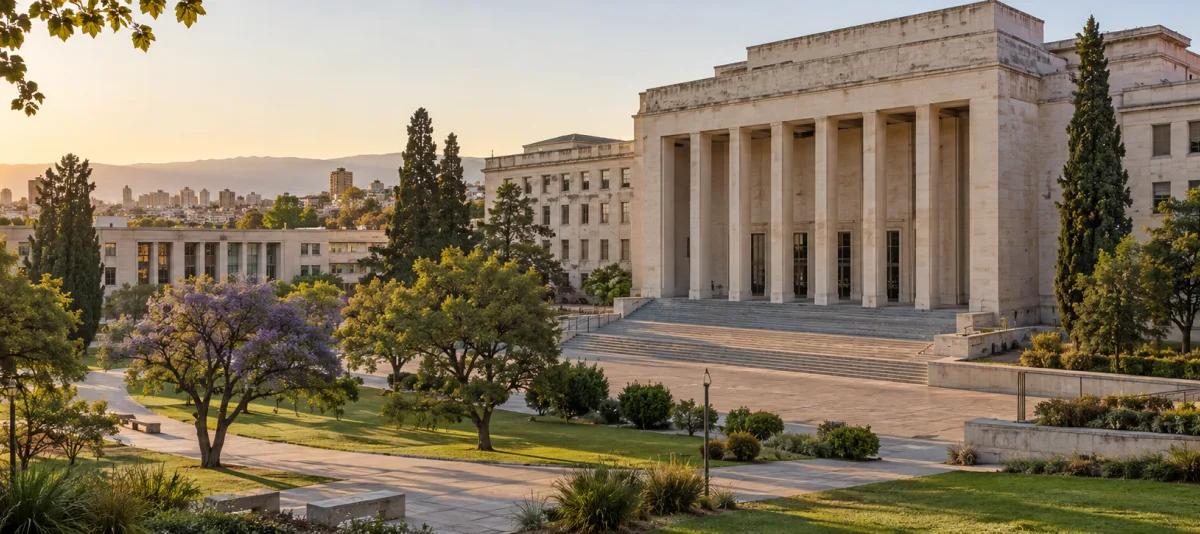
Quick facts
- City
- Córdoba
- Country
- Argentina
- Type
- Public
- Founded
- 1613
- Students
- 150,000
- National ranking
- #6
- International ranking
- #801
- Tuition (local students)
- ARS 0
- Tuition (international)
- ARS 0
- Guide score
- 7.8/10
Official website: www.unc.edu.ar
Overview
Universidad Nacional de Córdoba (UNC) was founded in 1613 and is Argentina's oldest university. The Jesuit colonial block downtown (Manzana Jesuítica) is UNESCO World Heritage (2000). Most teaching now happens on the large Ciudad Universitaria beside Parque Sarmiento, a large campus of faculties, sports grounds and student traffic. UNC reports on the order of 150,000 students (figures vary by source between ~108,000 and 150,000+ depending on what is counted) across 15 faculties, with only a few hundred internationals — this is an Argentine mass public university that happens to host exchange, not an international campus.
In the QS World University Rankings 2027 (June 2026) UNC moved up from the 851–900 band to 801–850, the only Argentine university that improved; it is 6th among the Argentine universities in the table, behind UBA, UNLP, Austral, UCA and Palermo. Undergraduate tuition is free in practice; Decreto 366/2025 allows charging foreigners without permanent residence, but UNC had not become a tuition university for exchange or degree-seeking internationals as of 2026 — confirm.
Córdoba's identity is tied to UNC: the 1918 University Reform started here and reshaped Latin American higher education. Living in Nueva Córdoba next to campus is the student default.
Academic programs
UNC offers a wide range of undergraduate and postgraduate degrees. Strengths that show up on exchange factsheets include exact, physical and natural sciences (FCEFyN), medicine, law, architecture and the humanities. All regular courses are in Spanish. Factsheets ask for B1 (some units B2) certified by DELE, CELU or ACTFL. PECLA, UNC's Spanish and Latin American culture programme, is the on-ramp if you miss the level (recent extra cost around USD 200).
Calendar: first semester beginning of March to end of June/July (exams in July); second semester August to November (exams in December). Dates vary by faculty — always check with the academic coordinator of your school. Exchange students may take courses from different programmes and years if they have the background; *libre* (non-attending) status is not available to internationals. Register for the first exam sitting.
Campus life
Ciudad Universitaria plus Nueva Córdoba is as close as Argentina gets to a classic student town. Parque Sarmiento is the quad. UNC does not house internationals in any systematic way; you rent in Nueva Córdoba or Güemes. Sports fields, museums (17), libraries (25) and two astronomical observatories are part of the footprint.
Student politics is loud. Cuarteto, fernet and the Abasto bar strip are the unofficial student union. The buddy programme Friends from the World pairs incoming students with locals. Study Córdoba (city programme) publishes practical landing info.
Exchange programs
Apply through your home university onto KUNTUR, UNC's admissions platform. Typical windows from UNC's 2025–26 factsheet (confirm each year; UNC's 2026 information sheet lists October and May as the deadlines): 1–31 October for the March semester; 15 April–15 May for the August semester. The Central Office of International Relations issues admission letters; each faculty has an academic coordinator for syllabi, calendars and enrolment.
Modalities: bilateral / network exchange (no UNC tuition) and a free-mover track that can carry non-academic fees. Spanish is not optional. Incoming numbers are modest (~240 internationals in one 2026 factsheet), which is good for immersion and bad if you wanted an English bubble.
Academic programs
- Medicine
- Law
- Engineering
- Exact Sciences
- Architecture
- Social Sciences
- Humanities
- Agriculture
- Economics
- Psychology
- Languages
- Arts
Application deadlines
- fall: Exchange: 1–31 October (March semester)
- spring: Exchange: 15 April–15 May (August semester)
Exchange
Central Office of International Relations via the KUNTUR platform. Buddy programme "Friends from the World". All undergraduate teaching in Spanish (B1–B2; PECLA Spanish course ~USD 200 if needed). Semesters March–July and August–December.
Next steps
Sources
- estudiantes.internacionales.unc.edu.ar/home-en/
- unc.edu.ar/english/historical-overview
- topuniversities.com/universities/universidad-nacional-de-cordoba-unc
- fcefyn.unc.edu.ar/documents/6431/FCEFyN-UNC_Factsheet_2025-2026.pdf
- internationaloffice.unicamp.br/arquivo/uploads/anexo-1-unc-fact-sheet-2026/
- unc.edu.ar/facultades
- lanacion.com.ar/sociedad/la-uba-lidera-en-la-region-publicas-y-privadas-las-16-u
- infobae.com/educacion/2026/06/17/ranking-qs-la-uba-sigue-entre-las-100-mejores-d