Copenhagen Business School
Quick facts
- City
- Copenhagen
- Country
- Denmark
- Type
- Public
- Founded
- 1917
- Students
- 21,062
- International students
- 20 %
- Tuition (local students)
- €0
- Guide score
- 7.9/10
Official website: www.cbs.dk
Overview
Copenhagen Business School (CBS) is one of Northern Europe's largest and most prestigious business schools, with triple-crown accreditation (AACSB, EQUIS, AMBA). Founded in 1917, CBS takes a distinctly Scandinavian approach to business education, emphasising sustainability, social responsibility, and interdisciplinary thinking alongside traditional business disciplines. With about 21,000 students (around 4,300 of them international full-degree students), it is one of the largest business schools in Europe. CBS does not appear in the overall QS World University Rankings 2027, but it ranks among the world's top 20 in the QS subject ranking for Business and Management Studies (18th in 2026).
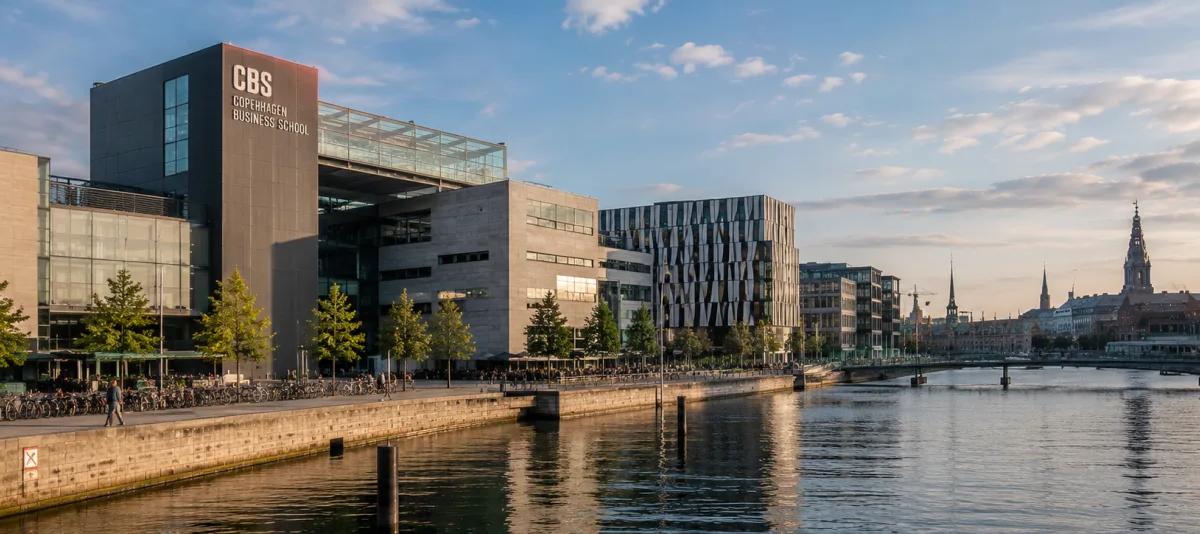
CBS's campus is located in Frederiksberg, a municipality surrounded by Copenhagen, with its main buildings around Solbjerg Plads and Porcelænshaven. Copenhagen itself is a world-class city known for design, sustainability, cycling culture, and high quality of life. The city regularly tops global rankings for liveability, green living, and happiness. While the cost of living is high, EU/EEA students benefit from free tuition, and Denmark offers generous student support.
Academic programs
CBS offers around 60 programmes in total (15 bachelor's programmes plus master's, executive master's and diploma programmes), many taught entirely in English. Programmes go beyond traditional business, including the BSc in International Shipping and Trade (reflecting Denmark's maritime heritage) and the BSc programmes in Digital Management, Service Management and Sociology. The academic approach is characterised by group work, case-based learning, and industry projects. CBS encourages students to think critically about business's role in society. The research environment is strong, with particular strength in organisation studies, finance, entrepreneurship, and sustainability. Class sizes are generally manageable, and student-faculty interaction is good by European standards.
Campus life
CBS campus life benefits from Copenhagen's vibrant student culture. Student-run Fridays bars (fredagsbarer) at each campus are a Danish tradition where students socialise with cheap drinks every Friday afternoon. CBS has an active student association (CBS Students) that organises events, conferences, and the annual CBS CASE Competition. The Copenhagen student scene extends beyond CBS, with interuniversity events and a thriving nightlife scene along Istedgade, Nørrebro, and the Meatpacking District (Kødbyen). Cycling is the primary mode of transport, and the city's waterfront, Tivoli Gardens, and design districts provide endless entertainment.
Exchange programs
CBS has around 294 exchange agreements with universities on every continent, and about 1,400 exchange students and freemovers come to CBS each year. Exchange is deeply embedded in the CBS culture — a high proportion of students spend a semester abroad. Autumn, spring and full-year stays are possible. Incoming exchange students can choose from a wide range of English-taught courses. The International Office provides comprehensive support, and ESN CBS organises social events for exchange students.
Admissions
Undergraduate applicants apply through KOT (the Danish coordinated application system). If you need a Danish student residence permit, the deadline is 15 March at 12:00 (noon); other applicants should check the CBS admissions page for the deadline that applies to their qualification. Bachelor's programmes taught in Danish require Danish language skills, while English-taught programmes require English proficiency (for the bachelor's, IELTS Academic 7.0 overall with at least 6.0 in each section). Master's admission is competitive, based on academic background and programme-specific requirements. Non-EU/EEA students pay tuition (EUR 16,000/year for a full-time master's, invoiced as EUR 8,000 per semester for a maximum of four semesters), while EU/EEA students study for free; CBS does not publish a single bachelor's fee on its main admission page, so check the CBS fee page. CBS offers scholarships for non-EU students. Master's application deadlines (23:59 CET) are 15 January for non-EU/EEA applicants who need a residence permit and 1 March for everyone else; the CBS page does not state the year, so confirm it in the application portal. GMAT/GRE is not required for most programmes.
Student housing
Housing in Copenhagen is a major challenge. CBS only helps exchange students, summer university students and freemovers with housing: it allocates a limited number of rooms in student residences by an automated random draw (applying on the first day gives no advantage), and in the autumn semester only it also connects students with private landlords, at about DKK 5,000–9,000/month (2025 figures). Full-degree students must search on their own, for example through the central dorm office Kollegiernes Kontor (KKIK), Facebook housing groups, flat-shares or the private market. The Housing Foundation prioritises University of Copenhagen students and may consider students from other universities only if it has capacity. Students often look in areas like Nørrebro, Amager, or Vesterbro, or in the suburbs, for more affordable options.
Career services
CBS Career provides counselling, employer events, and job platforms. The annual CBS Career Fair is one of Denmark's largest student-employer events. Denmark's thriving business landscape — home to companies like Maersk, Novo Nordisk, LEGO, Carlsberg, and Ørsted — provides strong employment opportunities. CBS graduates are well-regarded in Scandinavia and increasingly internationally. Starting salaries in Denmark are high by European standards. The CEMS MIM programme (available at CBS) provides additional corporate access. Copenhagen's growing startup scene, particularly in fintech and cleantech, offers entrepreneurial opportunities. International students should be aware that Danish language skills significantly improve long-term employment prospects in Denmark.
Academic programs
- Business Administration
- Economics
- Finance and Accounting
- International Business
- International Business and Politics
- Digital Management
- Service Management
- Sociology
- International Shipping and Trade
- Business Law
- Psychology and Business
Application deadlines
- fall: Bachelor: 15 March at noon CET for applicants who need a Danish residence permit (2027 round, confirm on cbs.dk); Master: 15 January (non-EU needing a permit) or 1 March (everyone else), 23:59 CET, confirm the year in the CBS application portal
Exchange
Around 294 exchange agreements with universities on every continent and about 1,400 incoming exchange students and freemovers a year; autumn, spring or full-year stays with courses taught in English. CBS is a member of CEMS and PIM.
Next steps
Sources
- cbs.dk/en/about-cbs/profile/reports-and-key-figures
- cbs.dk/sites/default/files/2026-05/cbs-annual-report-2025.pdf
- cbs.dk/sites/default/files/2025-11/cbs_fact_sheet_0.pdf
- cbs.dk/en/study-programmes/bachelor-programmes
- cbs.dk/en/study-programmes/bachelor-programmes/application-and-admission
- cbs.dk/en/study-programmes/master-programmes/application-and-admission
- cbs.dk/en/news/be-ready-quota-1-deadline
- cbs.dk/en/study-programmes/international-students/exchange-students/housing
- cbs.dk/uddannelser/international-students/international-full-degree-students
- housingfoundation.dk/qa-invitation-no-howcanigetaninvitation-student/
- topuniversities.com/universities/copenhagen-business-school
- study.eu/university/copenhagen-business-school-cbs/rankings