Leuven, Belgium
Quick facts
- Country
- Belgium
- Population
- 105,233
- Languages
- Dutch, English
- Currency
- EUR
- Time zone
- CET (UTC+1)
- Guide score
- 7.6/10
- Safety
- 9/10
Overview
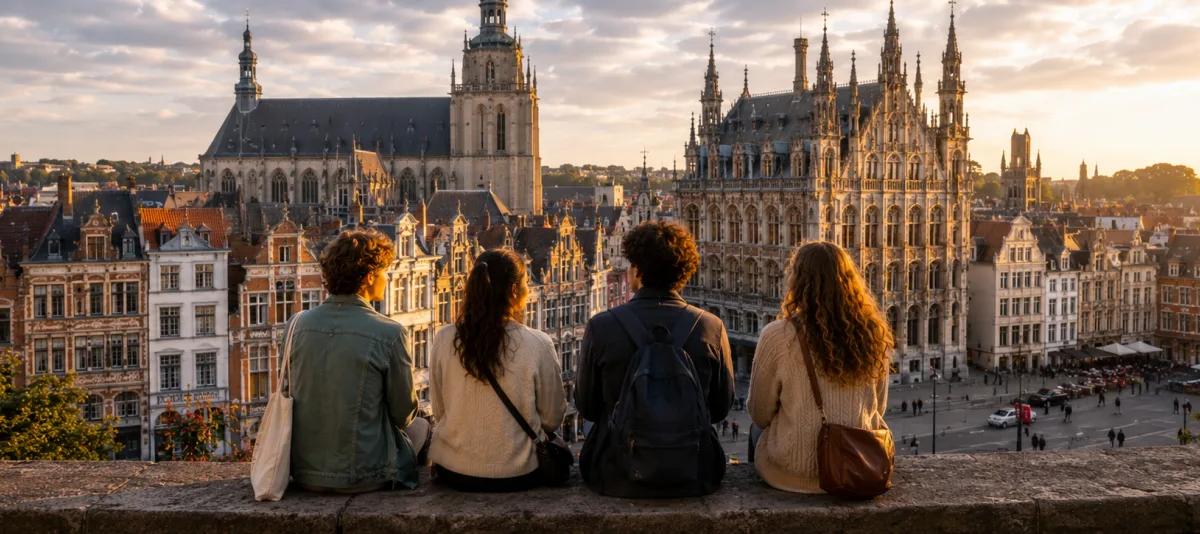
Leuven is a quintessential student city about 25 km east of Brussels, in Dutch-speaking Flanders. With around 105,000 residents and some 50,000 KU Leuven students on its Leuven campuses alone (over 64,000 across all KU Leuven campuses) — the oldest existing Catholic university in the world (founded 1425) and consistently one of Europe's top-ranked institutions — it's a place where student life defines the entire city. The historic centre is compact, beautiful, and overwhelmingly young.
For international students, Leuven offers world-class academics in an intimate, bike-friendly, walkable setting that's noticeably cheaper than Brussels, Amsterdam, or Paris. The city is best known for its stunning late-Gothic town hall, the Oude Markt (billed as "the longest bar in Europe"), and as the birthplace of Stella Artois beer. It combines historic charm with a vibrant, international, and famously social student atmosphere.
Student life
Leuven is a student's city through and through — with around 42,000 students living in student rooms ("koten") alongside roughly 105,000 residents, social life is everywhere and easy to plug into. KU Leuven's international community is large and welcoming, and orientation events, student clubs (kringen), and faculty associations organize a packed calendar. The academic culture is rigorous, with intense January and June exam periods (the "blok" study period is a shared ritual).
The heart of nightlife and socializing is the Oude Markt, a square ringed entirely by bars that fills with students Wednesday through Saturday. Cycling is the default way to get around, and most students live within a 10-minute bike ride of their faculty. Cultural life is strong for a small city — the M Leuven art museum, the STUK arts centre, and the Het Depot music venue are all central. The vibe is friendly, compact, and intensely community-driven.
Neighborhoods
City Centre (Binnenstad) (€490–€730/mo for a kot): The historic core, walkable and lively, close to everything — the classic student choice.
Heverlee (€490–€730/mo): South of the centre near the Arenberg science and engineering campus, quieter and green.
KU Leuven residence halls (€525–€668/mo for a room, all-in, in 2026–2027): University-run dorms with a strong communal atmosphere and no deposit; in some halls half of the rooms are reserved for international students. Studios run €718–€854.
Kessel-Lo (often a little cheaper): Just east, more residential, a short bike ride from the centre.
Around the station (similar to the centre): Convenient for commuting to Brussels and beyond.
Food & restaurants
Leuven's food scene is dense and student-priced. Cheap lunch deals in the centre run €8–12, and dinners €15–25. The city is packed with affordable options — frituren (fry shops) for the essential Belgian fries with mayo, kebab and pita joints, pizza, and a growing range of international restaurants. Student restaurants (Alma) run by the university offer subsidized meals for just a few euros.
Groceries at Colruyt, Delhaize, Aldi, and Lidl keep costs low (around €200/month). And of course, this is beer country: Leuven is the home of Stella Artois (the brewery offers tours), and local pubs serve an extraordinary range of Belgian ales well beyond the mass-market labels. Don't miss the waffles and chocolate either. Overall, eating and drinking well in Leuven is genuinely affordable.
Nightlife & entertainment
Leuven's nightlife is legendary for a city its size, thanks to the sheer density of students. The Oude Markt — "the longest bar in Europe" — is a single square lined entirely with bars and terraces, and it's the beating heart of student going-out, especially Wednesday to Saturday. Beers are cheap (€2.50–4), and the atmosphere is buzzing and friendly.
Beyond the bars, Het Depot hosts concerts, STUK runs cinema, theatre, and music, and student clubs throw regular parties (TD's — thé dansants). Cultural options include the M Leuven contemporary art museum, the Botanical Garden (Kruidtuin), and the historic Groot Begijnhof (a UNESCO World Heritage site). Brussels, with its bigger nightlife and events, is just 25 minutes away by train.
Transport
Leuven is a cycling city — bikes are the dominant and most convenient way to get around, and most students buy a second-hand bike on arrival. The compact centre is also very walkable. De Lijn buses cover the city and surroundings; KU Leuven students can buy a student bus pass for about €25 for unlimited travel in Leuven and the surrounding area for the whole academic year, and under-25s can get the Flanders-wide Buzzy Pazz (€165 a year). A single ticket costs €3. Velo rents student bikes from €15 a month or €85 a year, repairs and theft cover included.
The train station connects Leuven to Brussels in about 25 minutes and to Brussels Airport (Zaventem) in around 13 minutes — an exceptional link for both commuting and international travel. Belgium's dense rail network puts Antwerp, Ghent, and neighbouring countries within easy reach for weekend trips. A car is unnecessary and the centre is largely car-restricted. Watch out for bike theft and use a good lock.
Cost of living
Monthly budget for a student in Leuven:
- Accommodation (kot or residence hall): €490–€730
- Food & groceries: €250–€300
- Transport (bike + occasional bus/train): €10–€50
- Phone & internet: €15–€30
- Leisure & going out: €150–€250
- Total: €1,050–€1,400/month (KU Leuven's own estimate)
Leuven is cheaper than Brussels or Amsterdam. Housing is the key variable: around 42,000 students live in koten, but KU Leuven's housing service reports that private rents have been stable for two years and supply now covers demand, with new residences opening from 2027. Apply for KU Leuven housing or search the private market via the university's Kotwijs database as soon as you're admitted. University residence rooms need no deposit; private landlords and studios typically ask a deposit of a few hundred euros (€500 for a KU Leuven studio).
Safety
Leuven is a very safe city with low crime, a natural benefit of being a small, prosperous student town. Violent crime is rare, and walking or cycling home at night after the Oude Markt is generally safe. The main issues are bike theft (extremely common — always lock your bike well) and occasional petty theft in busy nightlife areas.
The compact, well-lit centre and the large, mostly student population create a comfortable environment. Emergency number: 112. Students and families consistently rate Leuven as secure, and it's an easy, low-stress place to live for those new to Europe.
Weather & climate
Leuven has a temperate maritime climate — mild but frequently grey, cloudy, and damp, with rain possible year-round. Winters (Dec–Feb) are cold and wet at 1–7°C with occasional frost and rare snow, and short, dark days. Spring (Mar–May) is mild and greener at 8–17°C. Summers (Jun–Aug) are pleasant at 18–24°C, occasionally warmer. Autumn (Sep–Nov) is cool and rainy at 8–15°C.
The weather is changeable, so a waterproof jacket and layers are everyday essentials. It's rarely extreme in either direction, but the persistent grey and drizzle take some getting used to. Late spring and summer are the most pleasant, when the terraces on the Oude Markt come alive and the parks and beguinage look their best.
Universities in Leuven
Next steps
Sources
- vrt.be/vrtnws/nl/2026/02/06/leuven-bereikt-kaap-van-105-000-inwoners/
- vrt.be/vrtnws/nl/2026/03/17/kotenmarkt-leuven-koelt-af/
- kuleuven.be/english/life-at-ku-leuven/housing/students/residences/student-servic
- kuleuven.be/residenties/english/life-at-ku-leuven/housing/find-housing/students
- kuleuven.be/english/life-at-ku-leuven/housing/money-matters/cost-of-living-in-be
- kuleuven.be/stuvo/studiekosten/studie-enleefkosten
- delijn.be/en/content/vervoerbewijzen/tarieven/
- kuleuven.be/english/about-kuleuven/facts-and-figures